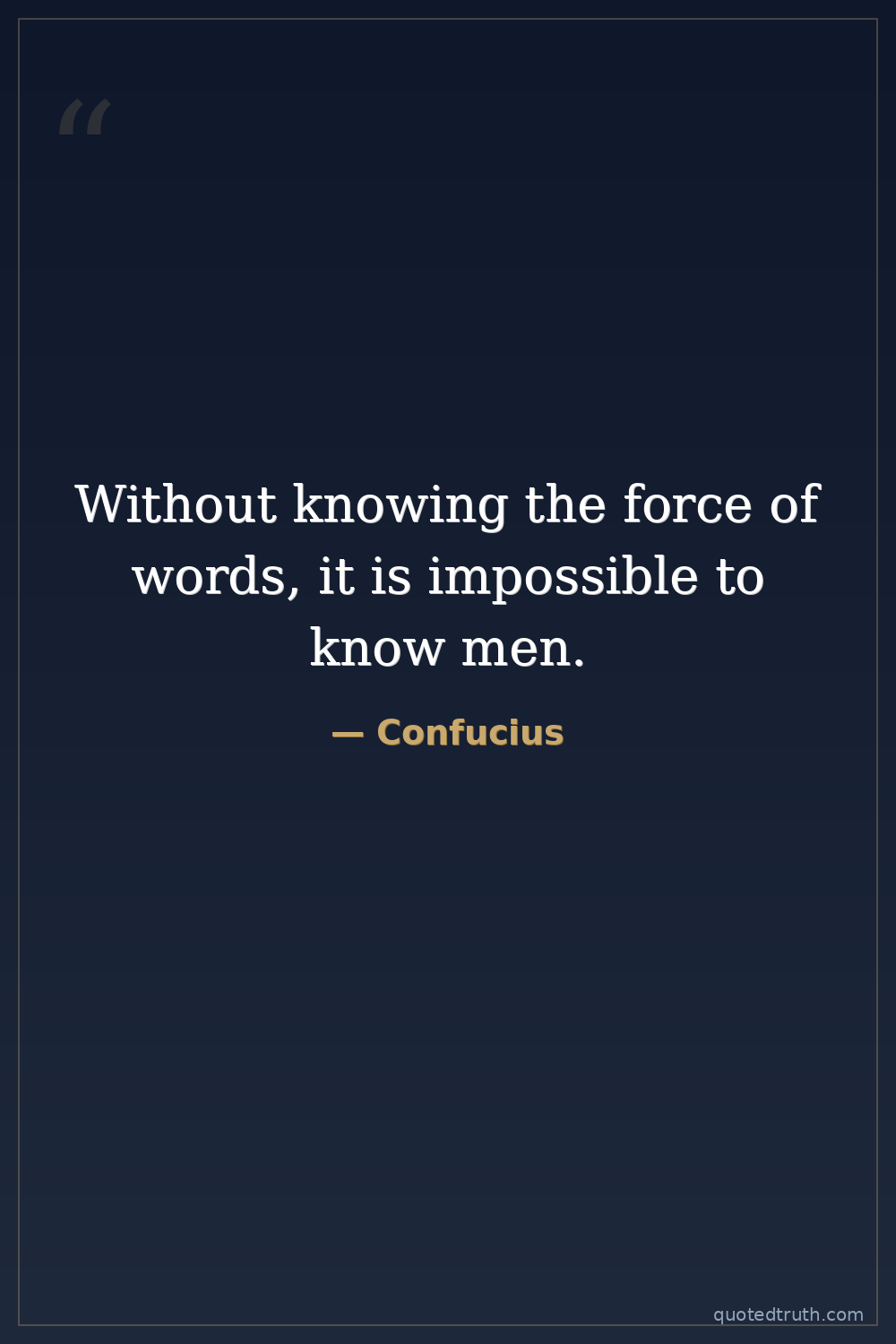
Confucius — "Without knowing the force of words, it is impossible to know men."
Without knowing the force of words, it is impossible to know men.
Without knowing the force of words, it is impossible to know men.
Click any product to generate a realistic preview. Up to 3 at a time.
* Initial load can take up to 90 seconds — revising the preview in another color is nearly instant.
"The Master said, 'The superior man is firm in the right way, and not merely firm.'"
"If I am walking with two other men, each of them will serve as my teacher. I will pick out the good points of the one and imitate them, and the bad points of the other and correct them in myself."
"The gentleman is easy to serve but difficult to please. He who tries to please him in the wrong way will not be pleased. He uses men according to their abilities. The petty man is difficult to serve a…"
"The scholar who cherishes the love of comfort is not fit to be deemed a scholar."
"I have never seen anyone who loved virtue as much as they loved sex."
Chinese philosopher and teacher whose teachings (compiled by his students in the Analects) became the foundational ethical framework of East Asian civilization for 2,500 years. Closely associated with Mencius (his most-influential follower a century later). For an intellectual contrast, see Laozi, near-contemporary Chinese sage and Tao Te Ching author — Confucius systematized social order through ritual and family hierarchy; Laozi's Taoist effortless-action philosophy argued such systems were the disease, not the cure. The two founding poles of Chinese moral philosophy — every East Asian moral tradition since has positioned itself between them.
The standard scholarly entry points to Confucius's work: Philip J. Ivanhoe (Georgetown, Chinese philosophy) — Confucian Moral Self Cultivation (2000); Edward Slingerland (UBC, Asian Studies) — Effortless Action: Wu-wei as Conceptual Metaphor (2003); Tu Weiming (Harvard, Confucian scholar) — Confucian Thought: Selfhood as Creative Transformation (1985). These are the works graduate seminars cite when teaching Confucius.
Found in 1 providers: grok
1 source checked
You cannot truly understand a person until you grasp how they use language. Words carry weight, nuance, and intention, and reading them carelessly leads to misreading the speaker. To judge character, motive, or sincerity, you must study vocabulary, tone, and what someone chooses to say or omit. Communication is the window into the mind, and linguistic literacy is therefore a prerequisite for social and moral understanding.
Confucius built his entire teaching around the rectification of names, insisting that social harmony collapses when words lose precise meaning. As a teacher, bureaucrat, and moral philosopher in the state of Lu, he trained disciples to examine speech carefully before trusting it. His Analects are compact sayings demanding interpretive care, and he repeatedly warned that glib talkers rarely possess genuine virtue, making linguistic discernment central to judging character.
Confucius lived during the late Spring and Autumn period around 551-479 BCE, when the Zhou dynasty was fracturing and warring states competed for dominance. Rulers routinely manipulated titles, treaties, and rhetoric to seize power, while ritual language eroded alongside political order. In this climate of linguistic and moral decay, Confucius argued that restoring proper meaning to words was inseparable from restoring a just society, giving his focus on speech urgent political weight.
AI-generated insights based on extensive research and information for context. Factual errors? Email [email protected].
Your cart is empty