Albert Einstein — "Falling in love is not at all the most stupid thing that people do-but gravitati…"
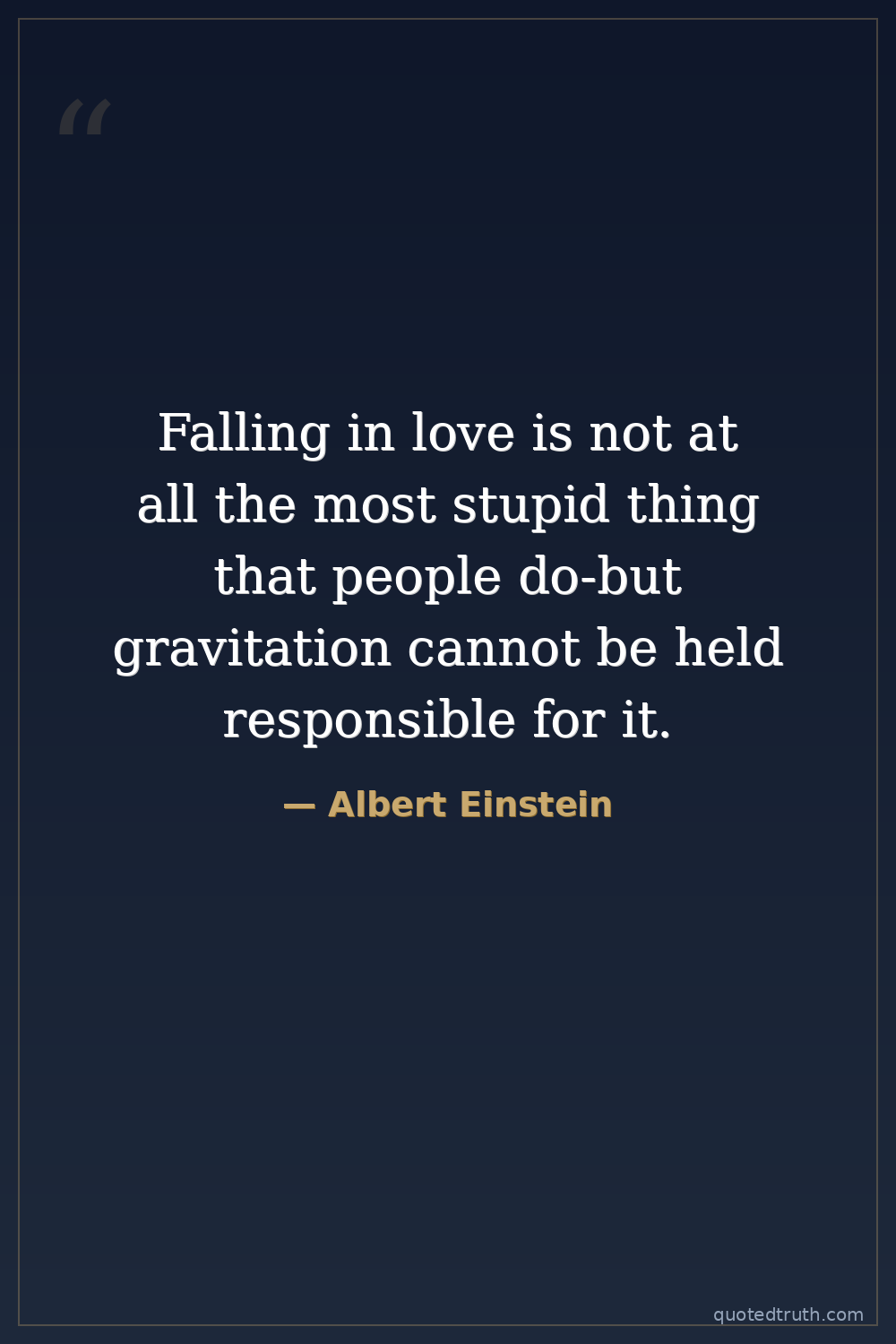
Falling in love is not at all the most stupid thing that people do-but gravitation cannot be held responsible for it.
Falling in love is not at all the most stupid thing that people do-but gravitation cannot be held responsible for it.
Click any product to generate a realistic preview. Up to 3 at a time.
* Initial load can take up to 90 seconds — revising the preview in another color is nearly instant.
"I am not only a pacifist but a militant pacifist. I am willing to fight for peace."
"Great spirits have always encountered violent opposition from mediocre minds."
"I have reached an age when if someone tells me to wear socks, I don't have to."
"The world is a dangerous place to live; not because of the people who are evil, but because of the people who don't do anything about it."
"If I were not a physicist, I would probably be a musician. I often think in music. I live my daydreams in music."
A humorous and slightly cynical remark on love, in a quote to Fred Wall.
Date: 1933
Love & RelationshipsFound in 1 providers: gemini
1 source checked
Love is a human choice, not a cosmic accident—and while falling for someone might seem irrational, it's hardly the dumbest thing we do. Physical laws govern falling objects, not falling hearts; we own our emotional decisions. The joke turns on the word "falling": gravity pulls things downward, but whatever pulls people toward each other operates entirely beyond physics to explain, predict, or excuse.
Einstein's personal life was famously turbulent—he divorced first wife Mileva Marić after years of emotional neglect and an affair, then married cousin Elsa Löwenthal. His self-deprecating wit was well-documented by colleagues. For the man who reformulated gravity as curved spacetime, invoking his own field to joke about love's irrationality was signature Einstein: using science as a wry lens on human absurdity while candidly admitting no equation captures the heart.
Einstein published General Relativity in 1915, making gravity a dominant topic in public scientific imagination. Simultaneously, Freudian psychology was reshaping how society understood human drives and romantic attraction. Post-WWI disillusionment had eroded Victorian romantic idealism, and modernism brought skeptical, ironic sensibilities toward grand emotions. Einstein's quip bridged cutting-edge physics and human folly at the precise cultural moment when both science and psychology were radically competing to explain what invisible forces actually govern human behavior.
AI-generated insights based on extensive research and information for context. Factual errors? Email [email protected].
Your cart is empty