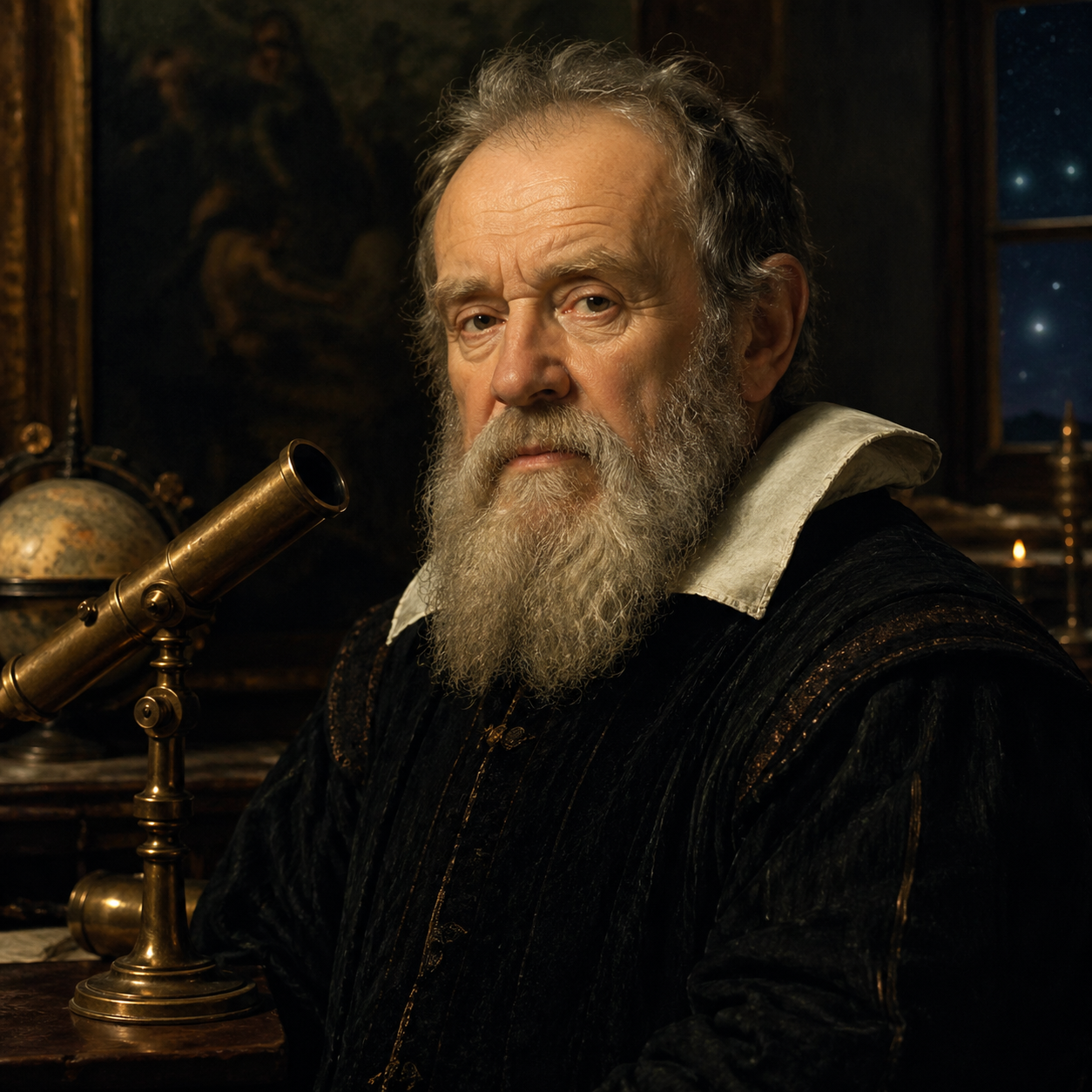
Galileo Galilei — "I have never met a man so ignorant that I couldn't learn something from him."
I have never met a man so ignorant that I couldn't learn something from him.
I have never met a man so ignorant that I couldn't learn something from him.
Click any product to generate a realistic preview. Up to 3 at a time.
* Initial load can take up to 90 seconds — revising the preview in another color is nearly instant.
"I wish to persuade the wise and not to compel them."
"I think that in the discussion of natural problems we ought not to begin at the authority of places of Scripture, but at sensible experiments and necessary demonstrations."
"To deny one's senses and reason is to deny God's gifts."
"I have loved the stars too fondly to be fearful of the night."
"Ignorance is the root of all evil."
Found in 3 providers: gemini,grok,deepseek
3 sources checked
Every person, no matter how uneducated or limited, possesses some knowledge, experience, or perspective worth absorbing. True intellectual humility means approaching all people as potential teachers. Knowledge isn't the exclusive province of scholars — a farmer's practical wisdom, a sailor's navigation instincts, or a craftsman's material knowledge all contain genuine insight that a curious mind can extract and use.
Galileo built his astronomical discoveries partly by studying practical craftsmen in Venetian shipyards, learning about materials and mechanics that informed his physics. Despite his elite academic status, he wrote major works in Italian rather than Latin to reach common readers. His empirical method demanded observing reality over deferring to authorities — the same humility that made him listen to anyone with direct experience of the natural world.
Renaissance and early modern Europe was rigidly hierarchical — scholars dismissed artisans, clergy dismissed laypeople, and Latin-educated elites dismissed vernacular thinkers. Yet this era's Scientific Revolution was fueled precisely by breaking those barriers: Vesalius examined actual corpses, navigators shared sea charts, and instrument-makers collaborated with astronomers. Galileo's openness reflected the revolutionary idea that observation and experience outranked inherited authority and social rank.
AI-generated insights based on extensive research and information for context. Factual errors? Email [email protected].
Your cart is empty