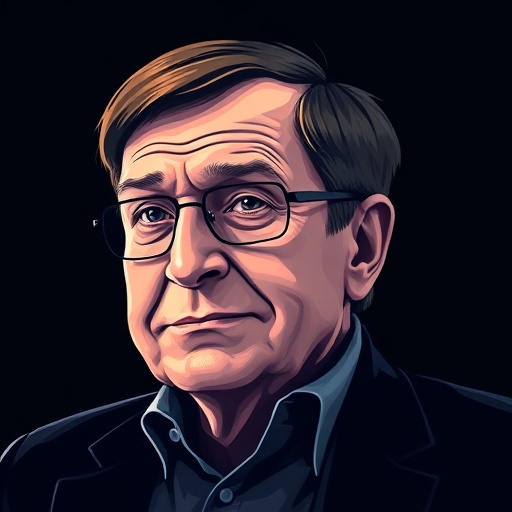
Stephen Hawking — "I believe that there is no heaven or afterlife. That is a fairy story for people…"
I believe that there is no heaven or afterlife. That is a fairy story for people afraid of the dark.
I believe that there is no heaven or afterlife. That is a fairy story for people afraid of the dark.
Click any product to generate a realistic preview. Up to 3 at a time.
* Initial load can take up to 90 seconds — revising the preview in another color is nearly instant.
"There is no heaven or afterlife for broken down computers; that is a fairy story for people afraid of the dark."
"What makes human beings unique? Some say it's language or tools. Others say it's logical reasoning. They obviously haven't met many humans."
"The world would be a much better place if everyone had a clear, rational view of the universe."
"The greatest danger for our future is apathy."
"When I gave a lecture in Japan, I was asked not to mention the possible re-collapse of the universe, because it might affect the stock market. However, I can reassure anyone who is nervous about their…"
British theoretical physicist whose Hawking radiation work and A Brief History of Time (1988) brought black-hole physics to a mass audience while he lived with ALS for 55 years. Closely associated with Roger Penrose (his collaborator on singularity theorems) and Carl Sagan (fellow popularizer who wrote Brief History's foreword). For an intellectual contrast, see William Lane Craig, American philosopher of religion — Craig's Kalam cosmological argument depends on the Big Bang requiring a divine first cause; Hawking's no-boundary proposal was specifically designed to remove the moment that would require one — the cleanest cosmology-vs-natural-theology contrast in modern thought.
Found in 1 providers: grok
1 source checked
Death is simply the end of consciousness — no continuation, no reward, no punishment. The concept of heaven is a comforting fiction humans invented to cope with the terror of nonexistence. Hawking compares religious afterlife beliefs to bedtime fairy tales told to soothe frightened children. Just as a child fears the dark, adults fear death, and both fears get answered with stories rather than truth.
Hawking faced death intimately from age 21, when ALS left him with a two-year prognosis he outlived by five decades. A lifelong materialist, his cosmology work revealed a universe governed entirely by physical laws — no designer required. He explicitly compared the brain to a computer: when components fail, it stops. A scientist who demanded evidence over comfort, theological consolation was intellectually dishonest to him.
Hawking lived through the rise of New Atheism — a 2000s-2010s intellectual movement where scientists like Richard Dawkins and Christopher Hitchens publicly challenged religion's cultural authority. Debates over evolution in schools, stem cell research, and cosmological origins were intensely politicized. His statement, made in a 2011 Guardian interview, landed as both scientific verdict and cultural provocation at a moment when the boundary between faith and empirical evidence was bitterly contested.
AI-generated insights based on extensive research and information for context. Factual errors? Email [email protected].
Your cart is empty