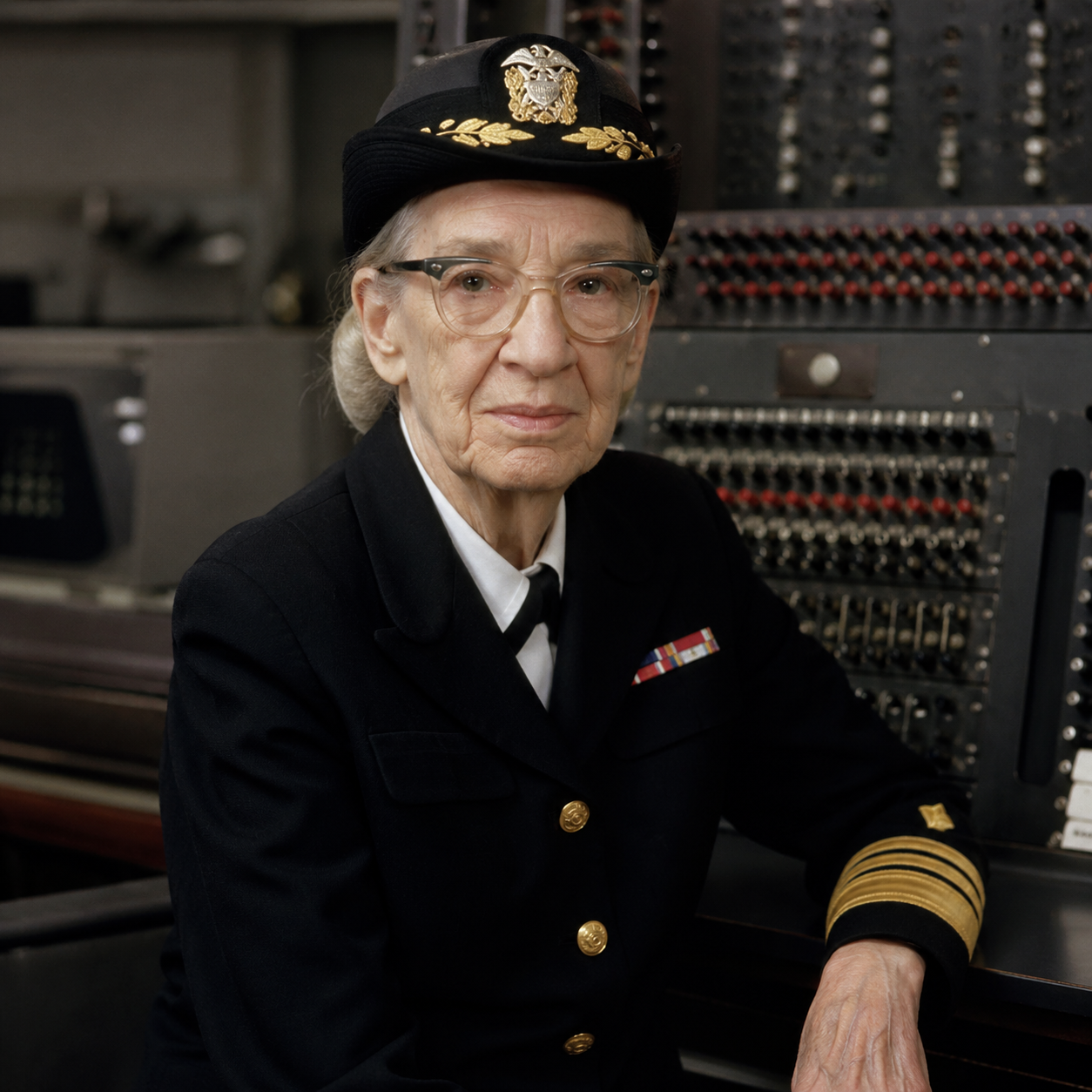
Grace Hopper — "It's easier to ask forgiveness than it is to get permission."
It's easier to ask forgiveness than it is to get permission.
It's easier to ask forgiveness than it is to get permission.
Click any product to generate a realistic preview. Up to 3 at a time.
* Initial load can take up to 90 seconds — revising the preview in another color is nearly instant.
"It's a beautiful thing, a computer. It's a wonderful thing."
"I don't think I'm a genius. I just work hard."
"There are two things that are hard in computer science: cache invalidation, naming things, and off-by-one errors."
"I've always been more interested in the future than in the past."
"It was much more fun to program the Mark I than to operate it."
Encouraging action and innovation, especially when dealing with bureaucracy.
Date: 1986 (U.S. Navy's Chips Ahoy magazine, July)
GeneralFound in 3 providers: gemini,deepseek,grok
3 sources checked
Acting first rather than waiting for bureaucratic approval is the practical path forward. Gatekeepers slow you down or block you entirely when permission is required. But if you move and something goes wrong, people are far more willing to accept a brief apology than they would have been to grant upfront authorization. Bias toward action beats process paralysis every time.
Hopper embodied this throughout her career. As a Navy admiral and computer scientist, she invented the first compiler in the early 1950s — a concept her superiors called impossible — without waiting for sanction. She also championed COBOL against institutional resistance. Repeatedly acting before authorization and justifying afterward was how she pushed computing forward past entrenched military and corporate bureaucracy.
Hopper worked in the mid-20th century, when computing was emerging from academic and military labs into broader use. The U.S. Navy, her primary institution, ran on rigid hierarchies and slow approval chains. Women in technical fields faced additional gatekeeping requiring constant justification. The postwar decades demanded rapid technological advance, making bureaucratic inertia a genuine drag on progress that Hopper had to repeatedly outmaneuver.
AI-generated insights based on extensive research and information for context. Factual errors? Email [email protected].
Your cart is empty