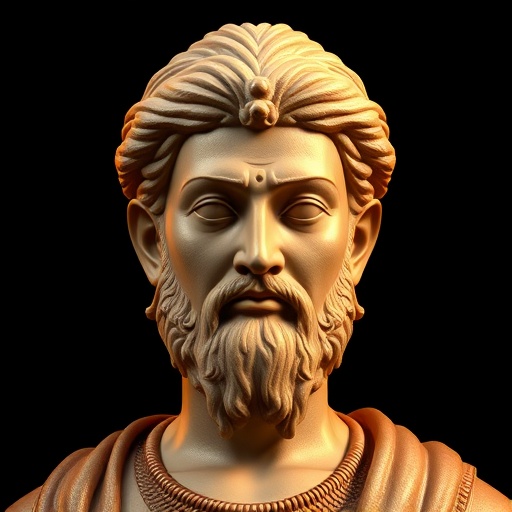
Mahavira — "The soul is the doer of its own deeds, and the enjoyer of its own fruits."
The soul is the doer of its own deeds, and the enjoyer of its own fruits.
The soul is the doer of its own deeds, and the enjoyer of its own fruits.
Click any product to generate a realistic preview. Up to 3 at a time.
* Initial load can take up to 90 seconds — revising the preview in another color is nearly instant.
"The soul can be liberated from the cycle of birth and death through right faith, right knowledge, and right conduct."
"Happiness and sorrow are the results of one's own actions."
"Control of the senses is the highest form of self-control."
"He who neglects the present moment, loses both future and past."
"Attachment and aversion are the root causes of Karma."
24th and last Tirthankara of Jainism, whose teachings of strict ahimsa (non-violence), aparigraha (non-attachment), and karma reshaped ancient Indian religion. Closely associated with The Buddha (near-contemporary moral revolutionary, also reacting against Vedic ritualism). For an intellectual contrast, see Vedic Brahmanical ritual sacrifice, the animal-sacrifice-centered Vedic religion of his era — Mahavira's ahimsa demanded total non-violence, including not eating root vegetables that kill the plant — a maximum-distance ethical move from the Vedic priestly tradition that ritually sacrificed cattle and horses. The two cleanest poles of ancient Indian religious ethics.
Found in 1 providers: deepseek
1 source checked
Each person is entirely responsible for their own actions and must experience the consequences of those actions personally. No external force, god, or fate determines your outcomes. What you choose to do shapes your reality directly, and you alone experience the results — both positive and negative — of every decision you make.
Mahavira spent 12 years in intense ascetic practice and meditation before achieving enlightenment, embodying radical personal responsibility. Central to his Jain teaching was the rejection of a creator god who rewards or punishes. He taught that liberation requires purifying the soul through one's own disciplined conduct, not divine grace — making this principle the philosophical foundation of everything he stood for.
In 6th century BCE India, Brahmanical Hinduism emphasized ritual sacrifice and priestly intercession to appease gods who controlled human fate. Mahavira directly challenged this by asserting individual moral agency over cosmic intermediaries. Alongside contemporary Buddha, he represented a reformist wave rejecting hereditary religious authority and insisting ordinary people bore direct responsibility for their spiritual destiny.
AI-generated insights based on extensive research and information for context. Factual errors? Email [email protected].
Your cart is empty