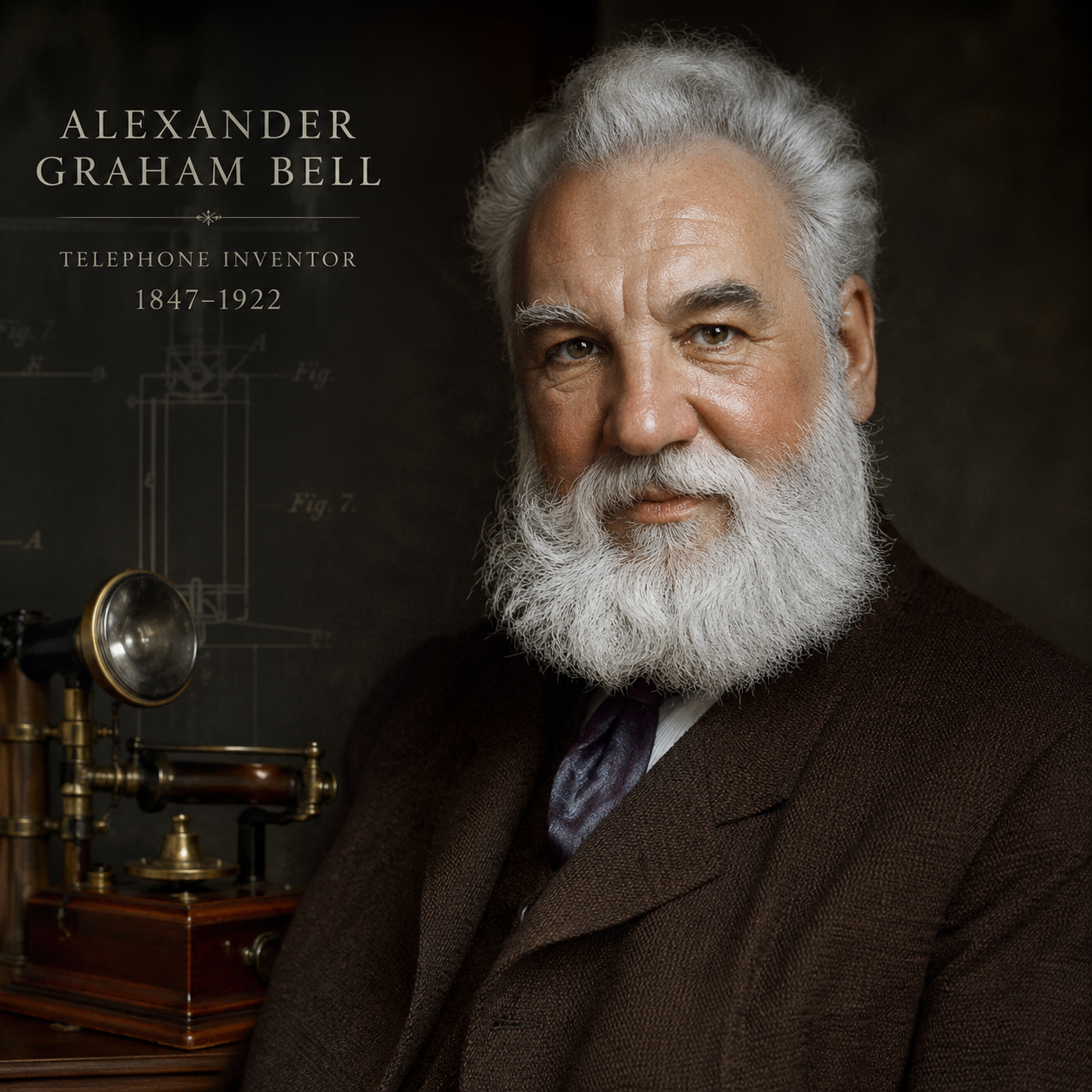
Alexander Graham Bell — "The day will come when the telephone will be used by every household in America."
The day will come when the telephone will be used by every household in America.
The day will come when the telephone will be used by every household in America.
Click any product to generate a realistic preview. Up to 3 at a time.
* Initial load can take up to 90 seconds — revising the preview in another color is nearly instant.
"I had made up my mind to find that for which I was searching even if it required the remainder of my life. After innumerable failures I finally uncovered the principle for which I was searching, and I…"
"Mr. Watson—Come here—I want to see you."
"Before anything else, preparation is the key to success."
"I begin my work at about nine or ten o'clock in the evening and continue until four or five in the morning. Night is a more quiet time to work. It aids thought."
"America is a country of inventors, and the greatest of inventors are the newspaper men."
Found in 1 providers: grok
1 source checked
Bell predicted that telephone communication would eventually reach every American home, not remain a luxury for the privileged few. He saw his invention as a tool for universal human connection, not just commerce or the wealthy. In modern terms, this mirrors how we talk about internet access or smartphones — a technology starting with early adopters that inevitably becomes infrastructure everyone depends on daily.
Bell patented the telephone in 1876 and immediately envisioned mass adoption. His life's work centered on communication — he taught deaf students, his wife Mabel and mother were both deaf, and he sought to bridge human isolation through sound. He founded the Bell Telephone Company in 1877 to commercialize the invention at scale. This prediction reflects his identity as not just an inventor but a democratizer of communication.
When Bell spoke these words in the late 1800s, telephones were costly novelties — only businesses and wealthy households subscribed. America was in its Gilded Age, industrializing rapidly but with deep inequality in access to new technologies. The telegraph had already proven electrical communication could transform commerce. Universal telephone access seemed utopian to most, yet Bell's prediction proved accurate: by 1920 over thirteen million American households had phones.
AI-generated insights based on extensive research and information for context. Factual errors? Email [email protected].
Your cart is empty