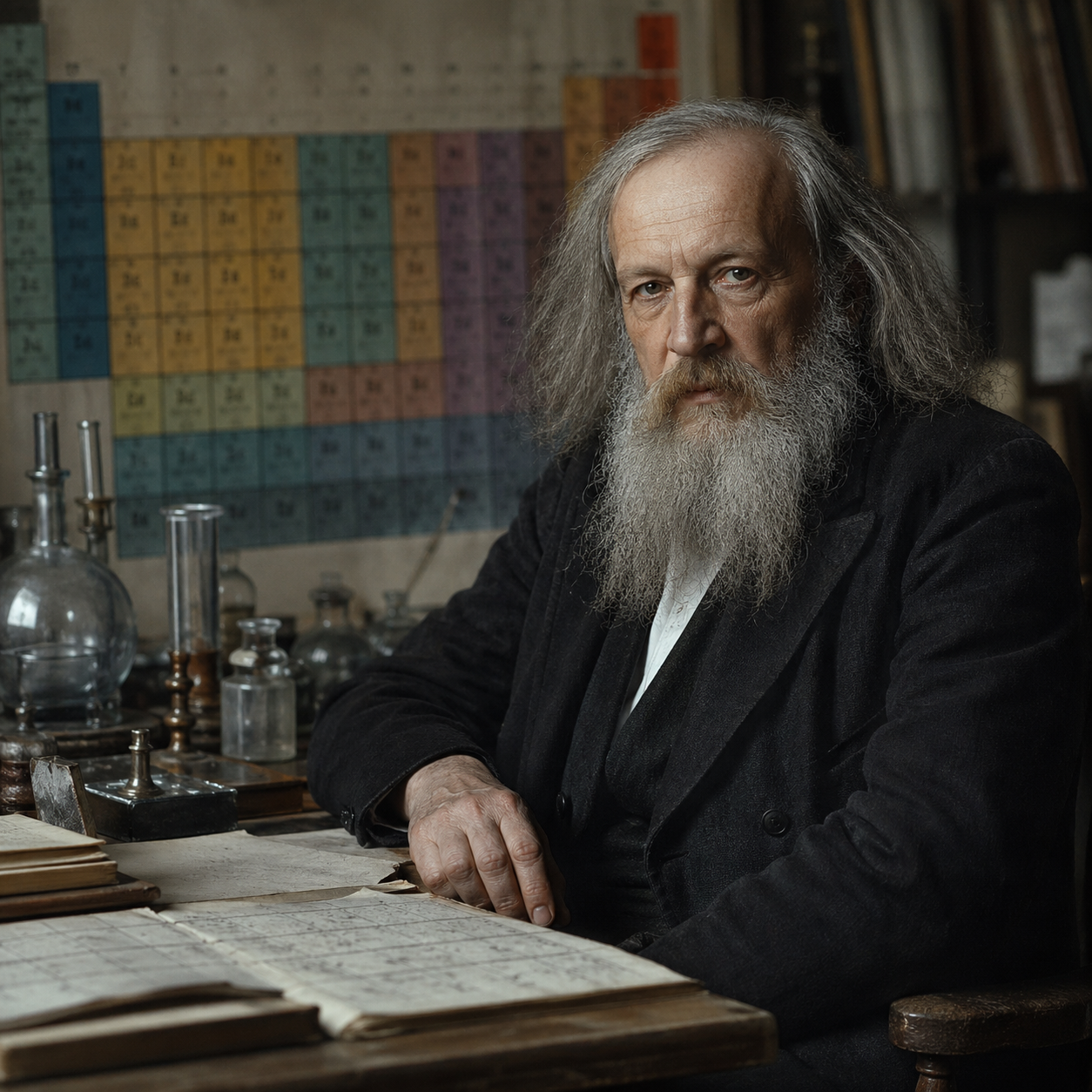
Dmitri Mendeleev — "The chemical elements are not created, but are transformed."
The chemical elements are not created, but are transformed.
The chemical elements are not created, but are transformed.
Click any product to generate a realistic preview. Up to 3 at a time.
* Initial load can take up to 90 seconds — revising the preview in another color is nearly instant.
"If statements of fact themselves depend upon the person who observes them, how much more distinct is the reflection of the personality of him who gives an account of methods and of philosophical specu…"
"Blessed is the soil that produces such men."
"It was clear that in the United States there was a development not of the best, but of the middle and worst sides of European civilization; the notorious general voting, the tendency to politics... al…"
"To protect the Russian borders from enemies, I would surround the whole country with a continuous wall of vodka."
"Why do they [Americans] quarrel, why do they hate Negroes, Indians, even Germans, why do they not have science and poetry commensurate with themselves, why are there so many frauds and so much nonsens…"
Reflecting on the conservation of matter and elemental change
Date: Undated
Art & CreativityFound in 1 providers: grok
1 source checked
Elements cannot be manufactured or destroyed through ordinary means. They exist as fundamental building blocks of matter, and chemical reactions only rearrange them into new combinations. What appears to be creation is actually transformation—atoms shifting bonds, changing states, or combining differently. The underlying substances persist throughout every reaction, merely taking new forms rather than coming into or going out of existence.
Mendeleev devoted his career to cataloging and understanding elements, publishing his periodic table in 1869. He organized the 63 known elements by atomic weight and properties, predicting undiscovered ones like gallium and germanium. This quote reflects his conviction that elements were permanent, classifiable entities with fixed identities—a belief that made systematic organization possible and underpinned his entire life's work in chemistry.
Mendeleev worked in 19th-century Russia during a chemistry revolution. Dalton's atomic theory was established, but elements remained poorly organized. Debates raged over atomic weights, and alchemy's ghost lingered in popular imagination. Industrial chemistry was transforming Europe, demanding systematic knowledge of materials. Mendeleev's statement rejected transmutation fantasies while affirming the conservation principles—Lavoisier's legacy—that grounded modern chemistry in measurable, predictable science.
AI-generated insights based on extensive research and information for context. Factual errors? Email [email protected].
Your cart is empty