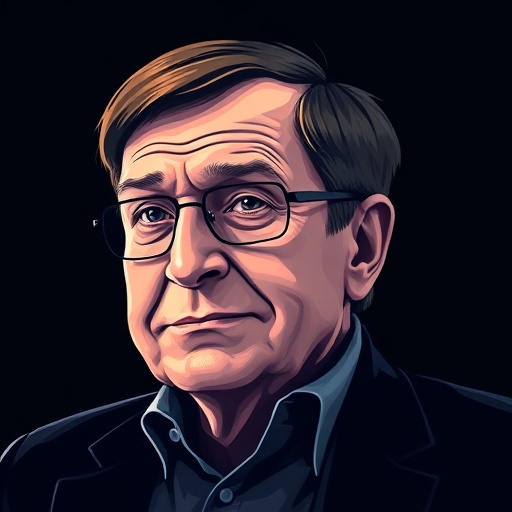
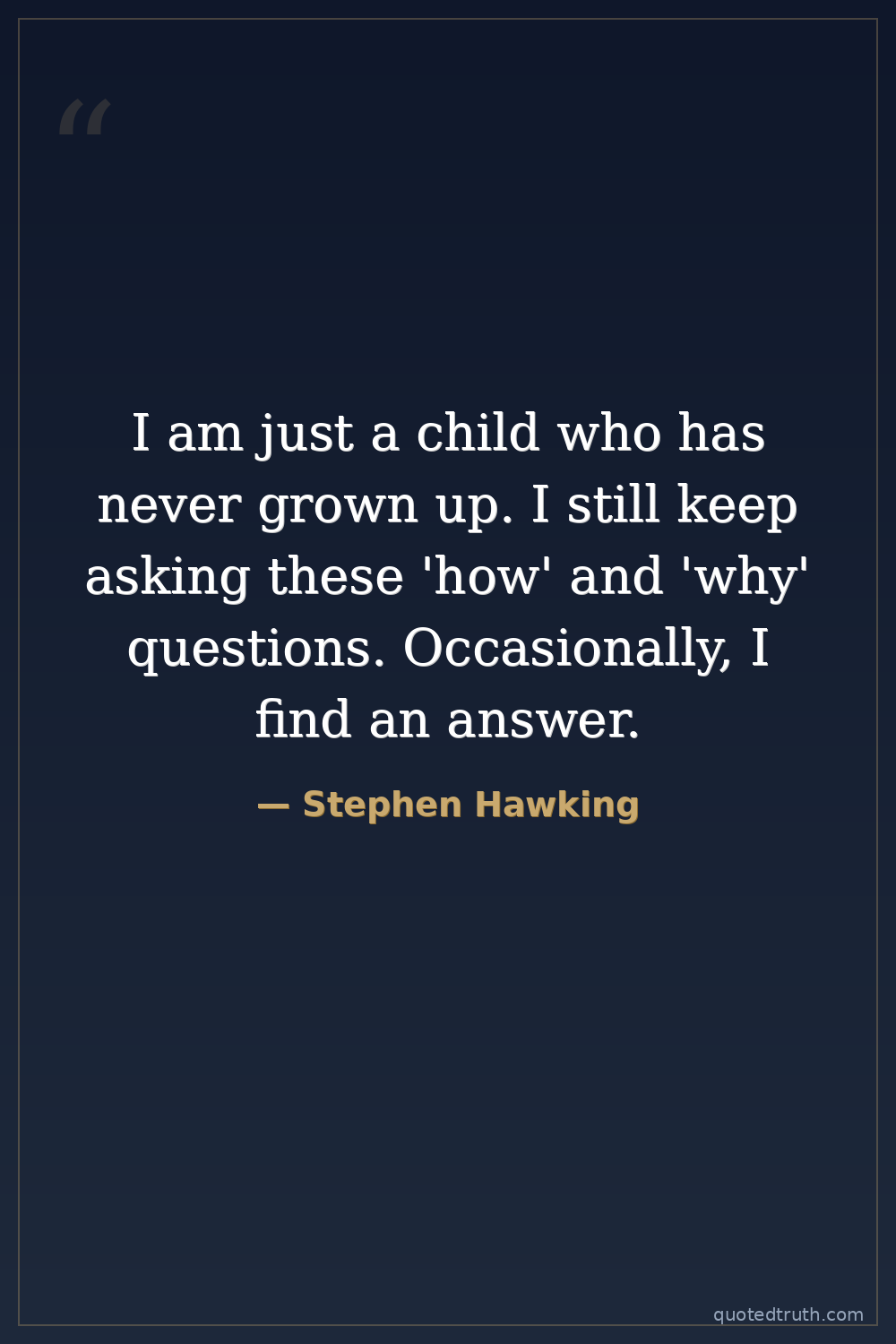
Stephen Hawking — "I am just a child who has never grown up. I still keep asking these 'how' and 'w…"
I am just a child who has never grown up. I still keep asking these 'how' and 'why' questions. Occasionally, I find an answer.
I am just a child who has never grown up. I still keep asking these 'how' and 'why' questions. Occasionally, I find an answer.
Click any product to generate a realistic preview. Up to 3 at a time.
* Initial load can take up to 90 seconds — revising the preview in another color is nearly instant.
"We are all connected to the universe, and the universe is connected to us."
"Life would be tragic if it weren't funny."
"The universe is a place of endless possibilities, and we are just beginning to explore them."
"We are very, very small, but we are profoundly significant."
"The world is a dangerous place to live; not because of the people who are evil, but because of the people who don't do anything about it."
British theoretical physicist whose Hawking radiation work and A Brief History of Time (1988) brought black-hole physics to a mass audience while he lived with ALS for 55 years. Closely associated with Roger Penrose (his collaborator on singularity theorems) and Carl Sagan (fellow popularizer who wrote Brief History's foreword). For an intellectual contrast, see William Lane Craig, American philosopher of religion — Craig's Kalam cosmological argument depends on the Big Bang requiring a divine first cause; Hawking's no-boundary proposal was specifically designed to remove the moment that would require one — the cleanest cosmology-vs-natural-theology contrast in modern thought.
From 'Stephen Hawking: A Life in Science' by Michael White and John Gribbin.
Date: 1992
Power & LeadershipFound in 1 providers: grok
1 source checked
Relentless curiosity—constantly asking how things work and why they exist—is a childlike quality worth preserving into adulthood. Wonder doesn't require sophistication; it requires stubborn persistence. The payoff isn't constant revelation but occasional breakthrough amid years of sustained questioning. Scientific genius isn't about already knowing answers; it's about refusing to stop asking, even when the universe responds rarely and incompletely.
Hawking received an ALS diagnosis at 21 that was supposed to end his career before it started. Instead, he spent fifty more years attacking the deepest questions in physics—singularities, the origin of the universe, whether black holes destroy information. Confined to a wheelchair, communicating through a single cheek muscle, he remained obsessed with 'how' and 'why.' Hawking radiation, his most celebrated discovery, came from asking why quantum mechanics and general relativity couldn't coexist near a black hole.
Hawking's career unfolded during cosmology's most explosive transformation. The 1960s brought confirmation of the Big Bang through cosmic microwave background detection, while black holes shifted from mathematical oddities to physical reality. Quantum mechanics and general relativity—the century's two great theories—remained stubbornly incompatible, creating the exact kind of unanswered 'why' Hawking thrived on. His era was defined by realizing how much remained unknown about the universe's origin, structure, and ultimate fate.
AI-generated insights based on extensive research and information for context. Factual errors? Email [email protected].
Your cart is empty