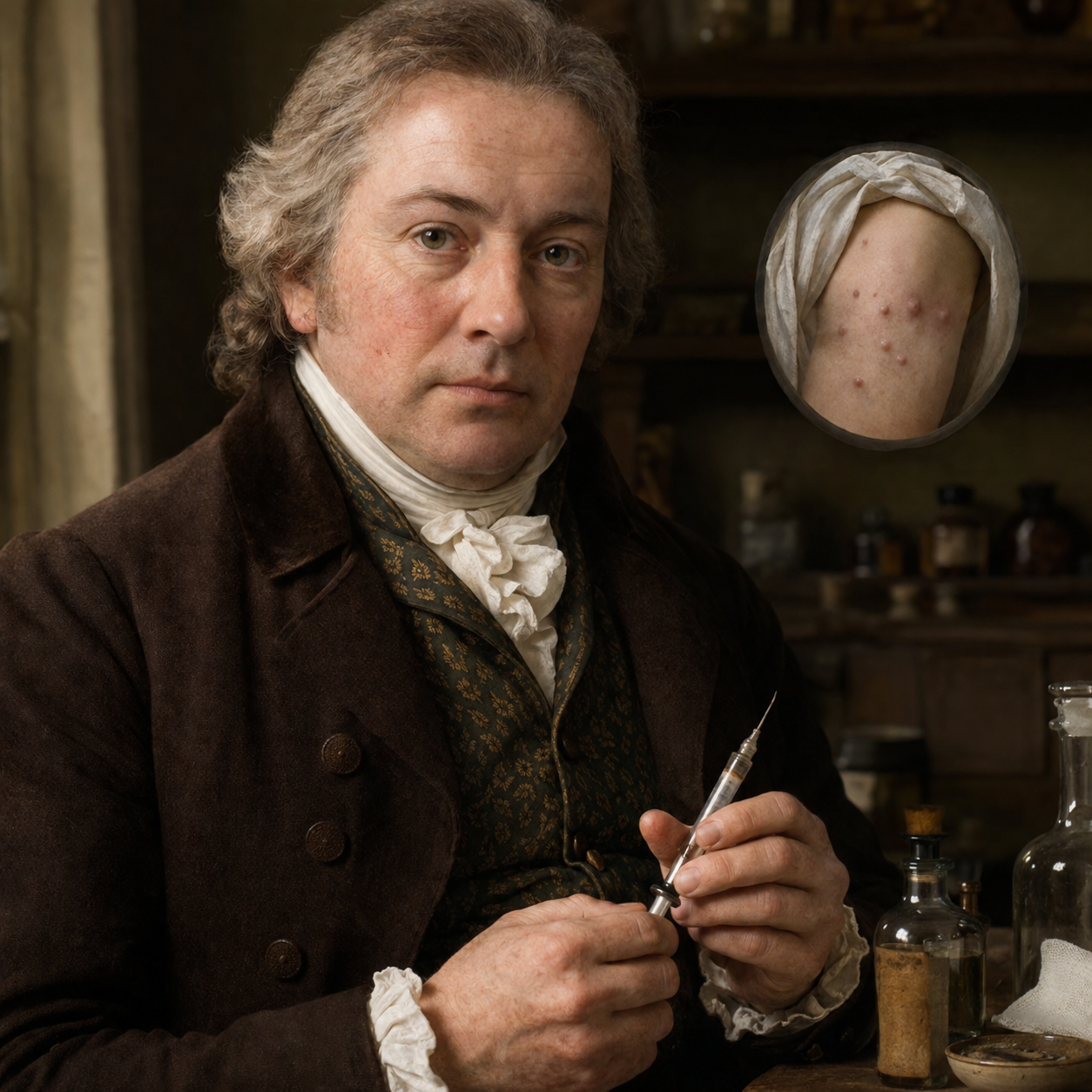
Edward Jenner — "I have been so much engaged in making experiments, that I have had no time to wr…"
I have been so much engaged in making experiments, that I have had no time to write letters.
I have been so much engaged in making experiments, that I have had no time to write letters.
Click any product to generate a realistic preview. Up to 3 at a time.
* Initial load can take up to 90 seconds — revising the preview in another color is nearly instant.
"The deviation of man from the state in which he was originally placed by nature seems to have proved to him a prolific source of diseases."
"I am not surprised that men are not grateful to me; but I wonder that they are not grateful to God for the good which He has made me the instrument of conveying to my fellow creatures."
"I have often thought that if mankind were more generally enlightened, they would be more virtuous."
"I have often been struck with the wonderful harmony that prevails throughout the works of nature."
"How wonderful that this horrid pestilence should at this time even have an existence in our island . . . A Physician from Copenhagen call'd on me today, and express'd his astonishment at an opposition…"
Found in 1 providers: grok
1 source checked
The speaker is explaining that hands-on experimental work has consumed all available time, leaving none for correspondence. It captures the tension between doing science and communicating about it — the lab bench versus the writing desk. For a researcher deep in discovery, every hour spent drafting letters is an hour stolen from the experiments that might change everything.
Jenner spent years conducting trials on cowpox inoculation before publishing his landmark 1798 Inquiry. His work was painstakingly empirical — testing on James Phipps and dozens of others required continuous observation. This remark reflects his obsessive dedication to proof over promotion, a trait that defined his slow, methodical path to validating vaccination against skeptical contemporaries.
In late 18th-century Britain, smallpox killed roughly 400,000 Europeans annually. Scientific correspondence was the primary means of sharing findings before journals dominated, making Jenner's tradeoff culturally loaded — silence from researchers meant delayed knowledge. Yet the urgency of conquering a devastating epidemic justified his prioritizing bench work over epistolary exchange with fellow natural philosophers.
AI-generated insights based on extensive research and information for context. Factual errors? Email [email protected].
Your cart is empty