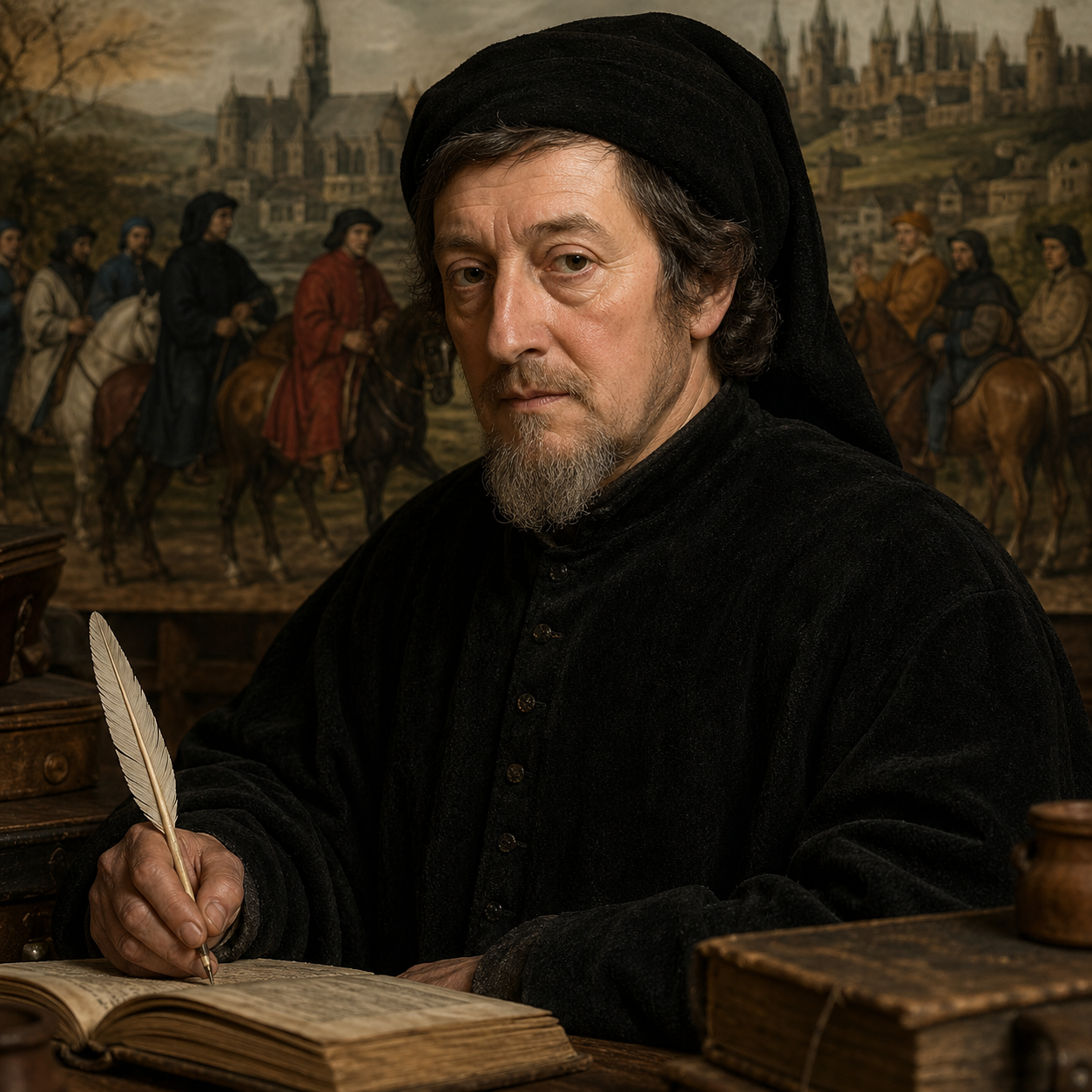
Geoffrey Chaucer — "A Monk ther was, a fair for the maistrie, An outridere, that loved venerie."
A Monk ther was, a fair for the maistrie, An outridere, that loved venerie.
A Monk ther was, a fair for the maistrie, An outridere, that loved venerie.
Click any product to generate a realistic preview. Up to 3 at a time.
* Initial load can take up to 90 seconds — revising the preview in another color is nearly instant.
"For if a man be ryche, he hath no drede, To have a wyf that is bothe fair and yong."
"He knew the cause of every maladye, / Were it of hoot, or coold, or moyste, or drye, / And where engendred, and of what humour."
"His mouth as greet was as a greet forneys."
"He knew hir conseil, and hir pryvetee, And for to been a maister of his craft, Ful ofte hadde this man bigiled his maister."
"Of smale houndes hadde she, that she fedde / With rosted flessh, or milk and wastel-breed."
English poet, civil servant, and the father of English literature; The Canterbury Tales (~1387-1400) is the founding text of English-language storytelling. Closely associated with Giovanni Boccaccio (his Italian predecessor; the Decameron preceded the Canterbury Tales by ~40 years). For an intellectual contrast, see John Wycliffe, English theologian and Lollard reform-movement leader — Wycliffe and Chaucer were near-contemporaries in the same English Christian world — Chaucer's Wife of Bath and Pardoner are the canonical literary defense of fleshly humanity against the Lollard moral austerity that would later become English Puritanism. Earthy storytelling vs proto-Protestant moralism.
The Canterbury Tales, General Prologue (ironic description of the Monk who loves hunting more than monastic duties)
Date: c. 1387-1400
RelationshipsFound in 1 providers: gemini
1 source checked
Your cart is empty