Tim Berners-Lee — "If you put everything on the web, then the world will be a better place. You wil…"
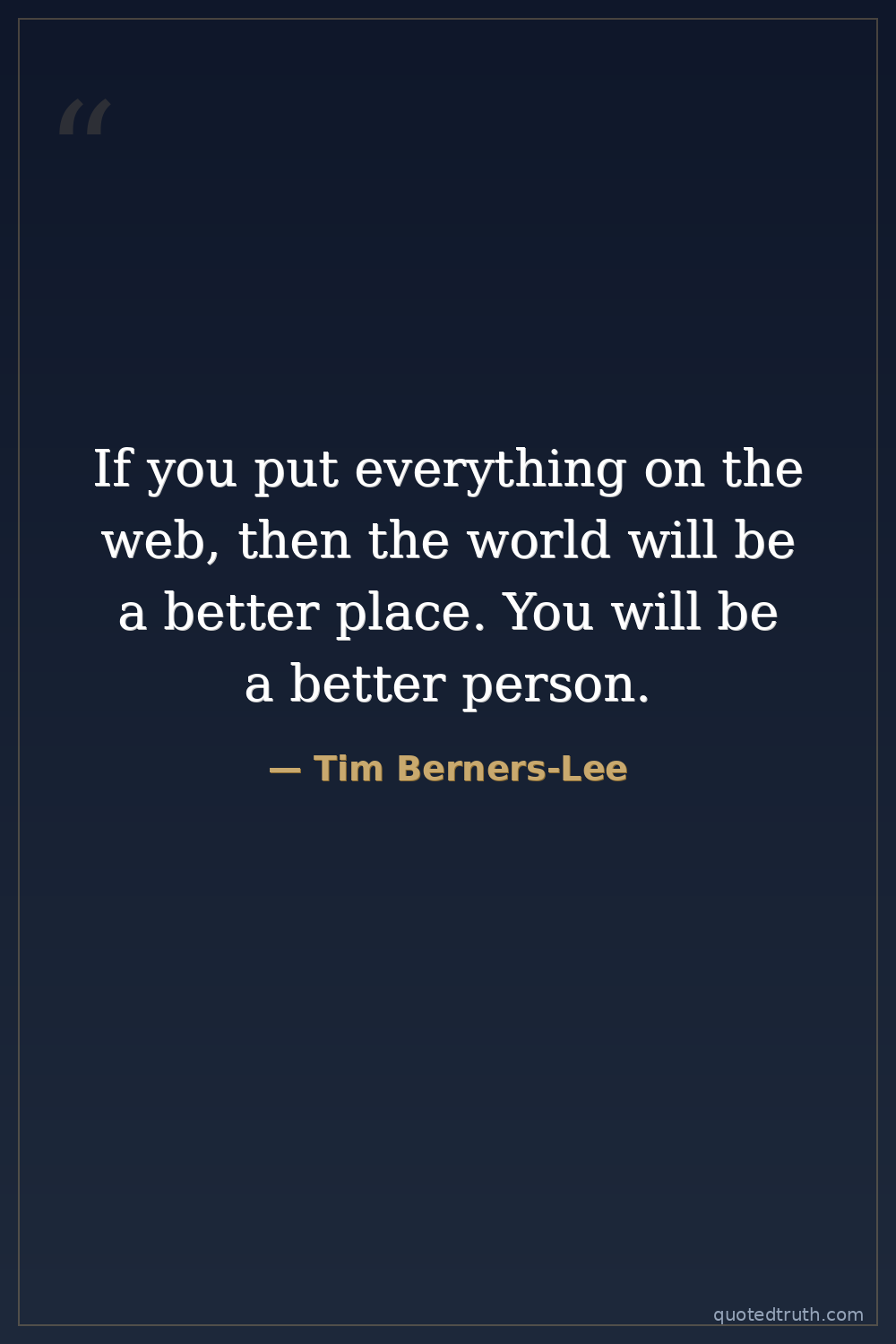
If you put everything on the web, then the world will be a better place. You will be a better person.
If you put everything on the web, then the world will be a better place. You will be a better person.
Click any product to generate a realistic preview. Up to 3 at a time.
* Initial load can take up to 90 seconds — revising the preview in another color is nearly instant.
"I’m not happy with the way the web has developed in some ways."
"The web is a tool for innovation, but it can also be used for stagnation."
"I'm not saying the web is all bad. It has done a lot of good. But it's also done a lot of harm."
"The web is still young. It's still evolving. We have to shape its future."
"I believe that the web can help to create a more just and equitable world."
British computer scientist who invented the World Wide Web at CERN in 1989 and founded the W3C, championing open web standards. Closely associated with Vint Cerf (TCP/IP co-creator and 'father of the internet') and Marc Andreessen (Mosaic browser creator and Netscape co-founder). For an intellectual contrast, see Mark Zuckerberg, Facebook (Meta) founder — Zuckerberg's walled-garden Facebook is the canonical contemporary opposite of Berners-Lee's open-web vision; Berners-Lee's Solid project and 'recapture the web' essays are explicitly written as a rebuttal to the platform-monopoly model Facebook pioneered.
Found in 1 providers: grok
1 source checked
Sharing information openly online creates collective good — for society and for the individual doing the sharing. The act of contributing knowledge to a global commons improves both the world's access to truth and your own clarity of thought, forcing you to articulate what you know and stand behind it publicly.
Berners-Lee invented the Web in 1989 as a free, open system — he deliberately refused to patent it, giving it to humanity. He spent decades championing net neutrality and the open web against corporate enclosure. This quote distills his foundational belief that radical openness is both ethically correct and personally transformative.
Berners-Lee made this case during the Web's explosive 1990s–2000s growth, when the internet's democratizing potential felt unlimited. Before social media's dark turn, the dominant hope was that universal information access would dissolve ignorance and empower individuals. His words captured that optimistic, pre-surveillance-capitalism vision of what the open web could become.
AI-generated insights based on extensive research and information for context. Factual errors? Email [email protected].
Your cart is empty