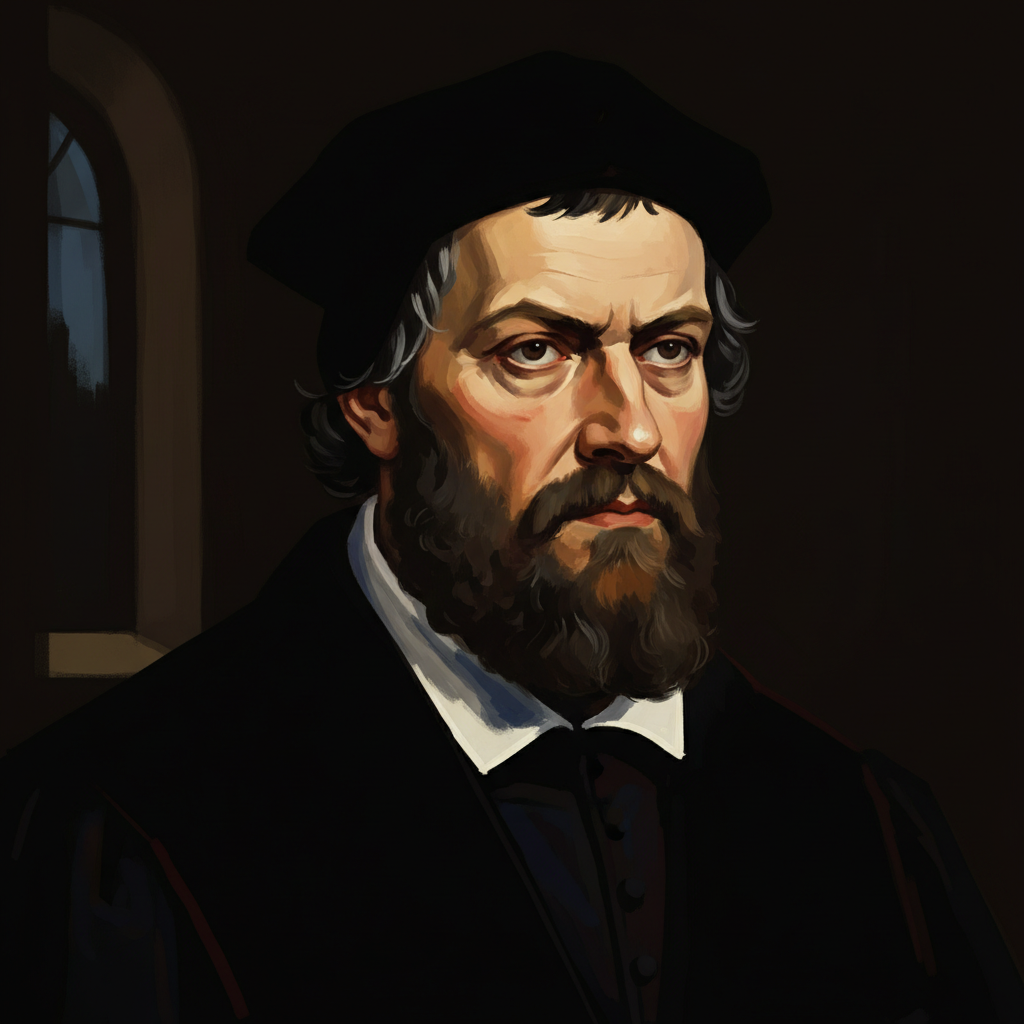
Martin Luther — "Even if I knew that tomorrow the world would go to pieces, I would still plant m…"
Even if I knew that tomorrow the world would go to pieces, I would still plant my apple tree.
Even if I knew that tomorrow the world would go to pieces, I would still plant my apple tree.
Click any product to generate a realistic preview. Up to 3 at a time.
* Initial load can take up to 90 seconds — revising the preview in another color is nearly instant.
"A man should not lie with his wife before she has been three nights in bed."
"If any man doth ascribe of salvation, even the very least, to the free will of man, he knoweth nothing of grace, and he hath not learnt Jesus Christ aright."
"The more you read the Bible, the more you will love it; the more you love it, the more you will read it."
"A happy fart never comes from a miserable ass."
"If God has no sense of humor, I don't want to go to Heaven."
German theologian whose 95 Theses (1517) launched the Protestant Reformation and broke the Catholic Church's monopoly on Western Christianity. Closely associated with Philipp Melanchthon (Lutheran systematizer) and John Calvin (later Reformer who built on Luther's break). For an intellectual contrast, see Pope Leo X, Renaissance pope (1513-1521) — Leo X's indulgence sales triggered Luther's break and Leo excommunicated him in 1521 — Luther's entire Reformation is structured as a direct answer to the indulgence-funded Vatican Leo represented.
Found in 2 providers: gemini,grok
2 sources checked
Do meaningful work today regardless of what tomorrow holds. Even facing certain catastrophe, the speaker would still perform a small, hopeful act like planting a tree that he'd never see grow. It's a rejection of despair and paralysis when the future looks grim. Purpose doesn't depend on outcomes or survival. Keep building, keep tending, keep investing in the future, because the act itself carries value separate from whether you live to enjoy the result.
Luther lived under constant threat after his 1521 excommunication and imperial ban, yet he kept preaching, translating the Bible into German, marrying Katharina von Bora, raising children, and writing hymns. His theology centered on faith expressed through ordinary vocation, not dramatic works. A farmer planting, a parent raising kids, a monk studying scripture all glorified God equally. This quote distills that conviction: steady faithfulness in daily duty matters more than spectacle, apocalypse predictions, or self-preservation.
Luther's early-modern era churned with apocalyptic anxiety: Ottoman armies pressed into central Europe, peasants revolted in 1524-25, plague recurred, and reformers openly debated whether the Last Days had arrived. Many expected Christ's imminent return and disengaged from worldly investment. Against that backdrop, quietly planting a fruit tree was countercultural: an affirmation that God governs history, that vocation continues under judgment, and that Christian hope produces patient work rather than panicked withdrawal from ordinary life and responsibility.
AI-generated insights based on extensive research and information for context. Factual errors? Email [email protected].
Your cart is empty