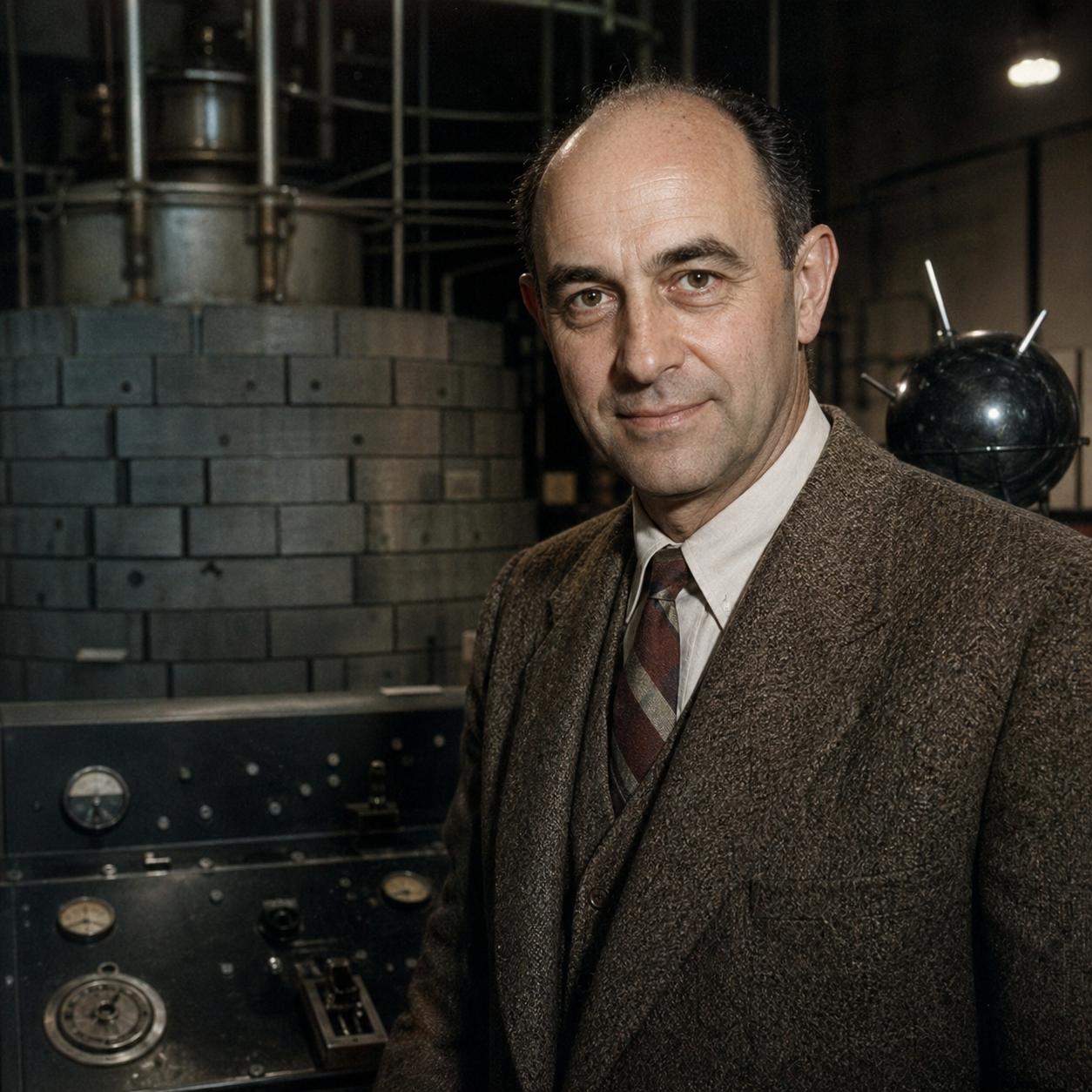
Enrico Fermi — "I am an optimist, because I believe that man is capable of solving his problems."
I am an optimist, because I believe that man is capable of solving his problems.
I am an optimist, because I believe that man is capable of solving his problems.
Click any product to generate a realistic preview. Up to 3 at a time.
* Initial load can take up to 90 seconds — revising the preview in another color is nearly instant.
"The universe is a strange and wonderful place, and we are only beginning to understand it."
"Never underestimate the joy of being proved wrong."
"One might be led to question whether the scientists acted wisely in presenting the statesmen of the world with this appalling problem. Actually there was no choice. Once basic knowledge is acquired, a…"
"Before the war, I was doing pure physics. Now I am doing applied physics. But it is still physics."
"The pursuit of knowledge is an endless journey."
Found in 1 providers: grok
1 source checked
The quote makes optimism conditional and reasoned rather than wishful. It argues that hope for the future isn't blind faith—it's grounded in confidence that human intelligence, creativity, and persistence are adequate tools for solving whatever problems arise. The speaker isn't ignoring difficulties; he's asserting that capability exists to meet them. It's a stance of earned confidence: humans face real problems, but humans also possess real capacity to overcome them.
Fermi escaped Mussolini's Italy in 1938, rebuilt his career in America, and led the team that achieved the first controlled nuclear chain reaction in Chicago in 1942. His career was defined by solving problems once thought impossible—unifying quantum theory with statistical mechanics, then taming nuclear fission. He invented Fermi estimation to quantify unknowns from first principles. His optimism wasn't abstract; it was methodological, rooted in lifelong proof that rigorous thinking conquers seemingly intractable problems.
Fermi worked during an era of extraordinary contradiction: science simultaneously cured diseases, fed billions through agricultural chemistry, and produced atomic bombs capable of mass annihilation. The 1940s–50s saw the dawn of nuclear power, the Cold War arms race, and post-WWII reconstruction. Scientists faced moral reckoning over weapons they had built. Fermi's optimism arrived during peak tension—when humanity's new powers made the question of whether humans could solve their problems literally existential.
AI-generated insights based on extensive research and information for context. Factual errors? Email [email protected].
Your cart is empty