Neil deGrasse Tyson — "If you are scientifically literate, the world looks very different to you, and t…"
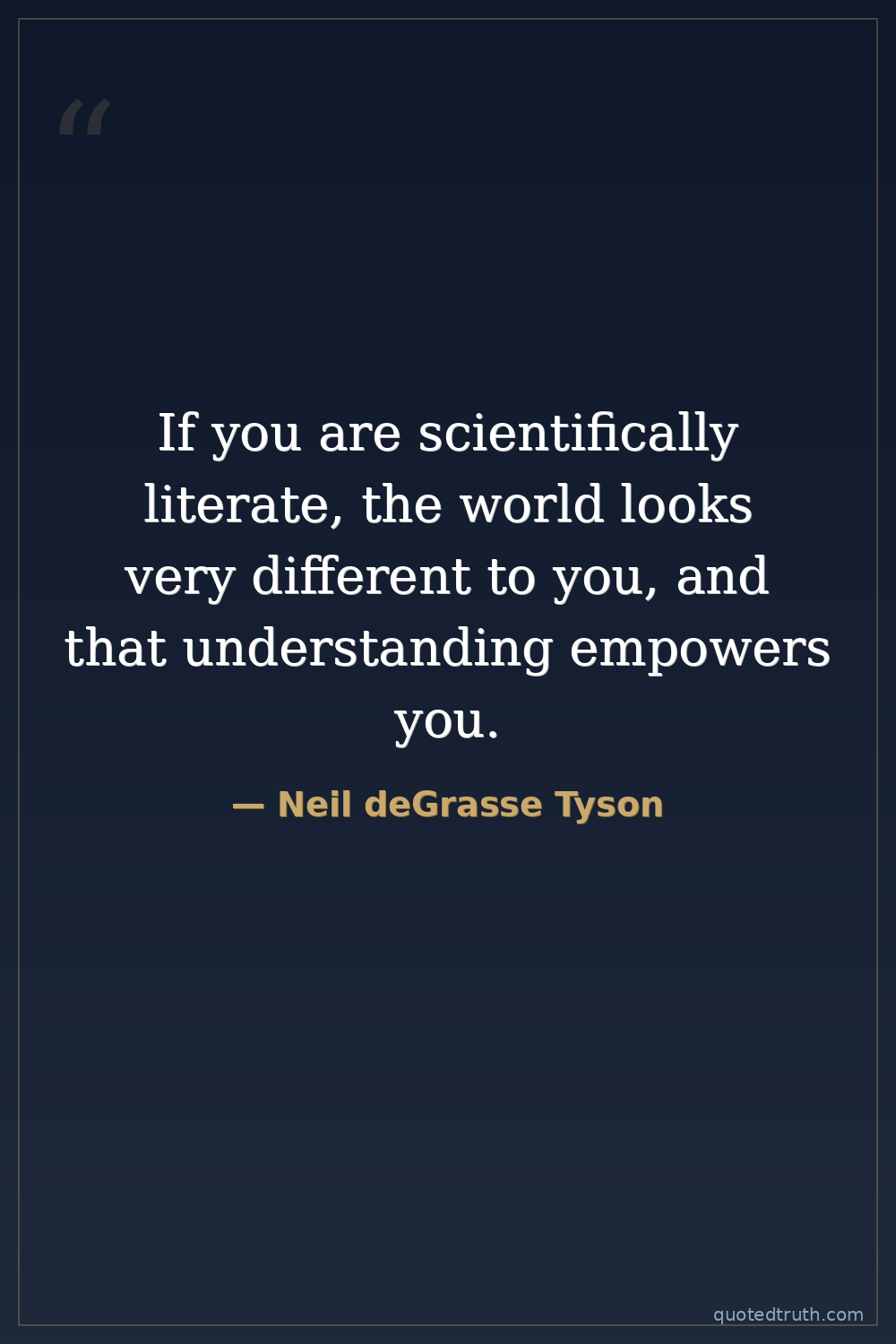
If you are scientifically literate, the world looks very different to you, and that understanding empowers you.
If you are scientifically literate, the world looks very different to you, and that understanding empowers you.
Click any product to generate a realistic preview. Up to 3 at a time.
* Initial load can take up to 90 seconds — revising the preview in another color is nearly instant.
"I’m not trying to convince you that science is cool. Science IS cool."
"The universe is not obliged to be beautiful."
"I find that if you have a goal, that you're going to work toward it. And if you don't have a goal, you're going to wander around aimlessly."
"I don't think there's any such thing as a 'dumb question' when it comes to science. There are just questions that reveal a lack of information."
"I'm not an atheist. I'm an agnostic. I don't know what's out there, and neither do you."
American astrophysicist, Hayden Planetarium director, and Cosmos: A Spacetime Odyssey host who carries the Carl Sagan public-science mantle. Closely associated with Bill Nye (fellow science communicator) and Brian Greene (theoretical physicist and string-theory popularizer). For an intellectual contrast, see Ken Ham, founder of Answers in Genesis and the Creation Museum — Ham's career has been organized around defending biblical 6-day creationism — exactly the science-education position Tyson's mainstream-science communication is structured to refute.
Found in 2 providers: grok,deepseek
2 sources checked
Understanding how science works fundamentally changes how you perceive reality. When you grasp evidence-based reasoning, cause and effect, and the scale of the universe, ordinary phenomena reveal hidden depth. That knowledge isn't passive — it gives you agency, letting you evaluate claims critically, make informed decisions, and navigate a complex world without being misled by misinformation or false certainty.
Tyson built his career not just doing astrophysics but translating it for the public through StarTalk, Cosmos, and countless interviews. As director of the Hayden Planetarium, he consistently argued scientific literacy is a civic necessity, not elitist pursuit. His entire professional identity is rooted in the belief that understanding the cosmos changes how humans value themselves and their choices.
Tyson rose to cultural prominence during an era of accelerating science denial — climate change skepticism, vaccine hesitancy, and flat-earth movements flourishing on social media. Simultaneously, STEM education gaps widened globally. His message directly countered a post-truth information environment where unverified claims spread virally, making scientific literacy an urgent democratic imperative rather than merely academic enrichment.
AI-generated insights based on extensive research and information for context. Factual errors? Email [email protected].
Your cart is empty