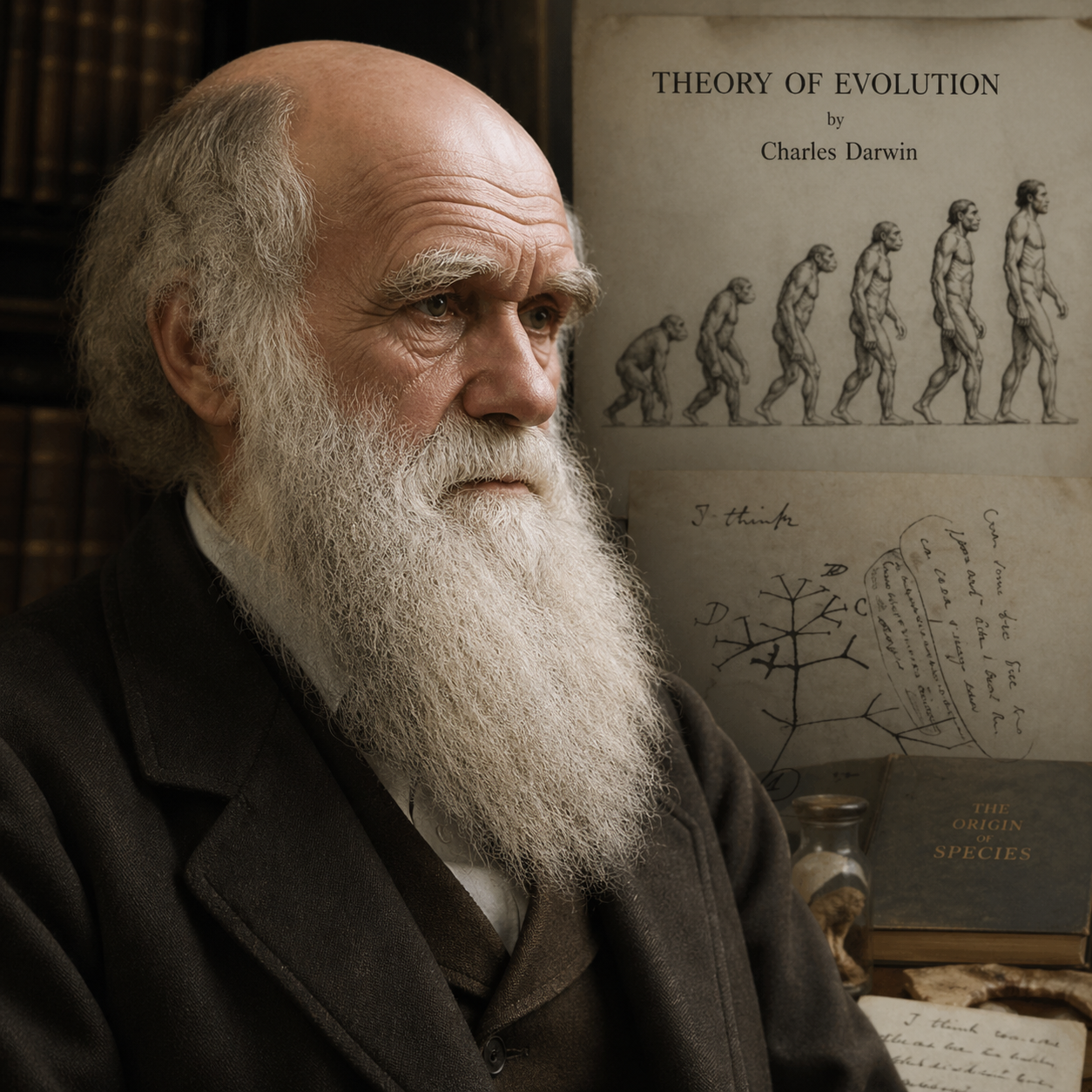
Charles Darwin — "If I have seen further than others, it is by standing upon the shoulders of gian…"
If I have seen further than others, it is by standing upon the shoulders of giants.
If I have seen further than others, it is by standing upon the shoulders of giants.
Click any product to generate a realistic preview. Up to 3 at a time.
* Initial load can take up to 90 seconds — revising the preview in another color is nearly instant.
"The very essence of instinct is that it's followed independently of reason."
"We are not to be discouraged by the smallness of the means, but to remember that the greatest results are often produced by the accumulation of small effects."
"I could show fight on natural selection having done and doing more for the progress of civilization than you seem inclined to admit."
"The highest possible stage in moral culture is when we recognize that we ought to control our thoughts."
"My mind seems to have become a kind of machine for grinding general laws out of large collections of facts, but why this should have caused the atrophy of that part of the brain alone, on which the hi…"
British naturalist whose On the Origin of Species (1859) established evolution by natural selection — the unifying theory of modern biology. Closely associated with Thomas Henry Huxley (his 'bulldog' public defender) and Alfred Russel Wallace (independent co-discoverer of natural selection). For an intellectual contrast, see William Paley, Anglican theologian and Natural Theology author (1743-1805) — Origin of Species is structurally a 400-page reply to Paley — Darwin admired Paley's watchmaker-argument as an undergraduate at Cambridge and then spent 20 years building the empirical machinery to displace him. The cleanest 'design argument vs natural selection' founding rebuttal in science.
The standard scholarly entry points to Charles Darwin's work: Janet Browne (Harvard, history of science) — Charles Darwin: Voyaging (1995) and The Power of Place (2002); Adrian Desmond (UCL, biographer) — Darwin: The Life of a Tormented Evolutionist (1991, with James Moore). These are the works graduate seminars cite when teaching Charles Darwin.
Though often attributed to Newton, Darwin also used similar sentiments in his letters, acknowledging intellectual lineage.
Date: c. 1860s
Self-DeprecatingFound in 1 providers: grok
1 source checked
No breakthrough happens in isolation. Every scientist, thinker, or innovator reaches their conclusions by absorbing, questioning, and extending the work of those who came before them. Acknowledging intellectual predecessors isn't false modesty—it's honest accounting of how knowledge actually grows. The deepest insights emerge from generations of accumulated observation, debate, and refinement, not from a single brilliant mind working alone.
Darwin's theory of evolution depended directly on predecessors: Malthus's population pressure theory, Lyell's geological uniformitarianism establishing deep time, and Wallace's parallel discovery that finally pushed Darwin to publish. He spent over 20 years synthesizing vast natural history literature before releasing On the Origin of Species in 1859, consistently crediting others in his correspondence and writings throughout his career.
The mid-Victorian era saw science institutionalize rapidly—the British Association for the Advancement of Science, expanding universities, and specialist journals created a culture of cumulative discovery. Darwin published in 1859 amid fierce religious controversy and scientific debate. Natural history had been built on centuries of work by Linnaeus, Buffon, and Cuvier, making the acknowledgment of intellectual inheritance both professionally expected and personally meaningful.
AI-generated insights based on extensive research and information for context. Factual errors? Email [email protected].
Your cart is empty