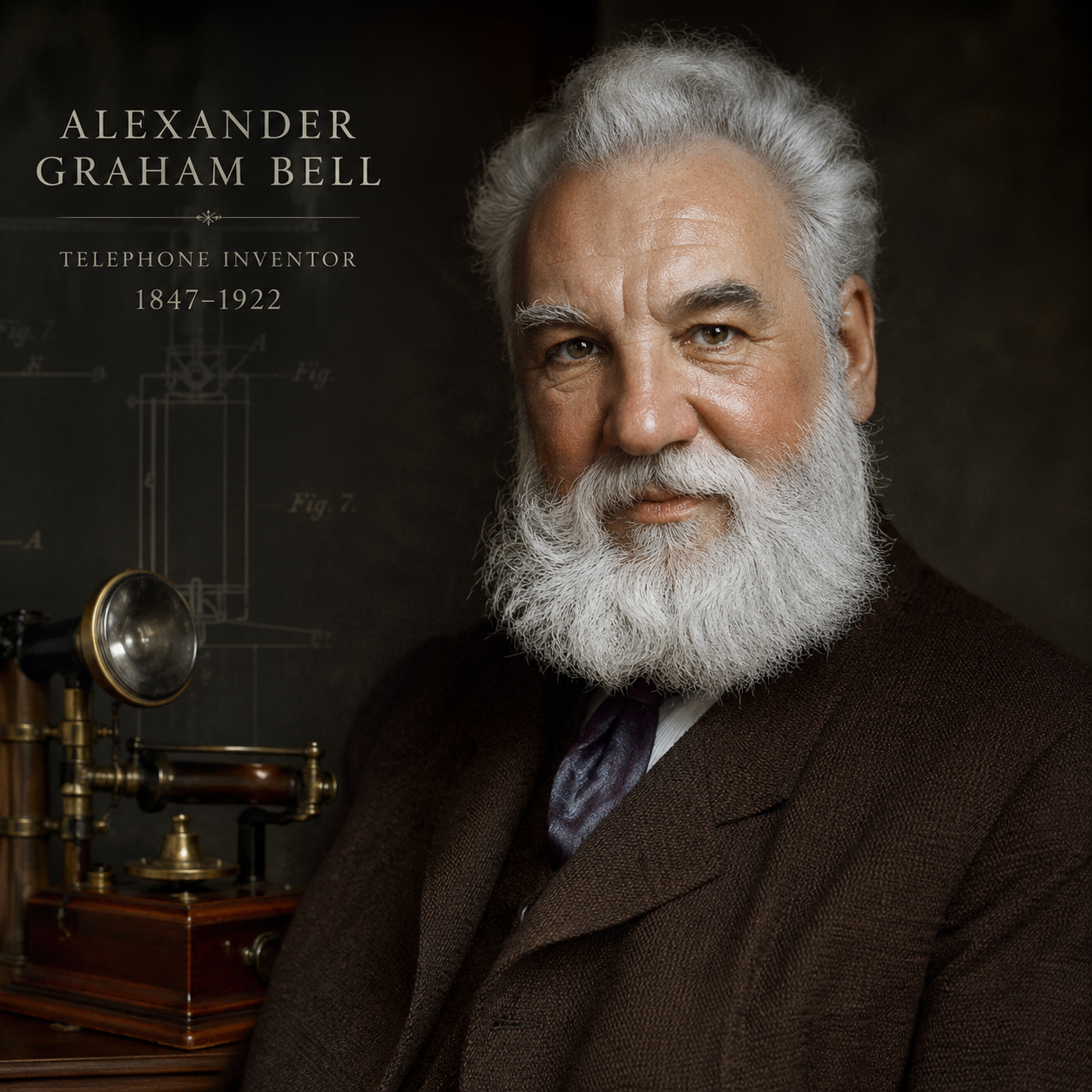
Alexander Graham Bell — "I am a man of science, and I believe in the power of observation and experimenta…"
I am a man of science, and I believe in the power of observation and experimentation.
I am a man of science, and I believe in the power of observation and experimentation.
Click any product to generate a realistic preview. Up to 3 at a time.
* Initial load can take up to 90 seconds — revising the preview in another color is nearly instant.
"The greatest achievement is to rise above yourself."
"The most successful men in the end are those whose success is the result of steady accretion. That intellectuality is more vigorous that has attained its strength gradually. It is the man who carefull…"
"The inventor looks at the world and is not contented with things as they are. He wants to improve them, he wants to change things, he is inspired by the desire to invent."
"Observe, Remember, Compare."
"The greatest minds are those who are not afraid to be wrong."
Found in 1 providers: grok
1 source checked
Knowledge comes through direct, systematic engagement with the world — watching carefully and testing hypotheses — rather than accepting inherited theory or tradition. Bell is declaring empiricism as his personal creed: reality is knowable, but only through disciplined inquiry. Claims must be grounded in evidence. Science here isn't a career label but a worldview — a commitment to letting the physical world answer questions rather than deferring to assumption or authority.
Bell's entire career was built on relentless experimentation. His father, Alexander Melville Bell, trained him in acoustics and elocution from childhood, grounding him in observable phenomena. Bell conducted hundreds of documented trials before the telephone breakthrough in 1876. His notebooks show methodical trial-and-error, not lucky invention. Beyond telephony he pursued aviation, hydrofoils, and deaf education — all through hands-on testing. Observation wasn't just his method; it was his identity as inventor and lifelong teacher of the deaf.
Bell worked during the peak of scientific positivism — the conviction that empirical method could unlock all of nature's secrets. Darwin's evolution theory, Pasteur's germ theory, and Maxwell's electromagnetism reshaped human understanding within decades. Yet mesmerism, spiritualism, and fraudulent inventions competed loudly for public credibility. Declaring oneself a 'man of science' was a pointed alignment with rigorous evidence-based inquiry, distinguishing serious inventors from charlatans in an era crowded with genuine breakthroughs and spectacular quackery alike.
AI-generated insights based on extensive research and information for context. Factual errors? Email [email protected].
Your cart is empty