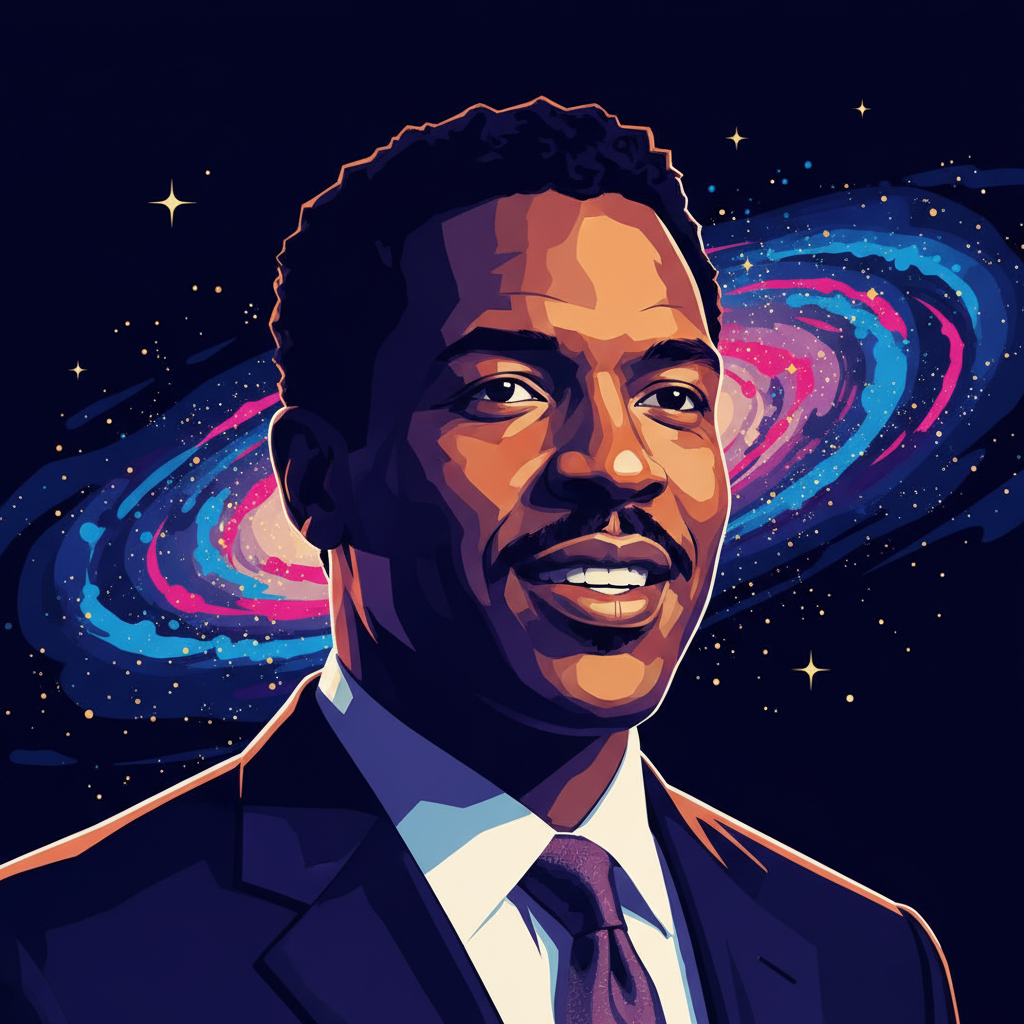
Neil deGrasse Tyson — "The universe is not just cold and empty. It's full of wonder."
The universe is not just cold and empty. It's full of wonder.
The universe is not just cold and empty. It's full of wonder.
Click any product to generate a realistic preview. Up to 3 at a time.
* Initial load can take up to 90 seconds — revising the preview in another color is nearly instant.
"I don't think there's any such thing as a 'dumb question' when it comes to science. There are just questions that reveal a lack of information."
"I don't have a problem with people believing in God. I have a problem with people who believe in God and use that as an excuse to be ignorant."
"I don't have a problem with people believing in anything they want to believe in. I have a problem with people telling me what I should believe in."
"The most important thing is to never stop asking questions."
"The claim that the universe was made for us is a human vanity."
American astrophysicist, Hayden Planetarium director, and Cosmos: A Spacetime Odyssey host who carries the Carl Sagan public-science mantle. Closely associated with Bill Nye (fellow science communicator) and Brian Greene (theoretical physicist and string-theory popularizer). For an intellectual contrast, see Ken Ham, founder of Answers in Genesis and the Creation Museum — Ham's career has been organized around defending biblical 6-day creationism — exactly the science-education position Tyson's mainstream-science communication is structured to refute.
Found in 1 providers: grok
1 source checked
Space isn't a barren void to fear or ignore — it overflows with astonishing phenomena: colliding galaxies, neutron stars, dark matter, cosmic webs spanning billions of light-years. Wonder isn't a childish reaction; it's the appropriate response to reality. The universe rewards curiosity with endless discovery, and that sense of awe is itself meaningful, even without supernatural explanation.
Tyson built his career on translating astrophysics into public excitement rather than academic jargon. As director of the Hayden Planetarium and host of Cosmos: A Spacetime Odyssey, he consistently argued that scientific understanding deepens rather than diminishes awe. His entire public persona is the living embodiment of this claim — infectious enthusiasm for cosmic scale.
In an era of social media-driven cynicism, climate anxiety, and political polarization, Tyson emerged as a prominent voice arguing science restores rather than removes meaning. Post-Hubble telescope imagery, exoplanet discoveries, and gravitational wave detection in the 2000s–2020s provided spectacular evidence that the cosmos is stranger and richer than any mythology imagined.
AI-generated insights based on extensive research and information for context. Factual errors? Email [email protected].
Your cart is empty