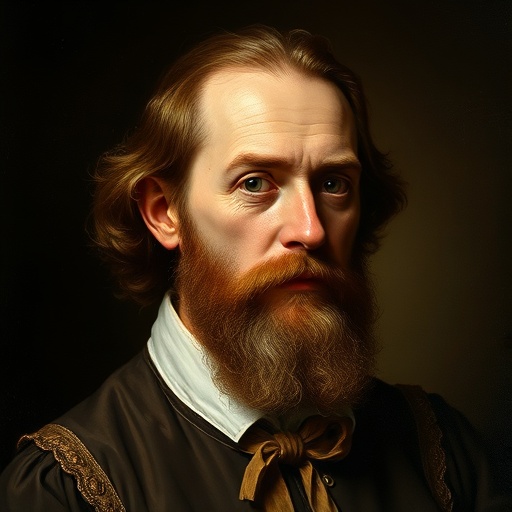
William Harvey — "The wise man will not be content with the knowledge of things as they are, but w…"
The wise man will not be content with the knowledge of things as they are, but will seek to know how they came to be so.
The wise man will not be content with the knowledge of things as they are, but will seek to know how they came to be so.
Click any product to generate a realistic preview. Up to 3 at a time.
* Initial load can take up to 90 seconds — revising the preview in another color is nearly instant.
"I have not only affirmed, but also demonstrated, the circulation of the blood."
"The blood, in truth, is the fountain of life, the first to move and the last to rest."
"Very many maintain that all we know is still infinitely less than all that still remains unknown; nor do philosophers pin their faith to others' precepts in such wise that they lose their liberty, and…"
"The best way to learn is to teach."
"The greatest pleasure is to discover something new."
English physician whose On the Motion of the Heart and Blood in Animals (1628) demonstrated blood circulation, overturning 1,400 years of Galenic medicine. Closely associated with Francis Bacon (his contemporary in the new English empiricism). For an intellectual contrast, see Galenic medicine, the 2nd-century Greek medical tradition (humors, blood-as-consumed-fuel) — Harvey calculated that the heart pumps more blood per hour than the body could possibly produce as fuel — a single quantitative observation that demolished the entire Galenic-Aristotelian medical worldview. The cleanest example in medical history of arithmetic disproving 14 centuries of authority.
Emphasizing the importance of understanding processes and origins, not just static observations.
Date: c. 1650s (attributed)
EducationalFound in 1 providers: gemini
1 source checked
True wisdom requires going beyond surface knowledge to causal understanding. A wise person refuses to stop at what is and pushes toward how did this come to be. It is a call to trace origins, mechanisms, and processes rather than accepting the world at face value. Knowledge of facts alone is incomplete; genuine understanding demands uncovering the processes that produced those facts.
Harvey exemplified this principle by refusing to accept Galen's 1,400-year-old claim that blood was consumed by tissues. Rather than documenting blood's presence, he traced its motion through systematic dissections and arithmetic calculations, discovering the heart pumps it in a continuous circuit. His 1628 De Motu Cordis proved that asking how, not merely what, transforms careful observation into revolutionary scientific discovery.
In Harvey's 17th-century Europe, the Scientific Revolution was displacing scholastic authority with empirical inquiry. Vesalius had challenged Galenic anatomy; Galileo was reframing physics through experiment. Yet most physicians still deferred to ancient texts over direct observation. Harvey's era made causal questioning radical, as inherited descriptions were replaced by mechanistic investigations into how living systems actually function, making this sentiment a manifesto for the age.
AI-generated insights based on extensive research and information for context. Factual errors? Email [email protected].
Your cart is empty