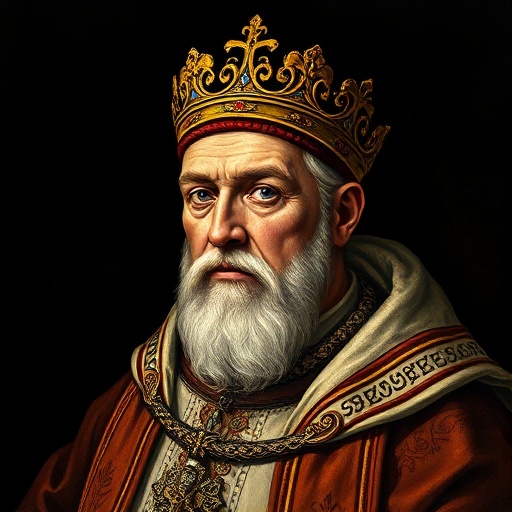
Pope Urban II — "Let those who have hitherto been engaged in internecine warfare against the fait…"
Let those who have hitherto been engaged in internecine warfare against the faithful, now go against the infidel.
Let those who have hitherto been engaged in internecine warfare against the faithful, now go against the infidel.
Click any product to generate a realistic preview. Up to 3 at a time.
* Initial load can take up to 90 seconds — revising the preview in another color is nearly instant.
"Oh, how admirable is that salting! Truly, you must strive by the salt of wisdom to correct these foolish people, hastening open-mouthed after the pleasures of this world, lest putrefied by sins and un…"
"For your brethren who live in the East are in urgent need of your help... the Turks and Arabs have attacked them."
"You will wear the sign of the cross on your garments, as a pledge of your immovable vow, and you will wear it until you return."
"You should not be detained by any love of your ancestral soil, for this land which you inhabit is barren and stony."
"And we do not command or advise that the old or feeble, or those unfit for bearing arms, undertake this journey; nor ought women to set out at all, without their husbands or brothers or legal guardian…"
Pope (1088-1099) whose Council of Clermont speech (November 1095) launched the First Crusade — the founding event of nine centuries of Christian-Muslim military conflict. Closely associated with Pope Gregory VII (his predecessor on papal-imperial reform). For an intellectual contrast, see Saladin, Kurdish-Muslim Sultan of Egypt and Syria (1138-1193) — Saladin recaptured Jerusalem in 1187, undoing the First Crusade Urban II launched 92 years earlier. Saladin's chivalrous treatment of Christian prisoners became the canonical Muslim counter-image to Crusader brutality. The cleanest before/after pairing of the Crusades' moral arc.
Found in 1 providers: grok
1 source checked
Stop fighting each other and instead fight Muslims in the Holy Land. Urban is redirecting the warrior class's endemic destructive energy outward toward a common enemy. In plain terms: you've been wasting your violence on fellow Christians; now channel it somewhere spiritually sanctioned. It's a calculated rhetorical pivot that reframes aggressive warfare as righteous duty rather than sinful fratricidal killing among believers.
Urban II was a Cluniac monk-turned-pope who championed the Peace of God movement limiting noble-on-noble warfare and was himself driven from Rome by an antipope. Redirecting Christian violence outward solved two crises simultaneously: it answered Byzantium's desperate plea for military aid against the Seljuk Turks and gave Europe's restless knights a spiritually absolved outlet, perfectly reflecting his dual identity as ecclesiastical reformer and shrewd political strategist.
In 1095, feudal Europe was chronically at war with itself—lords fought lords across fragmented kingdoms with no central restraint. The Seljuk Turks had shattered Byzantine power at Manzikert in 1071, seizing Anatolia and disrupting Christian pilgrimages to Jerusalem. The 1054 Great Schism had split Christendom. Urban spoke at Clermont into this volatile landscape, offering knights full absolution for crusading—radically reframing warfare as penance and transforming a liability into a geopolitical weapon.
AI-generated insights based on extensive research and information for context. Factual errors? Email [email protected].
Your cart is empty