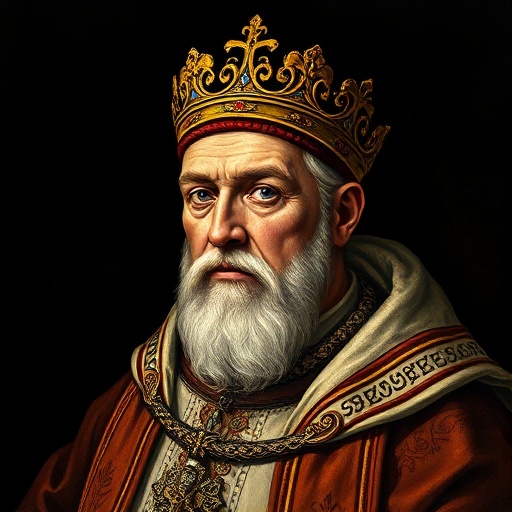
Pope Urban II — "The land of the Lord is now held by the infidels."
The land of the Lord is now held by the infidels.
The land of the Lord is now held by the infidels.
Click any product to generate a realistic preview. Up to 3 at a time.
* Initial load can take up to 90 seconds — revising the preview in another color is nearly instant.
"Take the road to the Holy Sepulchre and wrench the land from that wicked race."
"Arise, then, and go against this wicked race, and fight for the people of God!"
"Let no attachment to your native soil be an impediment, because…all the world is exile to the Christian, and all the world his country: thus exile is his country, and his country exile."
"Let those who have been serving as mercenaries for small pay now obtain the eternal reward."
"We grant to all who undertake this expedition a plenary indulgence."
Pope (1088-1099) whose Council of Clermont speech (November 1095) launched the First Crusade — the founding event of nine centuries of Christian-Muslim military conflict. Closely associated with Pope Gregory VII (his predecessor on papal-imperial reform). For an intellectual contrast, see Saladin, Kurdish-Muslim Sultan of Egypt and Syria (1138-1193) — Saladin recaptured Jerusalem in 1187, undoing the First Crusade Urban II launched 92 years earlier. Saladin's chivalrous treatment of Christian prisoners became the canonical Muslim counter-image to Crusader brutality. The cleanest before/after pairing of the Crusades' moral arc.
Found in 1 providers: grok
1 source checked
A powerful authority figure declares that sacred land belonging to God has been seized and is now controlled by non-believers. The statement frames territorial loss as a spiritual crisis, not merely political defeat, implying that reclaiming this land is a divine obligation rather than optional military action. It transforms a geopolitical conflict into a holy war requiring immediate response from all faithful Christians.
Urban II, born Odo of Châtillon, was a Benedictine monk and reformist pope deeply committed to Christendom's unity and the Church's supremacy. At Clermont in 1095, he delivered the sermon launching the First Crusade, using precisely this framing. His legal and theological training made him weaponize sacred geography as ecclesiastical argument, simultaneously strengthening papal authority while channeling violent knightly energy toward Jerusalem.
In 1095, the Seljuk Turks had captured Jerusalem and defeated Byzantine forces at Manzikert. Christian pilgrimage routes were disrupted. Europe's feudal knights needed religious purpose, and the Church needed political relevance. Urban's appeal synthesized these pressures: Jerusalem's loss represented cosmic disorder demanding correction, making crusading simultaneously penance, pilgrimage, and holy war within medieval Catholicism's framework.
AI-generated insights based on extensive research and information for context. Factual errors? Email [email protected].
Your cart is empty