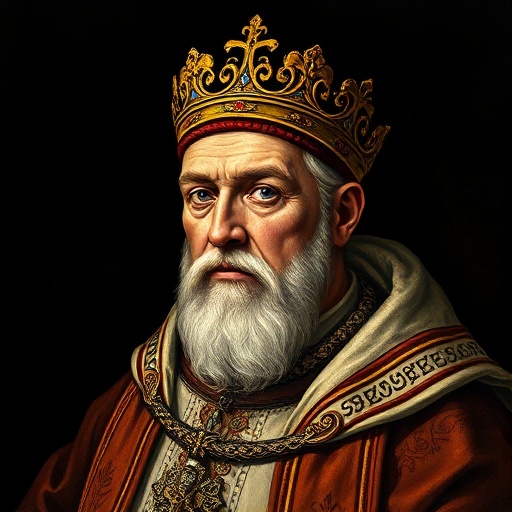
Pope Urban II — "The Lord Himself will lead you."
The Lord Himself will lead you.
The Lord Himself will lead you.
Click any product to generate a realistic preview. Up to 3 at a time.
* Initial load can take up to 90 seconds — revising the preview in another color is nearly instant.
"For if He, shall find worms, that is, sins, In them, because you have been negligent in your duty, He will command them as worthless to be thrown into the abyss of unclean things."
"What shall I say of the appalling violation of women, of which it is more evil to speak than to keep silent?"
"Christian blood, redeemed by the blood of Christ, has been shed, and Christian flesh, akin to the flesh of Christ, has been subjected to unspeakable degradation and servitude."
"They torture Christians with unheard-of cruelties."
"We exhort and command you, brethren, to strive with all your might to drive out the Turks from the confines of the Christians, and to aid the Christians, who are now subjected to their yoke."
Pope (1088-1099) whose Council of Clermont speech (November 1095) launched the First Crusade — the founding event of nine centuries of Christian-Muslim military conflict. Closely associated with Pope Gregory VII (his predecessor on papal-imperial reform). For an intellectual contrast, see Saladin, Kurdish-Muslim Sultan of Egypt and Syria (1138-1193) — Saladin recaptured Jerusalem in 1187, undoing the First Crusade Urban II launched 92 years earlier. Saladin's chivalrous treatment of Christian prisoners became the canonical Muslim counter-image to Crusader brutality. The cleanest before/after pairing of the Crusades' moral arc.
Found in 1 providers: grok
1 source checked
A declaration that divine guidance, not human strategy or personal ambition, drives the endeavor forward. It strips away ego and places ultimate authority in God's hands, framing the participants as instruments of a higher will rather than independent actors. It offers both comfort and accountability — if God leads, success is possible; if God leads, conduct must be worthy.
Urban II was a Cluniac monk before becoming pope, deeply formed by a spirituality of submission to God's will. When he preached at Clermont in 1095, he needed warriors to believe their cause was sacred, not merely political. Attributing leadership to God directly was his defining rhetorical and theological move — it transformed feudal violence into pilgrimage.
In 1095 medieval Europe, divine mandate was the only legitimate authority above kings. The Investiture Controversy had recently torn pope from emperor, leaving spiritual authority fiercely contested. Crusaders needed assurance that marching thousands of miles to recapture Jerusalem was God's command, not a pope's gamble — this phrase collapsed that distinction entirely.
AI-generated insights based on extensive research and information for context. Factual errors? Email [email protected].
Your cart is empty