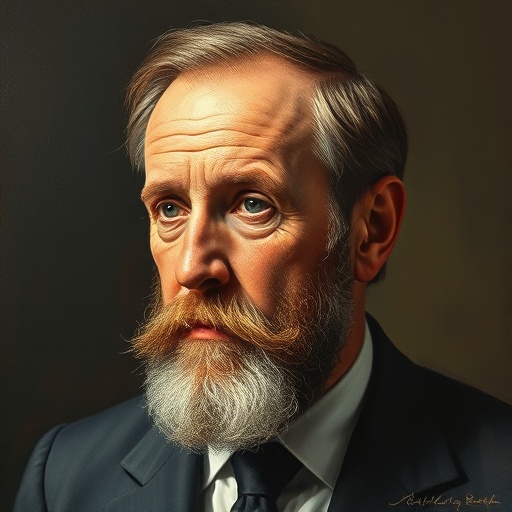
Niels Bohr — "The progress of science depends on the freedom of thought."
The progress of science depends on the freedom of thought.
The progress of science depends on the freedom of thought.
Click any product to generate a realistic preview. Up to 3 at a time.
* Initial load can take up to 90 seconds — revising the preview in another color is nearly instant.
"The aim of science is to purify our notions, not to increase the number of facts."
"Accuracy and clarity of expression are a matter of degree."
"The problem is not to know what the world is, but what we can say about it."
"It is not enough to be wrong, one must also be polite."
"The opposite of a correct statement is a false statement. But the opposite of a profound truth may well be another profound truth."
Found in 1 providers: grok
1 source checked
Scientific advancement requires the ability to question, challenge, and overturn existing ideas without institutional, political, or ideological interference. When researchers can pursue unconventional hypotheses, debate openly, and publish freely, knowledge compounds across generations. Suppress that freedom through censorship, dogma, or coercion, and science stagnates. Discoveries depend not just on intelligence or resources, but on intellectual environments where no idea is automatically forbidden from examination.
Bohr built the Copenhagen Institute for Theoretical Physics in 1920 as a model of open scientific dialogue, hosting Einstein, Heisenberg, and Pauli in relentless debate. He believed productive science demanded every assumption be challenged. When Nazi Germany occupied Denmark in 1940, Bohr—partly Jewish—protected refugee scientists until fleeing in 1943. His post-war push for international atomic transparency reflected his lifelong conviction that science thrives only when political borders and state secrecy retreat.
Bohr's working years spanned catastrophic ideological conflicts. Nazi Germany expelled Jewish scientists and declared quantum mechanics 'Jewish physics.' Soviet Lysenkoism rejected genetics in favor of politically approved pseudoscience, setting Soviet biology back decades. The Manhattan Project revealed how states could militarize and classify science entirely. Against this backdrop, Bohr lobbied Roosevelt and Churchill to share atomic knowledge internationally, arguing that openness—not secrecy—was the only path to lasting global stability.
AI-generated insights based on extensive research and information for context. Factual errors? Email [email protected].
Your cart is empty