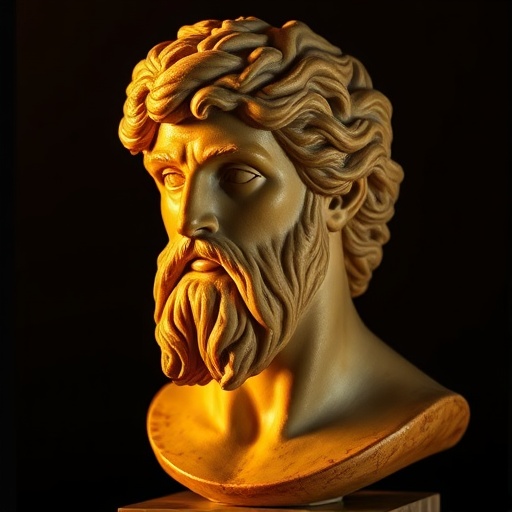
Pythagoras — "Do not break bread."
Do not break bread.
Do not break bread.
Click any product to generate a realistic preview. Up to 3 at a time.
* Initial load can take up to 90 seconds — revising the preview in another color is nearly instant.
"Do not go to bed until you have gone over the day three times in your mind. What did I do wrong? What did I do right? What did I leave undone?"
"Man, know thyself; then thou shalt know the Universe and God."
"The Monad (Unity) is the principle of stability since it preserves the identity of any number that it interacts with."
"Power is the near neighbour of necessity."
"Truth is so great a perfection, that if God would render himself visible to men, he would choose light for his body and truth for his soul."
Greek philosopher and mathematician whose school in Croton combined geometry (the Pythagorean theorem), number-mysticism, and a religious-vegetarian way of life. Closely associated with Thales of Miletus (earlier pre-Socratic and the first philosopher). For an intellectual contrast, see Heraclitus, pre-Socratic Greek philosopher of flux — Heraclitus called Pythagoras 'the chief of swindlers' — among the founding insults of the philosophical-rivalry tradition. Their 'all is flux' vs 'all is number' poles still organize the philosophy of mathematics today (Platonist vs anti-realist).
A Pythagorean maxim, possibly related to the symbolism of unity or avoiding division.
Date: c. 570 – c. 495 BC
ShockingFound in 1 providers: grok
1 source checked
This is a ritual prohibition against tearing a shared loaf of bread into pieces. In plain terms, the instruction tells followers not to divide what is meant to stay whole, especially food that binds people together in a meal. Breaking the loaf fractures the unity of those sharing it, so the rule preserves wholeness, fellowship, and the sacred character of communal eating by keeping the bread intact.
Pythagoras founded a tight-knit brotherhood in Croton where initiates shared meals, property, and silence under strict symbolic rules called akousmata. He treated numbers, harmony, and unity as sacred, so an uncut loaf mirrored his belief that the One should not be fragmented. As a vegetarian ascetic who governed disciples through cryptic sayings, this dietary taboo fits his pattern of using everyday acts to train the soul toward order, purity, and communal bonding.
In sixth-century BCE Magna Graecia, bread was hand-torn at shared tables and carried religious weight, often offered to gods or the dead before eating. Greek city-states were forming civic identities through common meals like the syssitia, and mystery cults such as Orphism spread purity codes around food. Pythagoras lived amid this fusion of ritual, politics, and emerging philosophy, where a seemingly small table custom could signal allegiance to a sect and a cosmic view of unity.
AI-generated insights based on extensive research and information for context. Factual errors? Email [email protected].
Your cart is empty