Confucius — "The superior man, in the world, does not set his mind either for anything, or ag…"
The superior man, in the world, does not set his mind either for anything, or against anything; what is right he will follow.
The superior man, in the world, does not set his mind either for anything, or against anything; what is right he will follow.
Click any product to generate a realistic preview. Up to 3 at a time.
* Initial load can take up to 90 seconds — revising the preview in another color is nearly instant.
"Respect yourself and others will respect you."
"The Master said, 'What is the highest wisdom? To know men.'"
"The cautious seldom err."
"The superior man has a dignified ease without pride. The mean man has pride without a dignified ease."
"The superior man has a proper pride, but is not proud."
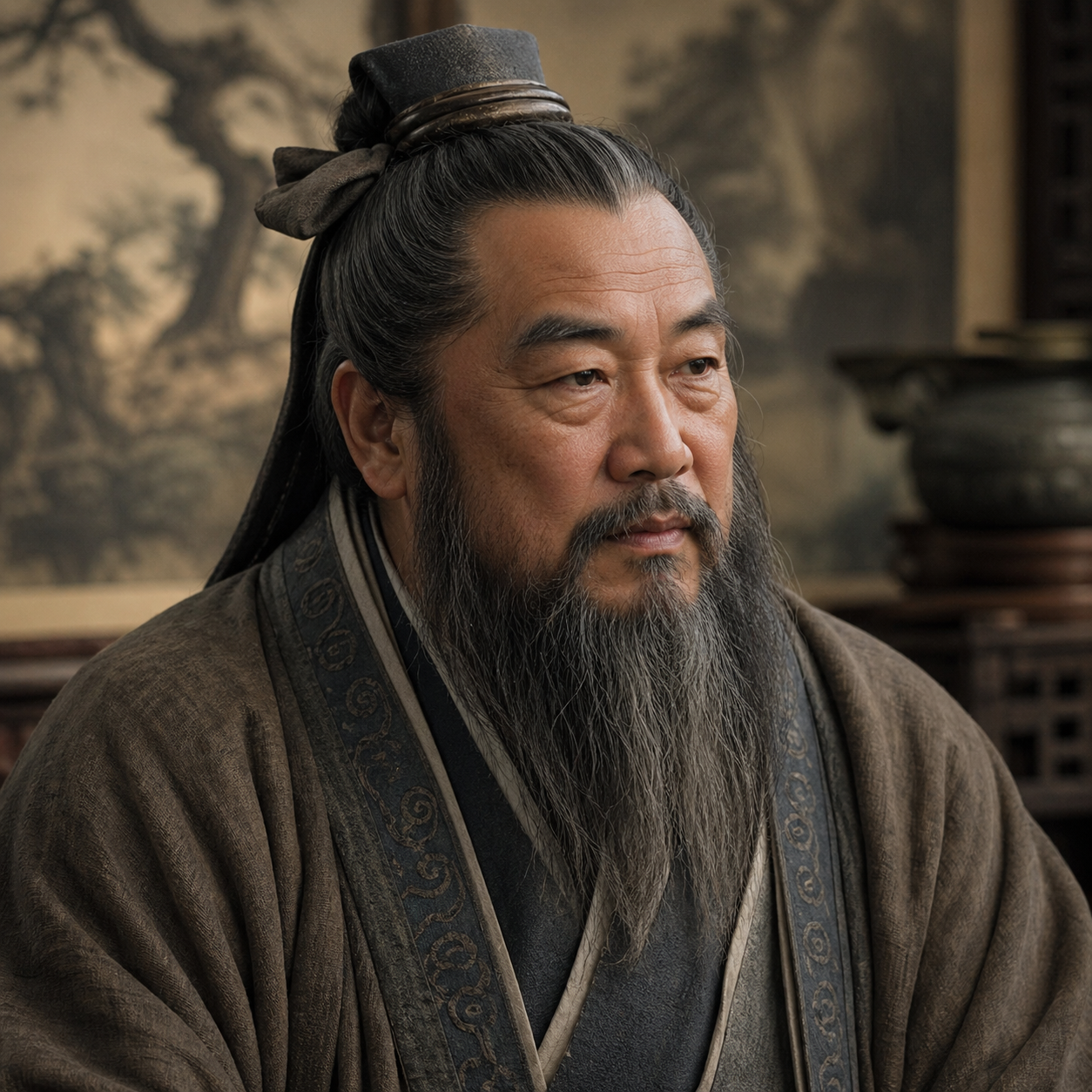
Chinese philosopher and teacher whose teachings (compiled by his students in the Analects) became the foundational ethical framework of East Asian civilization for 2,500 years. Closely associated with Mencius (his most-influential follower a century later). For an intellectual contrast, see Laozi, near-contemporary Chinese sage and Tao Te Ching author — Confucius systematized social order through ritual and family hierarchy; Laozi's Taoist effortless-action philosophy argued such systems were the disease, not the cure. The two founding poles of Chinese moral philosophy — every East Asian moral tradition since has positioned itself between them.
The standard scholarly entry points to Confucius's work: Philip J. Ivanhoe (Georgetown, Chinese philosophy) — Confucian Moral Self Cultivation (2000); Edward Slingerland (UBC, Asian Studies) — Effortless Action: Wu-wei as Conceptual Metaphor (2003); Tu Weiming (Harvard, Confucian scholar) — Confucian Thought: Selfhood as Creative Transformation (1985). These are the works graduate seminars cite when teaching Confucius.
From a teaching on impartiality and righteousness (Analects 4.10)
Date: c. 551-479 BCE
PhilosophicalFound in 1 providers: gemini
1 source checked
A person of real character doesn't walk into situations with fixed preferences or stubborn opposition. They don't pre-decide what they like or dislike before understanding the situation. Instead, they stay flexible and let the principle of rightness guide their choices. Whatever turns out to be genuinely correct, that's what they'll support, regardless of whether it matches what they initially wanted or expected.
Confucius built his entire ethical system around the junzi, the superior or exemplary person, and this saying captures his core teaching. As a traveling advisor who spent years seeking rulers who would adopt his reforms, he repeatedly chose principle over personal comfort or political expediency. His refusal to rigidly take sides, instead following righteousness (yi), defined both his teaching career and his moral philosophy for his disciples.
Confucius lived during the Spring and Autumn period of ancient China, an era of collapsing Zhou authority, constant warfare between states, and moral chaos among the aristocracy. Rulers picked advisors based on loyalty or flattery, not merit. Confucius countered this by defining a new ideal: the junzi, whose character rested on impartial judgment rather than factional allegiance. This redefinition of nobility, earned through virtue not birth, reshaped Chinese thought for millennia.
AI-generated insights based on extensive research and information for context. Factual errors? Email [email protected].
Your cart is empty