Confucius — "To govern is to rectify. If you lead the people by being rectified yourself, who…"
To govern is to rectify. If you lead the people by being rectified yourself, who will dare not be rectified?
To govern is to rectify. If you lead the people by being rectified yourself, who will dare not be rectified?
Click any product to generate a realistic preview. Up to 3 at a time.
* Initial load can take up to 90 seconds — revising the preview in another color is nearly instant.
"If a man does not say 'What shall I do? What shall I do?', I can do nothing with him."
"I have not seen a man who loves benevolence, or one who hates what is not benevolent. A man who loves benevolence will not place anything above it. A man who hates what is not benevolent will practice…"
"The superior man does not even for the space of a single meal act contrary to virtue. In moments of haste, he cleaves to it. In seasons of danger, he cleaves to it."
"The superior man, in the world, does not set his mind either for anything, or against anything; what is right he will follow."
"The superior man has a proper pride, but is not proud."
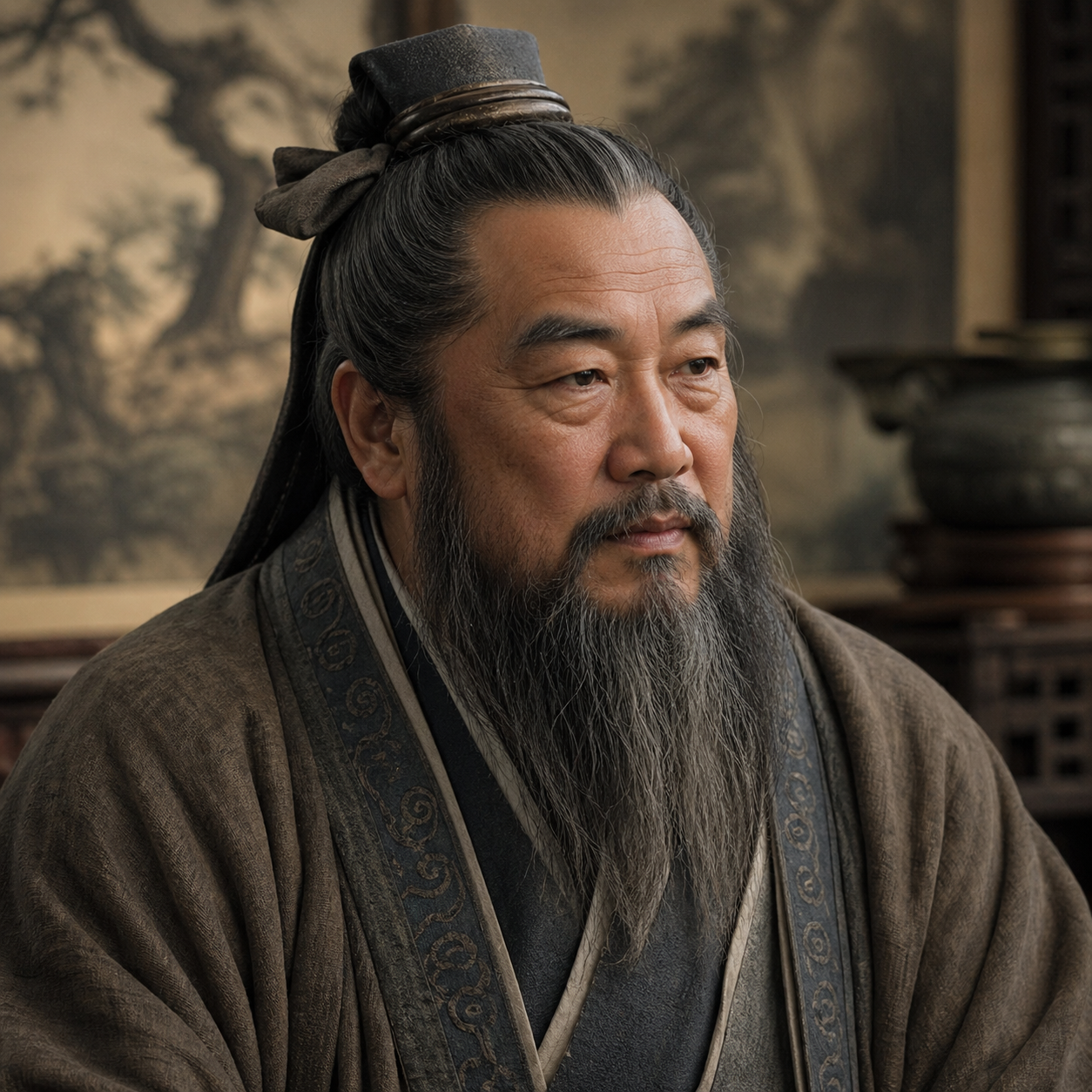
Chinese philosopher and teacher whose teachings (compiled by his students in the Analects) became the foundational ethical framework of East Asian civilization for 2,500 years. Closely associated with Mencius (his most-influential follower a century later). For an intellectual contrast, see Laozi, near-contemporary Chinese sage and Tao Te Ching author — Confucius systematized social order through ritual and family hierarchy; Laozi's Taoist effortless-action philosophy argued such systems were the disease, not the cure. The two founding poles of Chinese moral philosophy — every East Asian moral tradition since has positioned itself between them.
The standard scholarly entry points to Confucius's work: Philip J. Ivanhoe (Georgetown, Chinese philosophy) — Confucian Moral Self Cultivation (2000); Edward Slingerland (UBC, Asian Studies) — Effortless Action: Wu-wei as Conceptual Metaphor (2003); Tu Weiming (Harvard, Confucian scholar) — Confucian Thought: Selfhood as Creative Transformation (1985). These are the works graduate seminars cite when teaching Confucius.
Found in 1 providers: gemini
1 source checked
Leadership is fundamentally about moral correction, starting with the leader's own conduct. If those in power straighten their own lives, acting with integrity and ethical discipline, their subjects will naturally follow that example. You cannot demand honest or upright behavior from others while behaving crookedly yourself. Governance is less about issuing commands or enforcing rules than about modeling the standard you expect everyone below you to meet.
Confucius spent his life arguing that social order flows from personal virtue, not coercion or legalistic punishment. He served briefly as a minister in the state of Lu and advised rulers across warring states, always teaching that a junzi, or exemplary person, transforms society through moral cultivation. This saying distills his central conviction that ren (humaneness) and li (ritual propriety) must be embodied by rulers before they can be expected of anyone else.
Confucius lived during the Spring and Autumn period (roughly 551–479 BCE), when the Zhou dynasty's authority was collapsing and feudal states waged near-constant war. Dukes assassinated rivals, ministers usurped thrones, and moral order seemed to be dissolving. In that chaos, rulers typically relied on force, punishment, and shifting alliances. Confucius's insistence that rectification began with the ruler's own character was a radical counterproposal to the realpolitik of his age.
AI-generated insights based on extensive research and information for context. Factual errors? Email [email protected].
Your cart is empty