Pythagoras — "There is nothing so easy but that it becomes difficult when you do it reluctantl…"
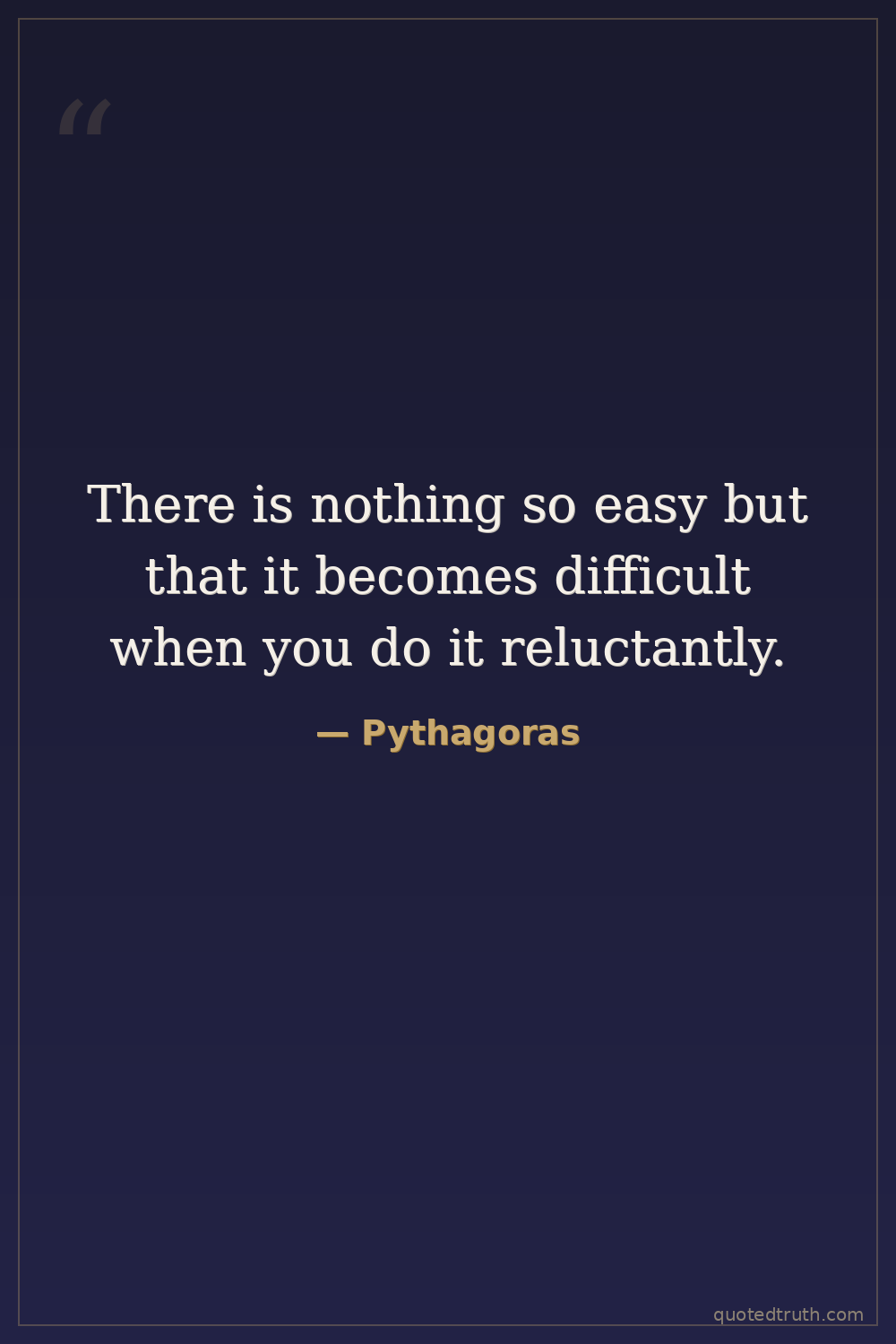
There is nothing so easy but that it becomes difficult when you do it reluctantly.
There is nothing so easy but that it becomes difficult when you do it reluctantly.
Click any product to generate a realistic preview. Up to 3 at a time.
* Initial load can take up to 90 seconds — revising the preview in another color is nearly instant.
"Pythagoras once claimed he had been reincarnated multiple times and was the son of Hermes, who gifted him the power of remembering who he was in all of his past lives."
"Don't sit on a bushel."
"The wind is blowing. Worship the sound."
"Concern should drive us into action and not into a depression."
"The monad, is god and the good, which is the origin of the One, and is itself intelligence; but the undefined dyad is a deity and the evil, surrounding which is the mass of matter."
Greek philosopher and mathematician whose school in Croton combined geometry (the Pythagorean theorem), number-mysticism, and a religious-vegetarian way of life. Closely associated with Thales of Miletus (earlier pre-Socratic and the first philosopher). For an intellectual contrast, see Heraclitus, pre-Socratic Greek philosopher of flux — Heraclitus called Pythagoras 'the chief of swindlers' — among the founding insults of the philosophical-rivalry tradition. Their 'all is flux' vs 'all is number' poles still organize the philosophy of mathematics today (Platonist vs anti-realist).
Highlights the impact of attitude and willingness on the ease of a task.
Date: c. 5th Century BCE
PhilosophicalFound in 1 providers: gemini
1 source checked
Any task, no matter how simple, turns into a struggle when you approach it without willingness or enthusiasm. Reluctance itself creates resistance, draining energy and focus that could otherwise make the work flow easily. The obstacle isn't the task's complexity but your attitude toward it. Motivation and mindset determine whether something feels effortless or burdensome, regardless of its actual demands.
Pythagoras led a disciplined philosophical brotherhood where members committed to rigorous daily practices: silence, dietary rules, memory exercises, and mathematical study. Success in his school required wholehearted dedication, not grudging compliance. As a teacher demanding years of initiation before sharing core doctrines, he understood that genuine learning and self-mastery depended on willing engagement. This saying reflects his conviction that inner discipline shapes outcomes more than external circumstances.
In 6th-century BCE Greece, manual labor, military service, and civic duty were often performed out of obligation rather than choice. Philosophical schools like Pythagoras's in Croton offered an alternative: voluntary communities pursuing wisdom through chosen hardship. Against a backdrop of aristocratic expectations and slave-based economies where reluctant toil was common, his teaching elevated willing effort as a moral and practical virtue, connecting ethics to everyday productivity and mental attitude.
AI-generated insights based on extensive research and information for context. Factual errors? Email [email protected].
Your cart is empty