Carl Linnaeus — "In natural science the principles of truth ought to be confirmed by observation."
In natural science the principles of truth ought to be confirmed by observation.
In natural science the principles of truth ought to be confirmed by observation.
Click any product to generate a realistic preview. Up to 3 at a time.
* Initial load can take up to 90 seconds — revising the preview in another color is nearly instant.
"Nature does not make leaps."
"The stony rocks are not primeval, but daughters of Time."
"Nature does not make any leaps. (Natura non facit saltus)"
"The stinking corpse flower smells like a rotting corpse to attract carrion beetles and flesh flies, which are its pollinators. Nature is both beautiful and repulsive."
"The greatest delight is to behold the earth, and to know what it is."
Swedish botanist and the father of modern taxonomy whose Systema Naturae (1735) introduced binomial nomenclature for naming all species. Closely associated with Joseph Banks (British naturalist who carried Linnaean classification on Cook's voyages). For an intellectual contrast, see Comte de Buffon, French naturalist and Histoire Naturelle author (1749-1788) — Buffon explicitly attacked Linnaean fixed-categories taxonomy as artificial and rejected the binomial system; his gradualist, environment-shaped natural history was the explicit alternative. Anticipates the fixed-species-vs-evolution debate Darwin would later resolve.
Found in 1 providers: gemini
1 source checked
Scientific truth must be grounded in what you can actually see and measure — not in tradition, authority, or logic alone. If a claim about the natural world can't be backed by direct observation, it shouldn't be accepted as fact. This is the core of empirical science: evidence must come first. Theories must be tested against reality, not just derived from reasoning or inherited assumptions.
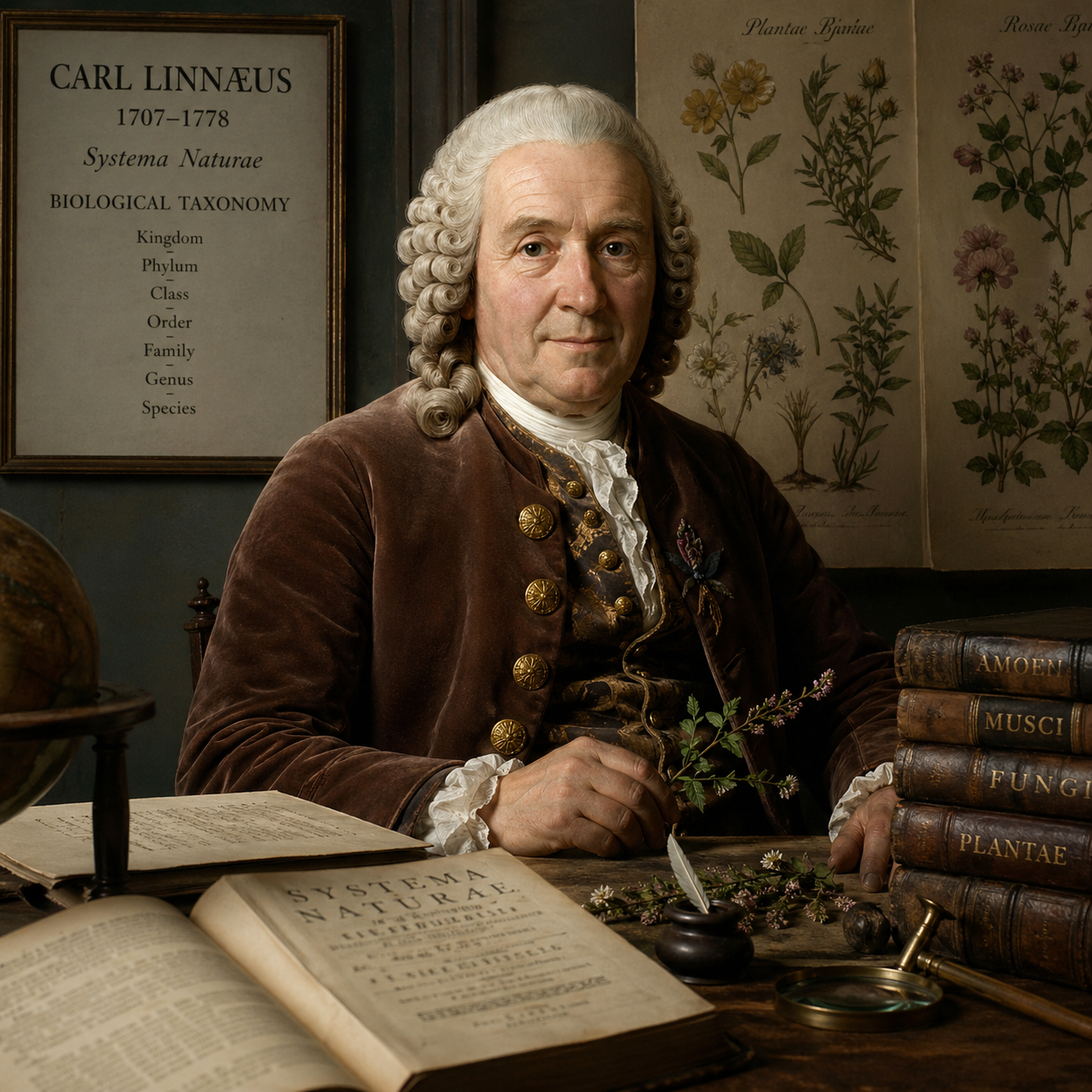
Linnaeus lived this principle. His Systema Naturae (1735) classified thousands of plants, animals, and minerals based entirely on observable physical traits — flower parts, body structures, anatomical features. He conducted field expeditions across Lapland and Europe, personally collecting and examining specimens. His binomial naming system demanded precise, repeatable observation rather than vague description. He rejected classification schemes built on theory alone, insisting nature reveal itself through direct examination.
The 18th-century Enlightenment was challenging centuries of knowledge derived from ancient texts and religious doctrine. Following Galileo and Newton's triumphs through empirical method, natural philosophers increasingly demanded evidence over authority. Exploratory voyages were flooding Europe with undescribed species, making systematic observation urgent. Yet many naturalists still relied on classical Greek sources. Linnaeus's insistence on observation-first principles positioned taxonomy as rigorous science rather than scholarly cataloguing of inherited descriptions.
AI-generated insights based on extensive research and information for context. Factual errors? Email [email protected].
Your cart is empty