William Harvey — "As art is a habit with reference to things to be done, so is science a habit in …"
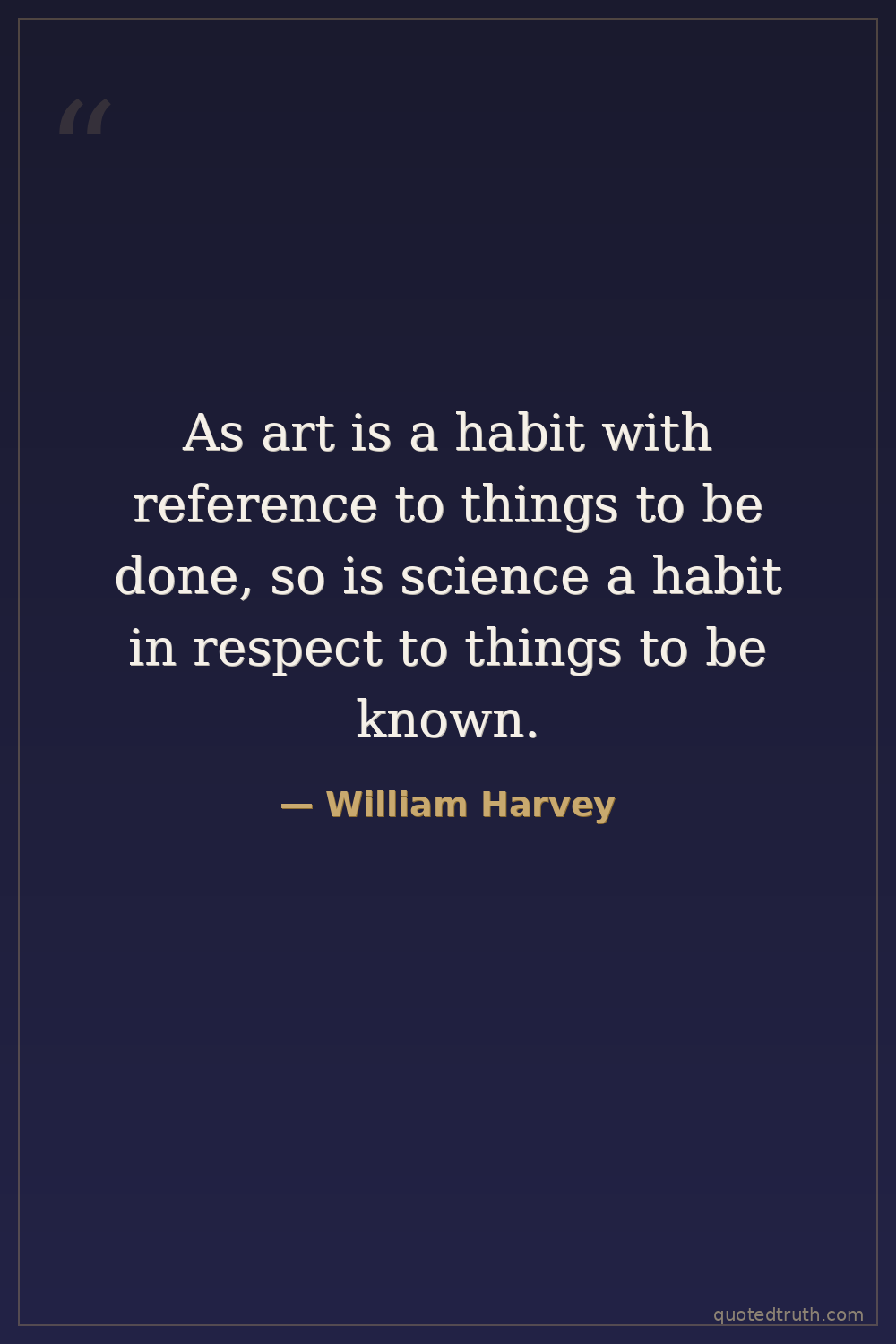
As art is a habit with reference to things to be done, so is science a habit in respect to things to be known.
As art is a habit with reference to things to be done, so is science a habit in respect to things to be known.
Click any product to generate a realistic preview. Up to 3 at a time.
* Initial load can take up to 90 seconds — revising the preview in another color is nearly instant.
"I have often wondered that the heart, though it be the chief seat of life, yet is not sensible of its own motion."
"Very many maintain that all we know is still infinitely less than all that still remains unknown; nor do philosophers pin their faith to others' precepts in such wise that they lose their liberty, and…"
"The more accurately and industriously I have examined the matter, the more clearly have I perceived the truth."
"The pulse is nothing more than the impulsion of the blood into the arteries."
"I have myself, in my dissections, seen the blood flow from the right ventricle into the pulmonary artery, and from the pulmonary vein into the left auricle."
English physician whose On the Motion of the Heart and Blood in Animals (1628) demonstrated blood circulation, overturning 1,400 years of Galenic medicine. Closely associated with Francis Bacon (his contemporary in the new English empiricism). For an intellectual contrast, see Galenic medicine, the 2nd-century Greek medical tradition (humors, blood-as-consumed-fuel) — Harvey calculated that the heart pumps more blood per hour than the body could possibly produce as fuel — a single quantitative observation that demolished the entire Galenic-Aristotelian medical worldview. The cleanest example in medical history of arithmetic disproving 14 centuries of authority.
From 'De Generatione Animalium' (1651), Introduction. Distinguishing art as practical skill and science as theoretical knowledge.
Date: 1651
PhilosophicalFound in 1 providers: gemini
1 source checked
Skill in making things comes from practiced habits of doing; knowledge of how things work comes from practiced habits of observing and reasoning. Just as a craftsman becomes expert through repeated action, a scientist becomes expert through disciplined, repeated inquiry. Mastery in either domain is not innate talent but cultivated through consistent, purposeful engagement over time.
Harvey embodied this perfectly: his discovery of blood circulation arose from decades of systematic dissection, vivisection, and careful observation rather than armchair philosophy. He rejected Galenic dogma not through argument alone but through relentless empirical habit, measuring, repeating, and refining experiments on dozens of animal species across his entire career as a physician and anatomist.
In early modern Europe, medicine was still largely Aristotelian and Galenic, relying on inherited textual authority rather than observation. The Scientific Revolution was dismantling this. Harvey's era saw Francis Bacon champion empiricism, Galileo reshape physics through experiment, and universities slowly accepting that knowledge required disciplined practice, not merely classical inheritance, making this distinction between art and science as cultivated habits genuinely radical.
AI-generated insights based on extensive research and information for context. Factual errors? Email [email protected].
Your cart is empty