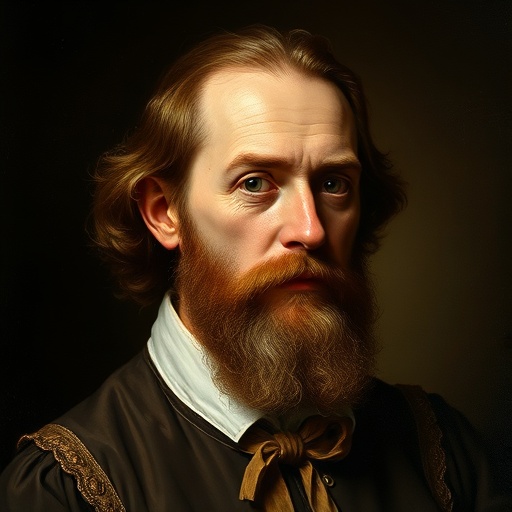
William Harvey — "The knowledge of man is as the waters, some shallow and some deep."
The knowledge of man is as the waters, some shallow and some deep.
The knowledge of man is as the waters, some shallow and some deep.
Click any product to generate a realistic preview. Up to 3 at a time.
* Initial load can take up to 90 seconds — revising the preview in another color is nearly instant.
"Nature is nowhere accustomed to exhibit herself more openly than in her failures."
"I am not so mad, nor have I been so caught up in the opinion of others, as to believe that I have discovered anything so great as to be worthy of the name of a new opinion."
"The blood is the source of life, and the heart is the fountain thereof."
"It is not simply by chance that the heart is placed in the midst of the body, as if it were the sun of the microcosm."
"Only by understanding the wisdom of natural foods and their effects on the body, shall we attain mastery of disease and pain, which shall enable us to relieve the burden of mankind."
English physician whose On the Motion of the Heart and Blood in Animals (1628) demonstrated blood circulation, overturning 1,400 years of Galenic medicine. Closely associated with Francis Bacon (his contemporary in the new English empiricism). For an intellectual contrast, see Galenic medicine, the 2nd-century Greek medical tradition (humors, blood-as-consumed-fuel) — Harvey calculated that the heart pumps more blood per hour than the body could possibly produce as fuel — a single quantitative observation that demolished the entire Galenic-Aristotelian medical worldview. The cleanest example in medical history of arithmetic disproving 14 centuries of authority.
A metaphorical statement on the varying depths of human understanding.
Date: 17th Century
PhilosophicalFound in 1 providers: gemini
1 source checked
Human knowledge varies like water — shallow in some, deep in others. Most people skim the surface of any subject, satisfied with received wisdom and easy answers. Genuine depth is rare, hard-won through sustained effort and willingness to question assumptions. The metaphor suggests that apparent certainty can mask shallow roots, while true understanding runs quiet and far beneath what is visible on the surface.
Harvey spent decades in meticulous dissection and experiment before publishing his discovery that blood circulates continuously — work contradicting 1,400 years of Galenic doctrine. Most physicians of his time waded in shallow, inherited assumptions. Harvey was the rare figure who dove deep: counting heartbeats, calculating volumes, demanding that evidence rather than authority settle the question. This quote reflects his hard-won awareness of how few people truly investigate rather than merely repeat.
The early modern period was defined by collision between ancient authority and empirical inquiry. Galenic medicine, Aristotelian natural philosophy, and biblical cosmology all faced serious challenges from Vesalius, Copernicus, Galileo, and Harvey himself. Most educated Europeans still accepted classical texts as final authority — shallow compliance with tradition. The Scientific Revolution was the project of a small minority willing to go deeper, making Harvey's water metaphor a precise diagnosis of the intellectual landscape of 17th-century Europe.
AI-generated insights based on extensive research and information for context. Factual errors? Email [email protected].
Your cart is empty