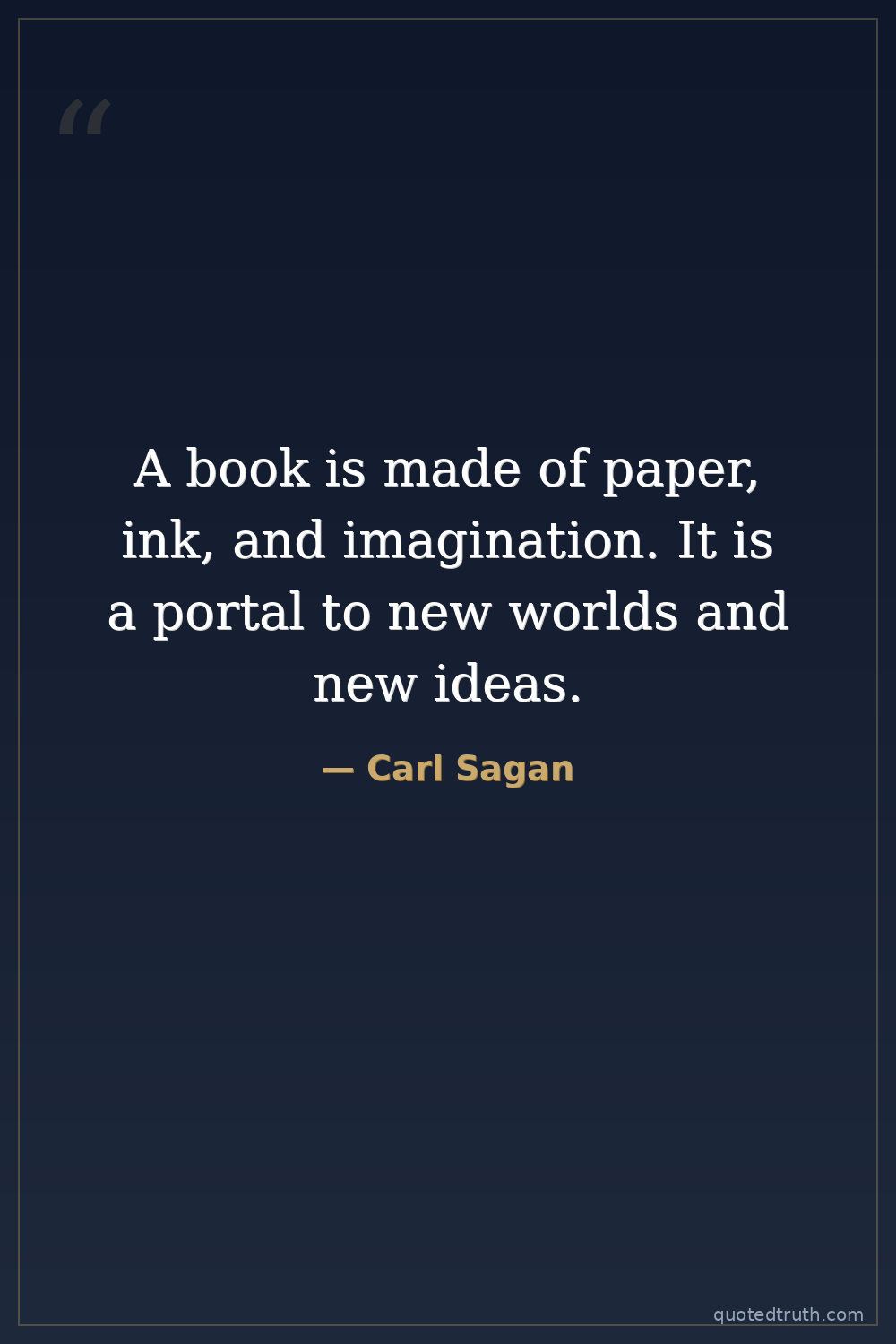
Carl Sagan — "A book is made of paper, ink, and imagination. It is a portal to new worlds and …"
A book is made of paper, ink, and imagination. It is a portal to new worlds and new ideas.
A book is made of paper, ink, and imagination. It is a portal to new worlds and new ideas.
Click any product to generate a realistic preview. Up to 3 at a time.
* Initial load can take up to 90 seconds — revising the preview in another color is nearly instant.
"Somewhere, something incredible is waiting to be known."
"The universe is a pretty big place. If it's just us, it seems like an awful waste of space."
"Better a painful truth than a comforting lie."
"The nitrogen in our DNA, the calcium in our teeth, the iron in our blood, the carbon in our apple pie were made in the interiors of collapsing stars. We are made of starstuff."
"If you want to make an apple pie from scratch, you must first invent the universe."
Discussing the power of literature.
Date: Unknown, likely from a lecture or essay
EducationalFound in 1 providers: grok
1 source checked
Books are more than their physical components—paper and ink are merely the vessel. The real substance is imagination: the author's capacity to conceive new worlds and the reader's willingness to enter them. A book functions as a doorway, not a container. Opening one means stepping into experiences, perspectives, and ideas that exist nowhere in physical space but become completely real in the mind.
Sagan devoted his career to building portals between science and public understanding. His TV series Cosmos and books like The Pale Blue Dot and Contact were designed precisely as gateways—making distant galaxies, ancient history, and speculative futures feel immediate and real. He often praised libraries as humanity's collective memory and saw books as tools for transcending the limits of one life, one era, one planet.
During Sagan's peak influence, television threatened to displace reading as America's dominant medium for ideas. Meanwhile, the Space Age had made 'new worlds' literal—humans had walked on the Moon. Cold War competition made scientific literacy feel urgent and civilizational. Books remained the primary vehicle for transmitting complex ideas across generations, lending Sagan's advocacy for reading a weight far beyond simple cultural appreciation.
AI-generated insights based on extensive research and information for context. Factual errors? Email [email protected].
Your cart is empty