Benjamin Franklin — "A good example is the best sermon."
A good example is the best sermon.
A good example is the best sermon.
Click any product to generate a realistic preview. Up to 3 at a time.
* Initial load can take up to 90 seconds — revising the preview in another color is nearly instant.
"A small leak will sink a great ship."
"Eat to please yourself, but dress to please others."
"After Supper walk a Mile, after Dinner sleep a while."
"There never was a good war or a bad peace."
"Without vanity, without an ostentatious display of learning, and without any other object than the good of the public, he is always ready to communicate his knowledge to others."
Polymath Founding Father, diplomat, and Poor Richard's Almanack author who helped draft the Declaration of Independence and the Constitution. Closely associated with John Adams (fellow Founder, Massachusetts statesman) and Thomas Jefferson (fellow Declaration drafter). For an intellectual contrast, see Thomas Hutchinson, last royal governor of colonial Massachusetts — Franklin leaked Hutchinson's loyalist correspondence to Boston in 1772 to inflame revolutionary sentiment — Hutchinson represented the colonial-aristocrat crown-loyalty that Franklin's revolution was organized to dismantle.
Found in 3 providers: grok,deepseek,gemini
3 sources checked
Actions speak louder than words — demonstrating a value through your own conduct is more persuasive and effective than any speech or lecture. Rather than telling people what to do, showing them through lived example creates genuine influence. It's a pragmatic case for leading by doing: real moral authority comes from modeling the behavior you want to see in others, not from preaching it at them.
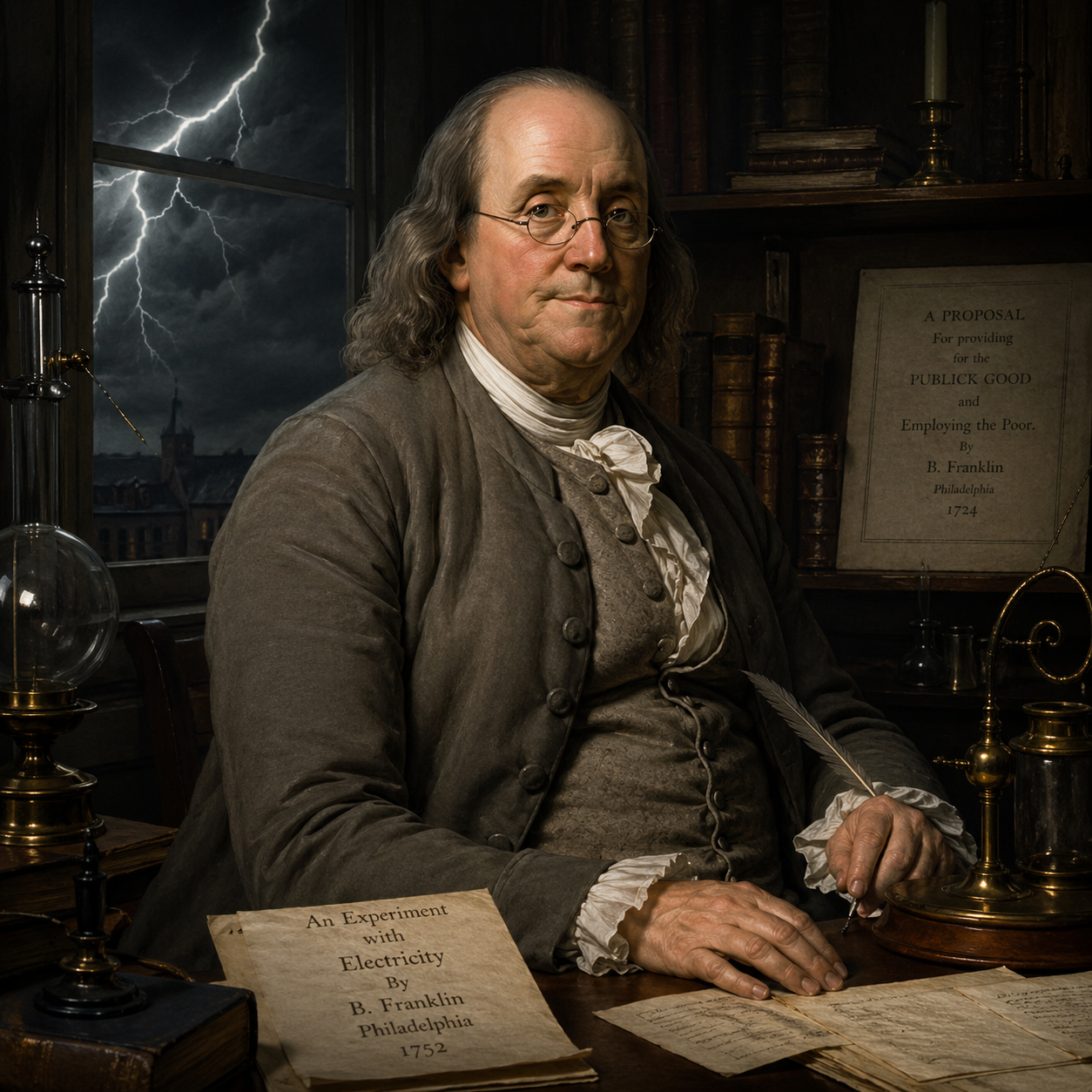
Franklin lived this principle literally, founding institutions rather than merely advocating for them — Philadelphia's first public library, fire department, and the University of Pennsylvania. His Poor Richard's Almanack modeled thrift and wit through action-oriented maxims rather than moral lectures. Even his electricity experiments were hands-on demonstrations of natural law. Franklin consistently distrusted empty rhetoric, using invention and institution-building to embody the civic virtues he championed.
Colonial America was saturated with religious sermonizing — Puritan preaching traditions and the Great Awakening revivals of the 1730s–40s made the pulpit the dominant source of moral authority. Franklin, a Deist and skeptic, deliberately pushed back by championing practical virtue over doctrinal oratory. His Enlightenment contemporaries prized observable action and reason over scripture, making his sermon metaphor a pointed, knowing challenge to clerical authority as the arbiter of how people ought to live.
AI-generated insights based on extensive research and information for context. Factual errors? Email [email protected].
Your cart is empty