Laozi — "A good traveler has no fixed plans and is not intent on arriving."
A good traveler has no fixed plans and is not intent on arriving.
A good traveler has no fixed plans and is not intent on arriving.
Click any product to generate a realistic preview. Up to 3 at a time.
* Initial load can take up to 90 seconds — revising the preview in another color is nearly instant.
"The Way that can be told of is not an unvarying way."
"Muddy water is best cleared by leaving it alone."
"When there is no desire, all things are at peace."
"When the great Tao is abandoned, there is humanity and righteousness. When wisdom and intelligence appear, there is great hypocrisy."
"The more you know, the less you understand."
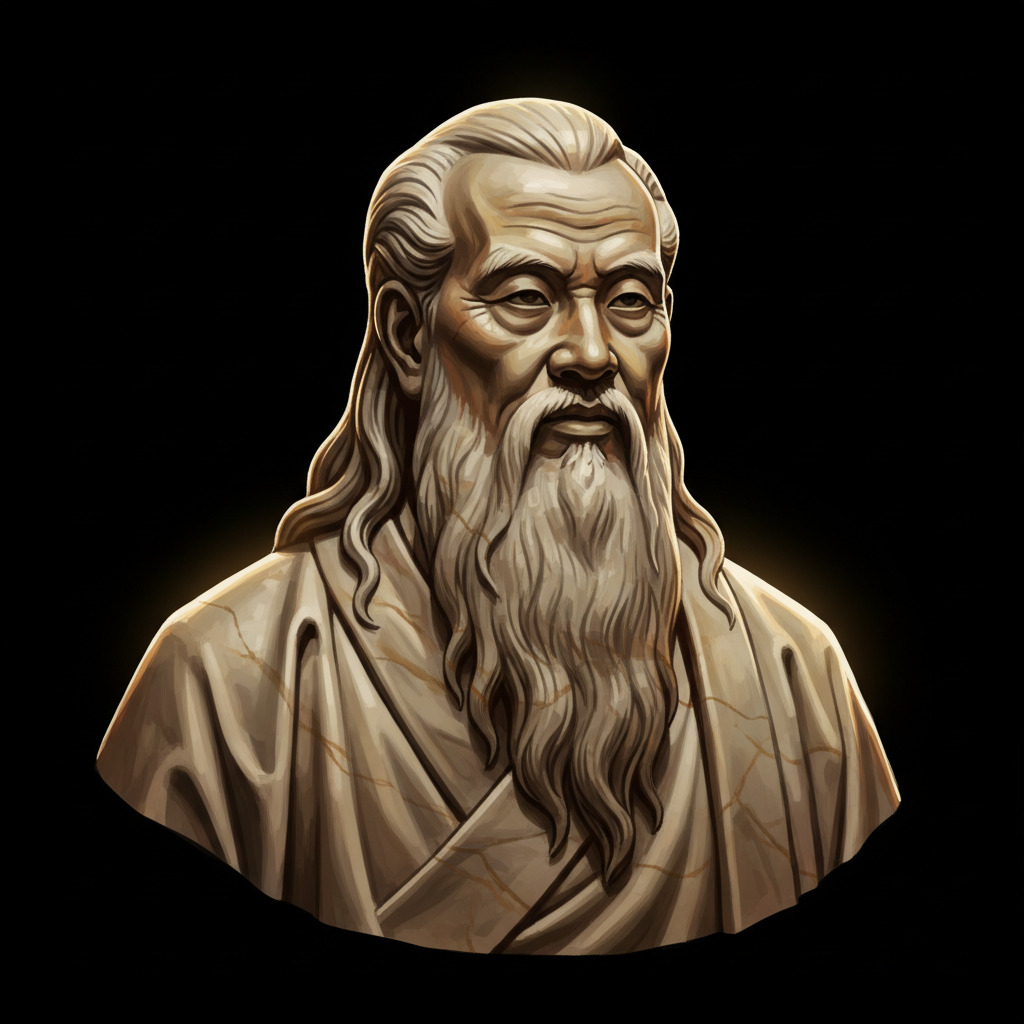
Reputed founder of Taoism and author of the Tao Te Ching, whose wu wei (effortless action) shaped East Asian philosophy. Closely associated with Zhuangzi (later Taoist who extended Laozi's framework). For an intellectual contrast, see Confucius, near-contemporary Chinese sage of social ritual and duty — Confucius systematized social order through ritual and hierarchy; Laozi argued that all such systems were the disease, not the cure — the two founding poles of Chinese moral philosophy.
Found in 2 providers: grok,gemini
2 sources checked
True skill in any journey comes from staying open rather than clinging to a rigid schedule or destination. Someone who moves through life well adapts to what actually shows up, follows the path as it unfolds, and treats detours as part of the experience instead of obstacles. Obsession with arriving blinds you to where you already are. Presence, flexibility, and responsiveness matter more than checking off a predetermined endpoint.
Laozi is said to have worked as an archivist in the Zhou royal court before growing disillusioned and riding westward on an ox, leaving society behind with no declared destination. His Tao Te Ching repeatedly praises wu wei, effortless action that yields to the natural flow rather than forcing outcomes. This line mirrors his own departure and his core teaching that grasping after goals distorts the Tao, while surrender to the Way reveals it.
Laozi lived during the late Zhou dynasty, around the 6th century BCE, as feudal order decayed into the violence of the Spring and Autumn period. Rival states schemed, Confucian scholars pushed rigid ritual and hierarchy as the cure, and ambitious officials chased titles and territory. Against this climate of striving and rigid planning, Taoist counsel to loosen grip on destinations was radical, offering retreat into nature and spontaneity as an alternative to court ambition.
AI-generated insights based on extensive research and information for context. Factual errors? Email [email protected].
Your cart is empty