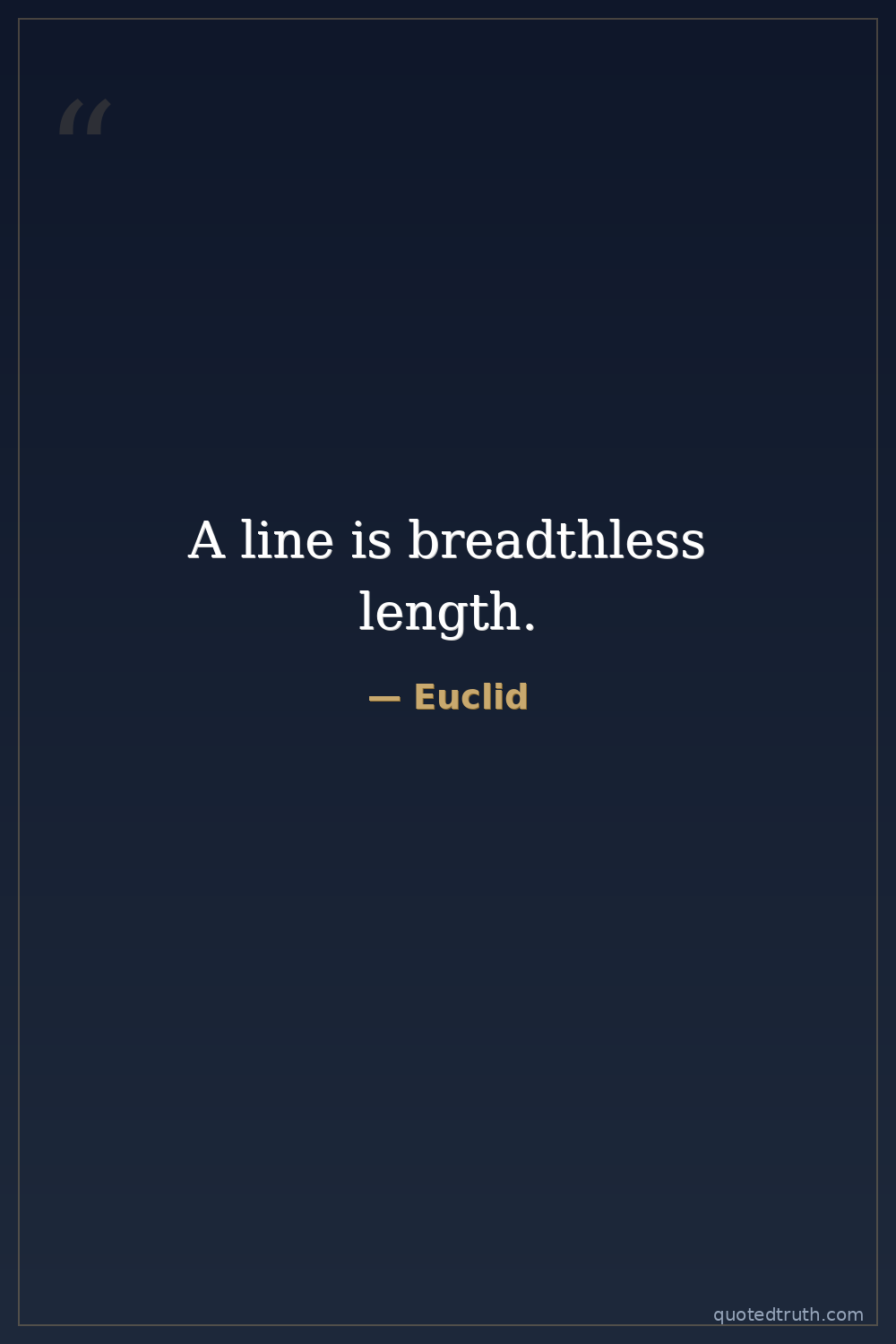
Euclid — "A line is breadthless length."
A line is breadthless length.
A line is breadthless length.
Click any product to generate a realistic preview. Up to 3 at a time.
* Initial load can take up to 90 seconds — revising the preview in another color is nearly instant.
"If two triangles have two sides equal to two sides respectively, and have the angles contained by the equal straight lines equal, they will also have the base equal to the base, the triangle will be e…"
"Further, of trilateral figures, a right-angled triangle is that which has a right angle, an obtuse-angled triangle that which has an obtuse angle, and an acute-angled triangle that which has its three…"
"To draw a straight line from any point to any point."
"A straight line is a line which lies evenly with the points on itself."
"Of trilateral figures, an equilateral triangle is that which has its three sides equal, an isosceles triangle that which has two of its sides alone equal, and a scalene triangle that which has its thr…"
Found in 3 providers: grok,deepseek,gemini
3 sources checked
A line has only one dimension: length. It has no width, no thickness, no physical presence — it is purely an abstraction. This strips away all sensory intuition about what a line looks like in the real world and defines it with logical precision, establishing only what is mathematically necessary. It forces the mind to work with pure concept rather than observable reality.
Euclid wrote this as Definition 2 in his foundational work Elements, compiled around 300 BCE. His entire project was building geometry from irreducible definitions and axioms upward through rigorous proof. This definition reflects his systematic, uncompromising commitment to logical foundations — he refused to assume anything, even something as obvious as what a line is, without first stating it explicitly.
In ancient Alexandria around 300 BCE, Greek thinkers were separating mathematical truth from physical measurement. Egyptian and Babylonian traditions used geometry practically — for land surveying and construction. Euclid represented a distinctly Greek intellectual shift: mathematics as a system of pure reasoning, independent of physical tools or measurement. Defining a line abstractly rather than practically marked this philosophical transformation.
AI-generated insights based on extensive research and information for context. Factual errors? Email [email protected].
Your cart is empty