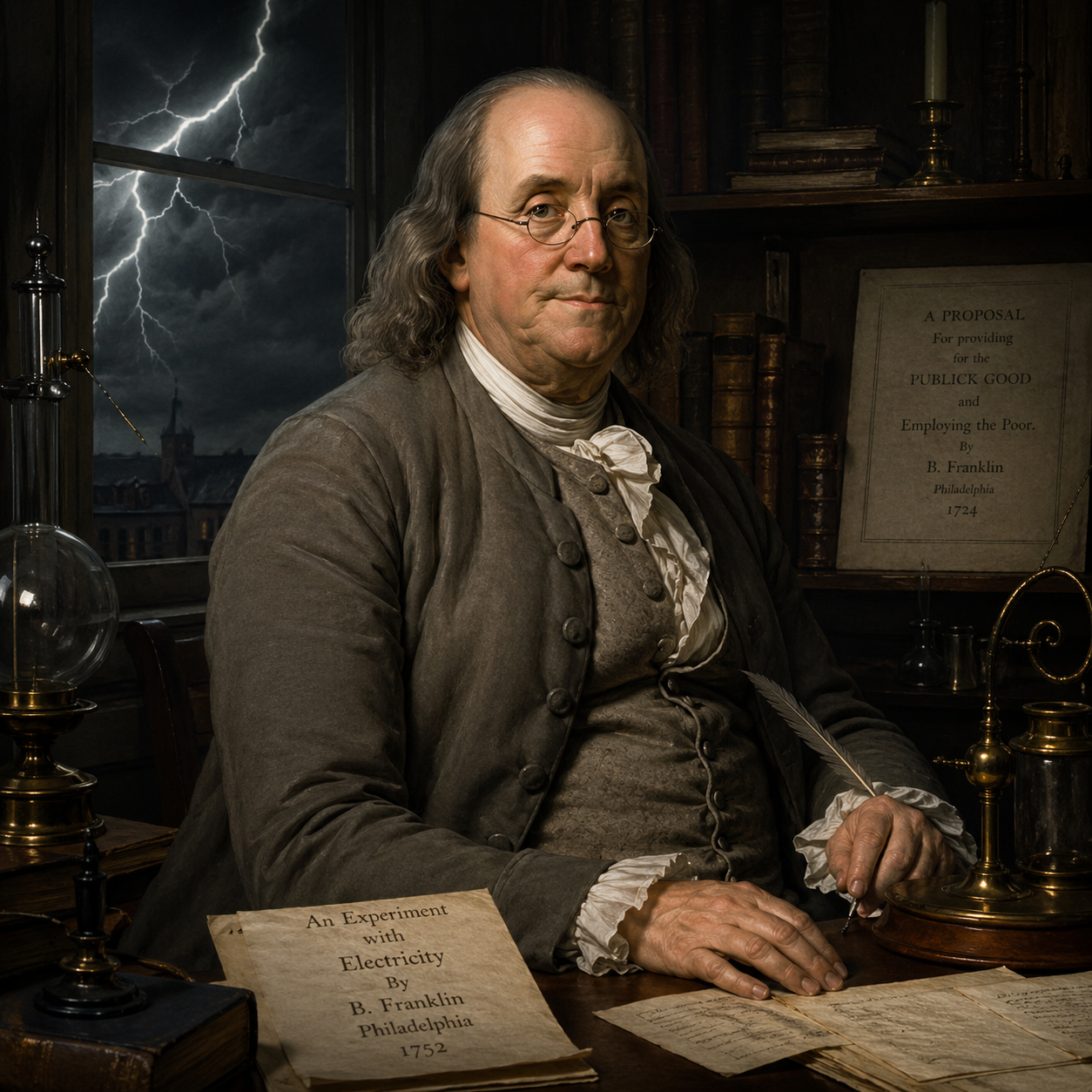
Benjamin Franklin — "A man without a wife is but half a man."
A man without a wife is but half a man.
A man without a wife is but half a man.
Click any product to generate a realistic preview. Up to 3 at a time.
* Initial load can take up to 90 seconds — revising the preview in another color is nearly instant.
"The way to be safe, is never to be secure."
"Never spare the parson's wine, nor the baker's pudding."
"Industry and frugality are the means of procuring wealth."
"Industry need not wish, and he that lives upon hopes will die fasting."
"He that is content, has enough."
Polymath Founding Father, diplomat, and Poor Richard's Almanack author who helped draft the Declaration of Independence and the Constitution. Closely associated with John Adams (fellow Founder, Massachusetts statesman) and Thomas Jefferson (fellow Declaration drafter). For an intellectual contrast, see Thomas Hutchinson, last royal governor of colonial Massachusetts — Franklin leaked Hutchinson's loyalist correspondence to Boston in 1772 to inflame revolutionary sentiment — Hutchinson represented the colonial-aristocrat crown-loyalty that Franklin's revolution was organized to dismantle.
Found in 1 providers: grok
1 source checked
Marriage completes a man — without a wife, he lacks partnership, domestic grounding, and full social standing. The quote frames matrimony as essential to personhood rather than optional. It reflects a worldview where human fulfillment required someone to share burdens, raise children, and anchor one's place in the community. A bachelor was structurally and socially incomplete.
Franklin married Deborah Read in 1730 in a common-law union lasting 44 years. He credited her with managing his printing business and household during his long diplomatic absences. Despite his famous flirtations abroad, Franklin consistently wrote about marriage as foundational to civic virtue. His Poor Richard's Almanack is filled with proverbs praising domestic stability — he lived and preached its value.
In colonial America, marriage was economic necessity as much as personal commitment. Single men faced practical hardship — no domestic labor, no legitimate heirs, reduced standing in church and commerce. The early modern worldview treated the married household as civilization's basic unit. Bachelorhood was not merely lonely but structurally deficient, making Franklin's sentiment mainstream rather than merely sentimental in 18th-century society.
AI-generated insights based on extensive research and information for context. Factual errors? Email [email protected].
Your cart is empty