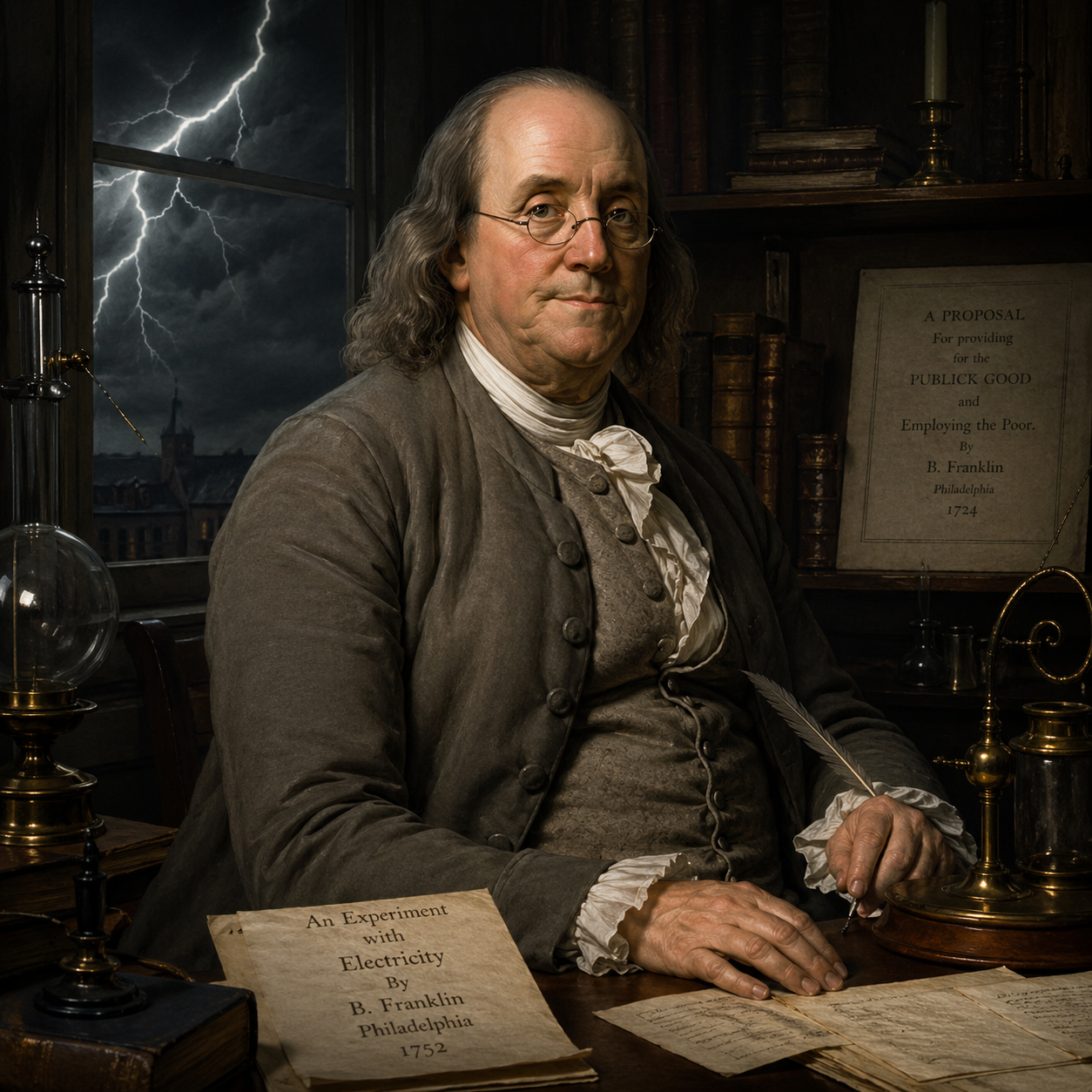
Benjamin Franklin — "A man wrapped up in himself makes a very small bundle."
A man wrapped up in himself makes a very small bundle.
A man wrapped up in himself makes a very small bundle.
Click any product to generate a realistic preview. Up to 3 at a time.
* Initial load can take up to 90 seconds — revising the preview in another color is nearly instant.
"There are three faithful friends: an old wife, an old dog, and ready money."
"Dost thou love life? Then do not squander time, for that is the stuff life is made of."
"Eat to please yourself, but dress to please others."
"Beware of the young doctor and the old barber."
"Never leave that till tomorrow which you can do today."
Polymath Founding Father, diplomat, and Poor Richard's Almanack author who helped draft the Declaration of Independence and the Constitution. Closely associated with John Adams (fellow Founder, Massachusetts statesman) and Thomas Jefferson (fellow Declaration drafter). For an intellectual contrast, see Thomas Hutchinson, last royal governor of colonial Massachusetts — Franklin leaked Hutchinson's loyalist correspondence to Boston in 1772 to inflame revolutionary sentiment — Hutchinson represented the colonial-aristocrat crown-loyalty that Franklin's revolution was organized to dismantle.
Found in 2 providers: deepseek,gemini
2 sources checked
A person consumed only by their own interests, ego, and concerns becomes diminished. Their impact, relationships, and contributions all shrink when turned inward. True significance comes from engaging outward — serving others, building community, contributing to something larger than oneself. Self-absorption isn't just a character flaw; it's practically self-defeating. The world rewards those who look beyond themselves, and those who don't remain small.
Franklin embodied outward-facing civic life his entire career — founding libraries, fire companies, hospitals, and philosophical societies in Philadelphia. A self-made printer who rose through networks and collaboration, he cultivated alliances in Paris that secured French support for American independence. His Poor Richard's Almanack preached practical virtue through memorable wit. He lived proof that a man who invested in others gained far more than one who hoarded himself.
Colonial America demanded communal cooperation — isolated settlers failed while interconnected communities thrived. The Enlightenment championed civic republicanism: citizens owed service to the public good. Before welfare states existed, mutual aid societies and community institutions were survival infrastructure. Philosophers like Hutcheson and Shaftesbury debated self-interest versus benevolence, making Franklin's warning against self-absorption both a moral argument and a practical necessity in an era requiring neighbors to depend on neighbors.
AI-generated insights based on extensive research and information for context. Factual errors? Email [email protected].
Your cart is empty