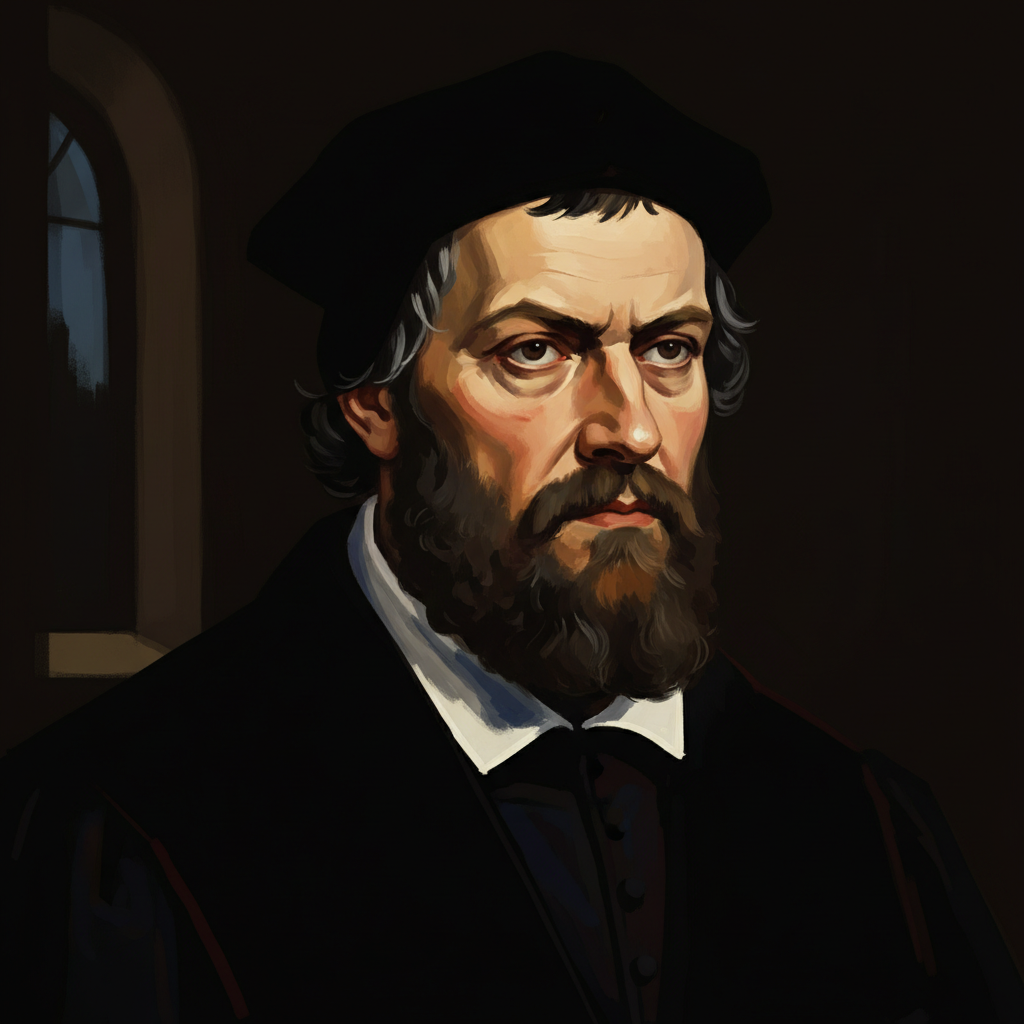
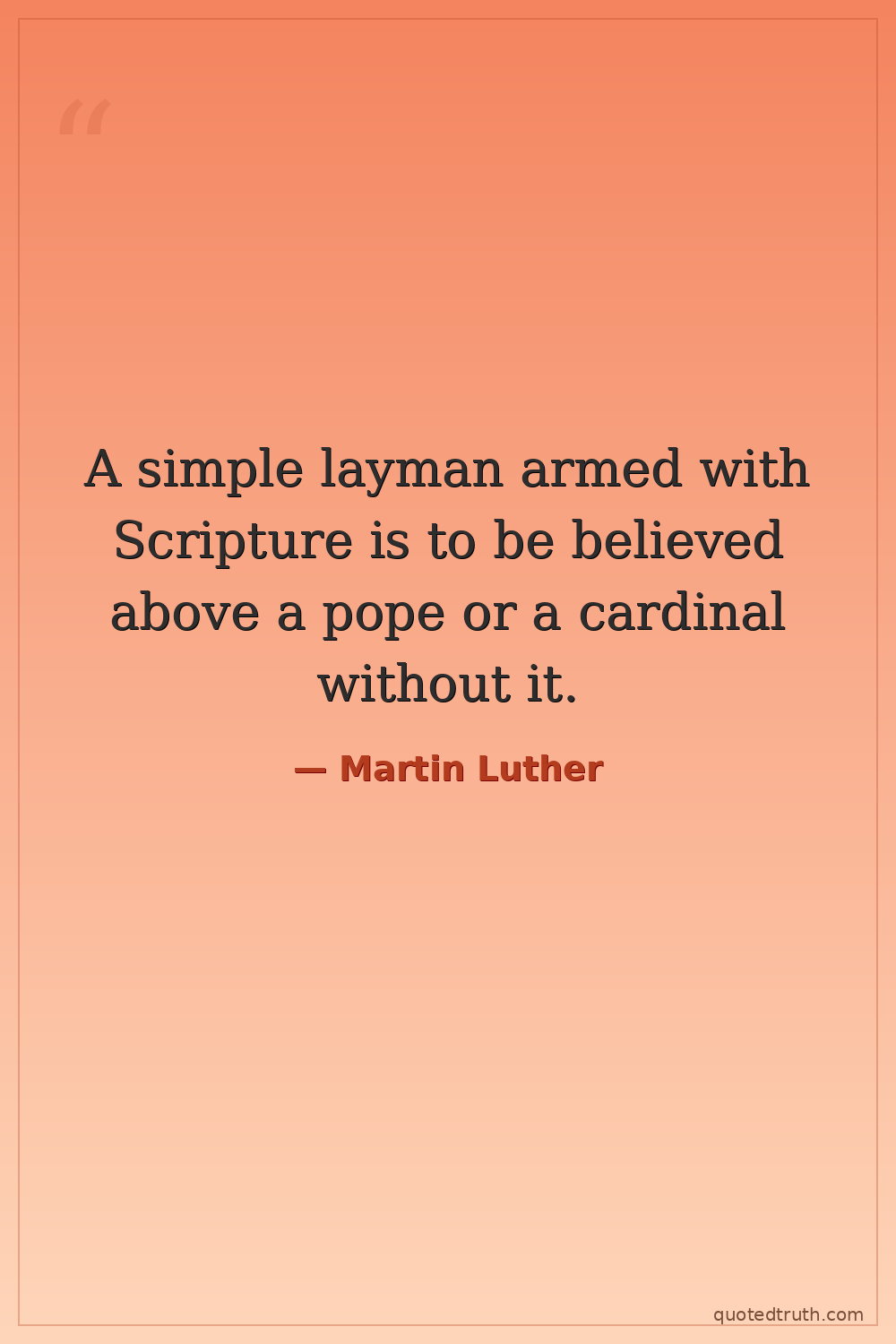
Martin Luther — "A simple layman armed with Scripture is to be believed above a pope or a cardina…"
A simple layman armed with Scripture is to be believed above a pope or a cardinal without it.
A simple layman armed with Scripture is to be believed above a pope or a cardinal without it.
Click any product to generate a realistic preview. Up to 3 at a time.
* Initial load can take up to 90 seconds — revising the preview in another color is nearly instant.
"The more you read the Bible, the more you will love it; the more you love it, the more you will read it."
"The true treasure of the church is the most holy gospel of the glory and grace of God."
"If you wish to make a good prayer, go into your closet, lock the door, and throw the key out the window."
"If I had to baptize a Jew, I would take him to the bridge of the Elbe, hang a stone around his neck and push him over with the words 'I baptize thee in the name of Abraham.'"
"The hair is the finest ornament a woman has. If she be a virgin, let her wear it loose; if married, let her wear it up."
German theologian whose 95 Theses (1517) launched the Protestant Reformation and broke the Catholic Church's monopoly on Western Christianity. Closely associated with Philipp Melanchthon (Lutheran systematizer) and John Calvin (later Reformer who built on Luther's break). For an intellectual contrast, see Pope Leo X, Renaissance pope (1513-1521) — Leo X's indulgence sales triggered Luther's break and Leo excommunicated him in 1521 — Luther's entire Reformation is structured as a direct answer to the indulgence-funded Vatican Leo represented.
Quoted in 'Martin Luther--The Early Years', Christian History, no. 34.
Date: Undated, but reflects his Reformation stance
GeneralFound in 2 providers: gemini,grok
2 sources checked
Biblical truth belongs to anyone who reads it, not just church officials. A regular person who can point to a clear passage of Scripture has more authority than the highest-ranking clergy speaking without that backing. Rank and title do not create truth; the text does. If an ordinary reader and a pope disagree, and only the layman can cite the Bible, the layman wins the argument on the merits.
Luther was an Augustinian monk and theology professor who challenged the papacy after studying Scripture directly in Greek and Hebrew. His doctrine of sola scriptura held the Bible alone as the final religious authority. He translated the New Testament into German so ordinary people could read it, and at the Diet of Worms in 1521 refused to recant unless proven wrong by Scripture, not by popes or councils.
In early sixteenth-century Europe, the Catholic Church controlled doctrine, Latin liturgy kept Scripture inaccessible to commoners, and indulgences were sold to fund Rome. Gutenberg's printing press was spreading cheap books, and humanist scholars were returning to original biblical texts. Luther's 1517 Ninety-Five Theses ignited the Reformation, splitting Western Christianity. Asserting that a literate peasant with a Bible outranked a cardinal was genuinely revolutionary and carried real risk of excommunication or execution.
AI-generated insights based on extensive research and information for context. Factual errors? Email [email protected].
Your cart is empty