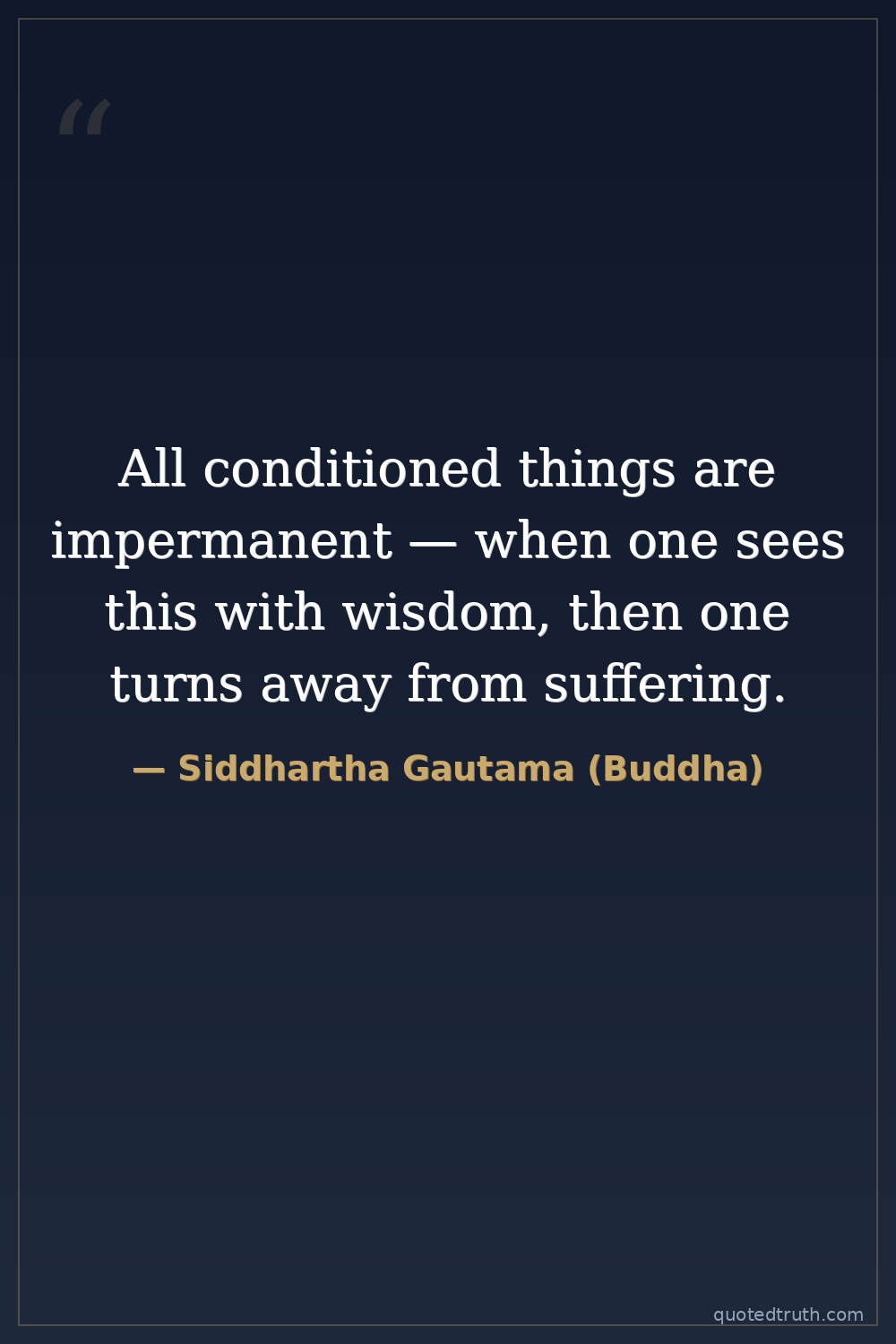
Siddhartha Gautama (Buddha) — "All conditioned things are impermanent — when one sees this with wisdom, then on…"
All conditioned things are impermanent — when one sees this with wisdom, then one turns away from suffering.
All conditioned things are impermanent — when one sees this with wisdom, then one turns away from suffering.
Click any product to generate a realistic preview. Up to 3 at a time.
* Initial load can take up to 90 seconds — revising the preview in another color is nearly instant.
"Conquer the angry one by love. Conquer the evil one by good. Conquer the stingy one by generosity. Conquer the liar by truth."
"The way is not in the sky. The way is in the heart."
"There are only two mistakes one can make along the road to truth; not going all the way, and not starting."
"There is no path to happiness: happiness is the path."
"Just as a tree, though cut down, sprouts up again if its roots are undamaged and strong, in the same way, if the root of craving is not wholly uprooted, suffering springs up again and again."
Found in 2 providers: grok,gemini
2 sources checked
Everything that comes into being through causes and conditions eventually changes or ends. Relationships, possessions, feelings, even our own bodies are temporary. The quote argues that truly grasping this truth, not just intellectually but deeply, loosens our grip on clinging. When we stop expecting permanence from things that cannot provide it, we free ourselves from the disappointment and craving that generate most of our pain.
This is a core teaching of the Buddha, tied directly to his awakening under the Bodhi tree. After abandoning his princely life and years of extreme asceticism, he identified impermanence (anicca) as one of the three marks of existence. As a teacher who spent 45 years traveling northern India guiding monks and laypeople, he repeatedly returned to this insight as the gateway out of dukkha, the suffering he vowed to help others escape.
In 5th-century BCE northern India, the dominant Vedic-Brahmanical tradition emphasized an eternal self (atman) and ritual sacrifice to secure favorable rebirth. The Buddha taught during the sramana movement, when wandering ascetics openly challenged priestly orthodoxy. Declaring all conditioned things impermanent directly contradicted Brahmanical metaphysics and offered an alternative path based on direct insight rather than caste-bound ritual, which is partly why his teachings spread rapidly across the Ganges plain.
AI-generated insights based on extensive research and information for context. Factual errors? Email [email protected].
Your cart is empty