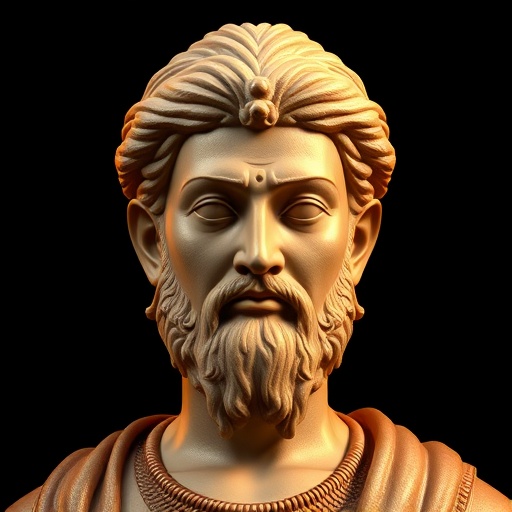
Mahavira — "All souls are equal and alike and possess the same nature and qualities."
All souls are equal and alike and possess the same nature and qualities.
All souls are equal and alike and possess the same nature and qualities.
Click any product to generate a realistic preview. Up to 3 at a time.
* Initial load can take up to 90 seconds — revising the preview in another color is nearly instant.
"Happiness and sorrow are the results of one's own actions."
"The soul is entangled in the web of karma."
"The world is full of illusion, and the truth is hidden."
"Do not indulge in unnecessary talk."
"One who knows himself, knows God."
24th and last Tirthankara of Jainism, whose teachings of strict ahimsa (non-violence), aparigraha (non-attachment), and karma reshaped ancient Indian religion. Closely associated with The Buddha (near-contemporary moral revolutionary, also reacting against Vedic ritualism). For an intellectual contrast, see Vedic Brahmanical ritual sacrifice, the animal-sacrifice-centered Vedic religion of his era — Mahavira's ahimsa demanded total non-violence, including not eating root vegetables that kill the plant — a maximum-distance ethical move from the Vedic priestly tradition that ritually sacrificed cattle and horses. The two cleanest poles of ancient Indian religious ethics.
Found in 1 providers: grok
1 source checked
Every person, regardless of birth, status, wealth, or caste, carries the same inner worth. No soul ranks above another by nature. Hierarchy and discrimination are human inventions, not cosmic truths. Genuine respect means recognizing that the same fundamental consciousness animates every living being, making cruelty, exploitation, or condescension toward any creature a logical contradiction of reality.
Mahavira was born a Kshatriya prince yet renounced wealth and royal privilege at 30, wandering naked for 12 years. This teaching directly justified that radical act: if all souls are equal, aristocratic birth confers no spiritual advantage. His entire monastic order rejected caste distinctions, admitting members from all social backgrounds, embodying this principle institutionally.
6th-century BCE India was rigidly stratified by the Vedic varna system, where brahmin priests claimed inherently superior souls and untouchables were deemed spiritually polluted by birth. Mahavira's contemporary Buddha made similar challenges, but Mahavira's formulation was starker and more absolute. This teaching was socially radical, directly confronting brahminical orthodoxy that justified caste inequality through cosmological hierarchy.
AI-generated insights based on extensive research and information for context. Factual errors? Email [email protected].
Your cart is empty