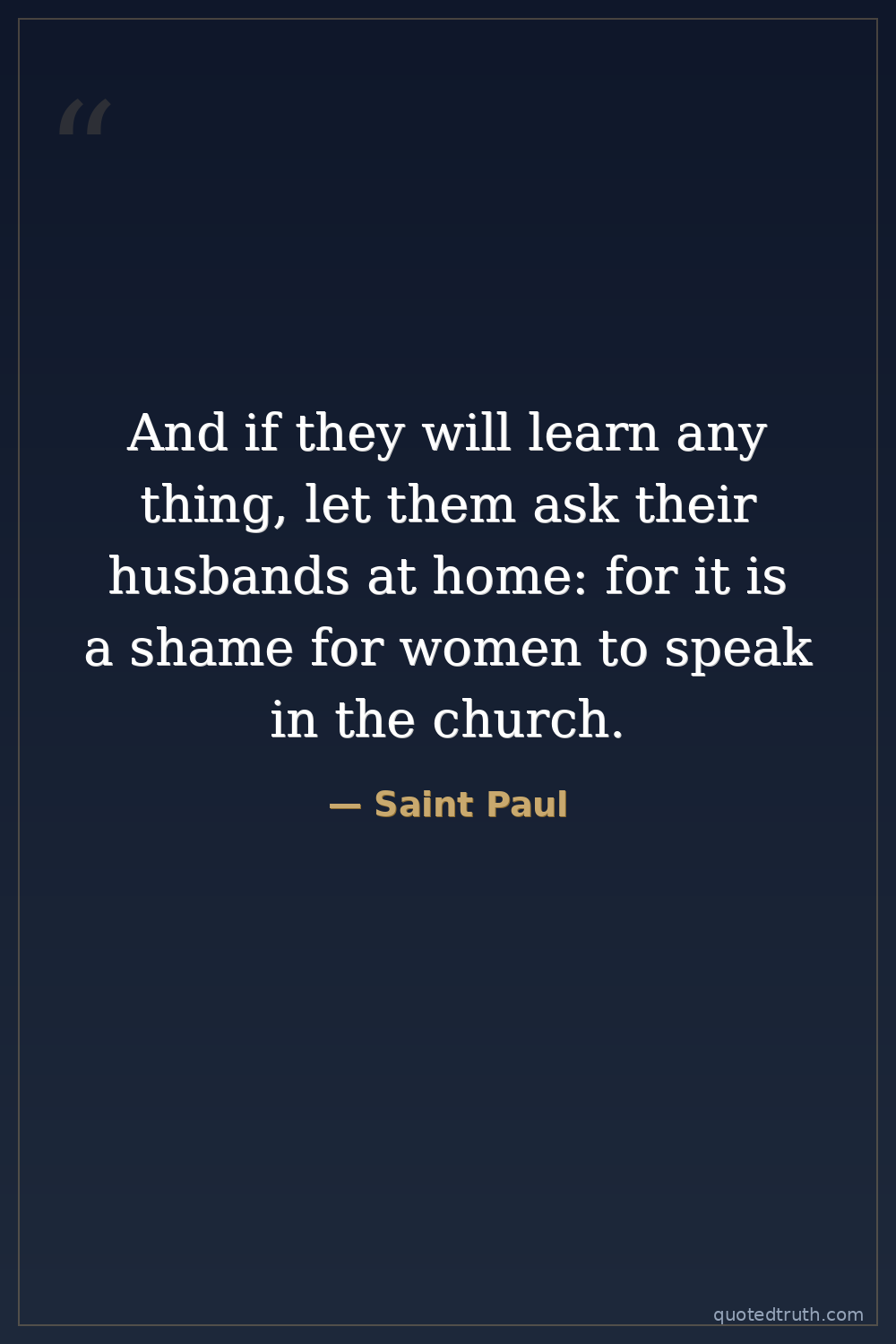
Saint Paul — "And if they will learn any thing, let them ask their husbands at home: for it is…"
And if they will learn any thing, let them ask their husbands at home: for it is a shame for women to speak in the church.
And if they will learn any thing, let them ask their husbands at home: for it is a shame for women to speak in the church.
Click any product to generate a realistic preview. Up to 3 at a time.
* Initial load can take up to 90 seconds — revising the preview in another color is nearly instant.
"Do not be deceived: ‘Bad company ruins good morals.’"
"But if ye be led of the Spirit, ye are not under the law."
"But though we, or an angel from heaven, preach any other gospel unto you than that which we have preached unto you, let him be accursed."
"I have fought the good fight, I have finished the race, I have kept the faith."
"If anyone thinks that he is something when he is nothing, he deceives himself."
Found in 1 providers: gemini
1 source checked
Paul instructs that if women have questions during congregational worship, they should wait and ask their husbands privately at home rather than speaking up in the assembly. He frames public speaking by women in church gatherings as inappropriate and disruptive to the order of worship, directing household conversation as the proper venue for their religious learning and inquiry.
Paul planted churches across the Roman world and wrote letters correcting their disorder, including this passage in 1 Corinthians addressing a chaotic congregation. As a Pharisee-trained rabbi, he carried rabbinic assumptions about gendered roles in religious instruction, yet elsewhere he names women like Phoebe, Priscilla, and Junia as coworkers, revealing tension between his inherited norms and his missionary practice.
First-century Corinth was a rowdy port city where Paul's house churches met in mixed-gender gatherings, unusual compared to segregated synagogue seating. Greco-Roman custom confined respectable women largely to the household, and public female speech drew suspicion of impropriety. Early Christian assemblies were still negotiating worship order, with prophecy, tongues, and debate erupting simultaneously, prompting Paul's repeated calls for decorum to keep outsiders from dismissing the movement as disreputable.
AI-generated insights based on extensive research and information for context. Factual errors? Email [email protected].
Your cart is empty