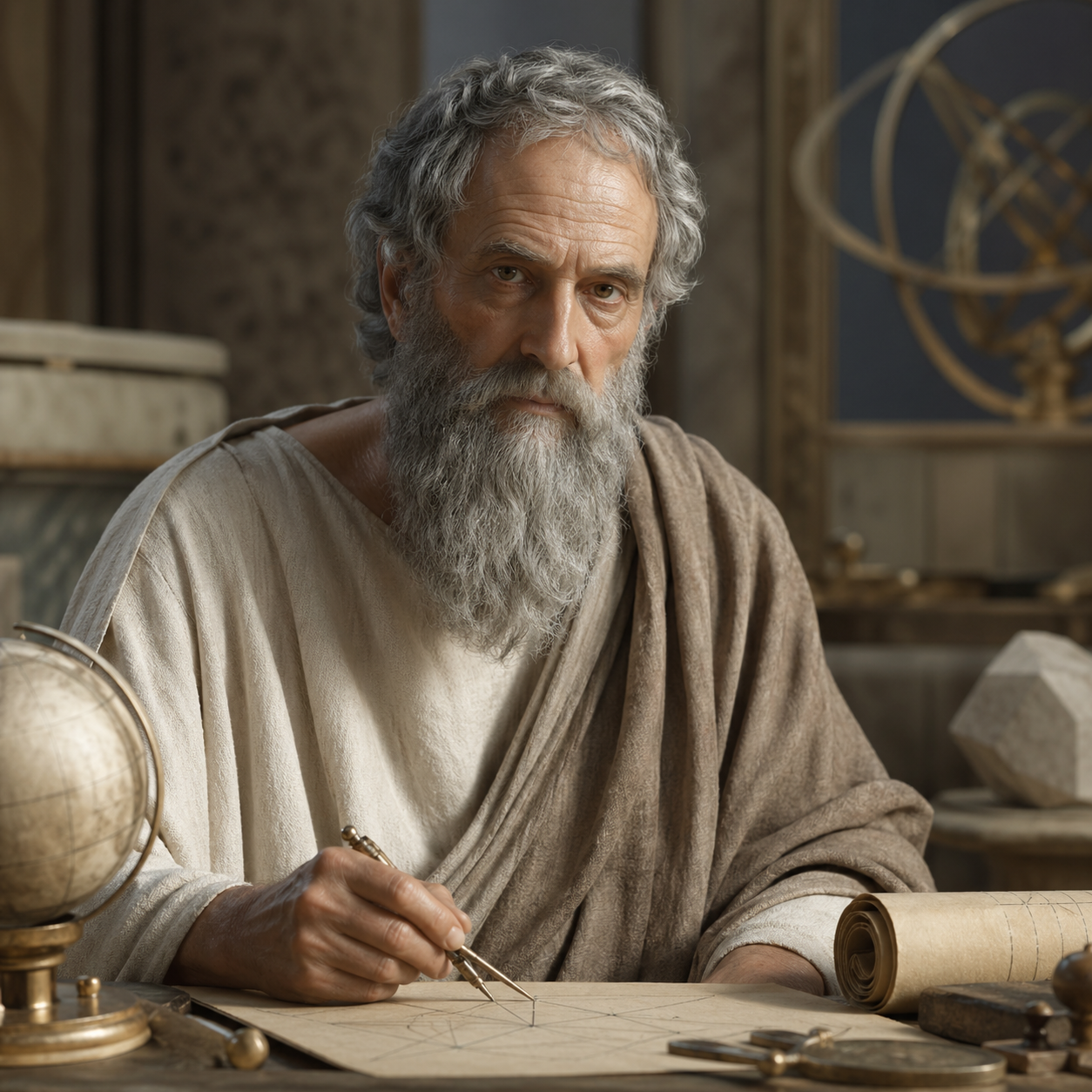
Euclid — "And the greater is a multiple of the less when it is measured by the less."
And the greater is a multiple of the less when it is measured by the less.
And the greater is a multiple of the less when it is measured by the less.
Click any product to generate a realistic preview. Up to 3 at a time.
* Initial load can take up to 90 seconds — revising the preview in another color is nearly instant.
"If a straight line touch a circle, and from the point of contact there be drawn across in the circle a straight line cutting the circle, the angles which it makes with the tangent will be equal to the…"
"And that, if a straight line falling on two straight lines make the interior angles on the same side less than two right angles, the two straight lines, if produced indefinitely, meet on that side on …"
"Let it be granted that a finite straight line may be produced to any length in a straight line."
"What do I gain by learning these things?"
"A prime number is that which is measured by a unit alone."
Found in 1 providers: grok
1 source checked
When you can count up by a smaller number and land exactly on a larger number, the larger is a multiple of the smaller. Three fits into twelve four times with nothing left over — so twelve is a multiple of three. This defines divisibility at its core: the smaller 'measures' the larger without remainder, establishing the clean numerical relationship that underlies all arithmetic, ratio, and proportion.
This comes directly from Book VII of Euclid's Elements, where he systematized number theory using tight definitions as the base of every subsequent proof. Euclid's defining characteristic was stripping ideas to their logical minimum — never assuming what could be precisely stated. For him, measurement and ratio were the skeleton of mathematical reality, reflecting his conviction that rigorous definitions, not intuition, were the only honest foundation for knowledge.
In Alexandria around 300 BCE, Greek scholars were converting mathematics from a practical craft into a deductive science. The Pythagorean tradition had made number ratios central to music, astronomy, and cosmology, so precise definitions of multiples were philosophically urgent. Egyptian and Babylonian predecessors used divisibility for taxation and surveying, but Euclid's era demanded abstract proof over calculation, transforming a merchant's arithmetic tool into the bedrock of pure mathematics.
AI-generated insights based on extensive research and information for context. Factual errors? Email [email protected].
Your cart is empty