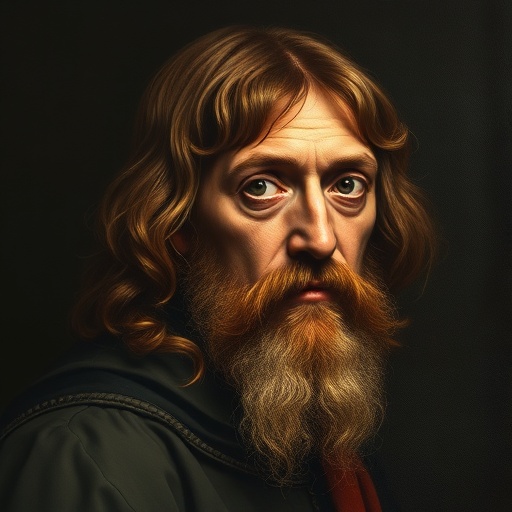
Nicolaus Copernicus — "At rest, however, in the middle of everything is the sun."
At rest, however, in the middle of everything is the sun.
At rest, however, in the middle of everything is the sun.
Click any product to generate a realistic preview. Up to 3 at a time.
* Initial load can take up to 90 seconds — revising the preview in another color is nearly instant.
"For I am not so enamored of my own opinions that I would disregard what others may think of them."
"The world is not a machine, but a living body, with a soul and a mind."
"There are three kinds of motion of the earth, as I shall demonstrate below."
"In the middle of all sits the Sun enthroned. In this most beautiful temple, could we place this luminary in any better position from which he can illuminate the whole at once?"
"For it is manifest that the movements of the planets are not uniform, but sometimes faster, sometimes slower, sometimes direct, sometimes retrograde."
Found in 1 providers: deepseek
1 source checked
The sun occupies the central position in the cosmos, stationary and unchanging, while planets orbit around it. This overturns the intuitive assumption that Earth is fixed and everything revolves around us. The sun's stillness is not absence of power but the source of all celestial order — everything else moves relative to this fixed, luminous anchor at creation's core.
Copernicus spent decades as a Polish canon and astronomer secretly developing his heliocentric model, published in De Revolutionibus Orbium Coelestium in 1543, the year he died. This line is literally from that work. Risking condemnation by displacing Earth — and humanity — from cosmic center, he subordinated religious convention to mathematical observation, embodying intellectual courage over comfortable orthodoxy.
In early 16th-century Europe, Ptolemaic geocentrism was Church-endorsed cosmological truth, woven into theology and Aristotelian philosophy. Challenging it meant challenging divine order. The Protestant Reformation simultaneously fractured religious authority, creating unexpected intellectual space. Copernicus wrote as Renaissance humanism elevated empirical inquiry, yet he delayed publication for years, understanding that repositioning Earth threatened not just astronomy but humanity's entire self-conception within God's creation.
AI-generated insights based on extensive research and information for context. Factual errors? Email [email protected].
Your cart is empty