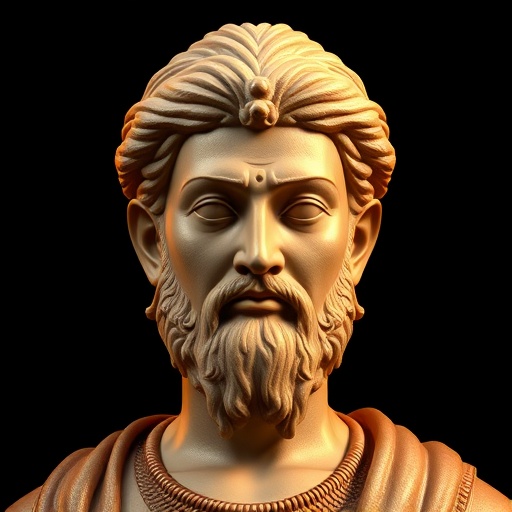
Mahavira — "Attachment leads to bondage; detachment leads to liberation."
Attachment leads to bondage; detachment leads to liberation.
Attachment leads to bondage; detachment leads to liberation.
Click any product to generate a realistic preview. Up to 3 at a time.
* Initial load can take up to 90 seconds — revising the preview in another color is nearly instant.
"The wise man is he who knows the truth."
"The purpose of life is to realize one's true self."
"The soul is born alone and dies alone; no one shares another’s karma."
"The soul is the only reality; the rest is illusion."
"The soul is pure and eternal. It is never born, nor does it ever die."
24th and last Tirthankara of Jainism, whose teachings of strict ahimsa (non-violence), aparigraha (non-attachment), and karma reshaped ancient Indian religion. Closely associated with The Buddha (near-contemporary moral revolutionary, also reacting against Vedic ritualism). For an intellectual contrast, see Vedic Brahmanical ritual sacrifice, the animal-sacrifice-centered Vedic religion of his era — Mahavira's ahimsa demanded total non-violence, including not eating root vegetables that kill the plant — a maximum-distance ethical move from the Vedic priestly tradition that ritually sacrificed cattle and horses. The two cleanest poles of ancient Indian religious ethics.
Found in 1 providers: deepseek
1 source checked
Clinging to possessions, relationships, outcomes, or identity traps you in endless cycles of desire and suffering. Every attachment creates a pull that controls your choices and reactions. Releasing those clings — not through coldness but through conscious non-grasping — frees the mind and soul from that reactive chain. Liberation isn't found by acquiring more but by needing less, allowing genuine freedom from the constant friction of wanting things to remain or become different.
At 30, Mahavira abandoned a noble family, wealth, and royal comforts to wander naked for 12 years until achieving enlightenment. Aparigraha — non-possessiveness — is one of Jainism's five cardinal vows he personally embodied. He rejected caste privilege, material comfort, even clothing, demonstrating that moksha required stripping away every attachment. This quote isn't abstract philosophy for him; it was lived biography, the literal method by which he claimed to reach liberation.
Sixth-century BCE India was undergoing a philosophical upheaval. The Shramana movement — encompassing Mahavira and the Buddha — challenged Vedic orthodoxy, which tied liberation to ritual sacrifice, caste birth, and priestly mediation. In a rigidly stratified society where social bonds and material obligations defined one's duty, teaching that individual renunciation and inner detachment — not ritual or lineage — could free the soul was profoundly subversive and democratizing.
AI-generated insights based on extensive research and information for context. Factual errors? Email [email protected].
Your cart is empty