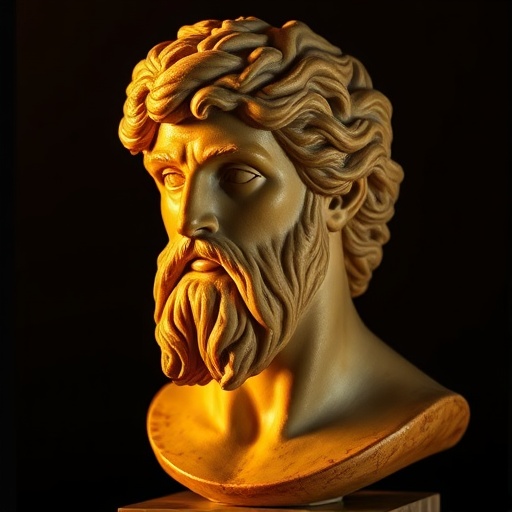
Pythagoras — "Beans look like the gates of Hades."
Beans look like the gates of Hades.
Beans look like the gates of Hades.
Click any product to generate a realistic preview. Up to 3 at a time.
* Initial load can take up to 90 seconds — revising the preview in another color is nearly instant.
"Neither be covetous nor stingy; a due measure is excellent in these things."
"Declining from the public ways, walk in unfrequented paths."
"Do not go to bed until you have gone over the day three times in your mind. What wrong did I do? What good did I accomplish? What did I forget to do?"
"Don't piss towards the sun."
"If you're asked: What is the silence? Respond: It is the first stone of the Wisdom's temple."
Greek philosopher and mathematician whose school in Croton combined geometry (the Pythagorean theorem), number-mysticism, and a religious-vegetarian way of life. Closely associated with Thales of Miletus (earlier pre-Socratic and the first philosopher). For an intellectual contrast, see Heraclitus, pre-Socratic Greek philosopher of flux — Heraclitus called Pythagoras 'the chief of swindlers' — among the founding insults of the philosophical-rivalry tradition. Their 'all is flux' vs 'all is number' poles still organize the philosophy of mathematics today (Platonist vs anti-realist).
Another symbolic reason attributed for the bean prohibition.
Date: c. 570-495 BCE (attributed later)
WisdomFound in 1 providers: gemini
1 source checked
Ordinary beans carry a sinister spiritual weight — their shape or essence connects them to death's doorway. In modern terms: a mundane food becomes symbolically forbidden, a portal to darkness. The quote encodes a strict taboo, warning that consuming beans means brushing against the realm of the dead. Something as simple as a legume becomes spiritually dangerous, not because of nutrition, but because of what it represents metaphysically.
Pythagoras famously banned his Brotherhood from eating beans entirely. He believed in metempsychosis — the transmigration of souls — and held that beans housed the souls of the dead. His community followed rigid dietary and behavioral codes alongside their mathematics. This quote reveals the deeply religious, mystical side of Pythagoras that his theorem overshadows: he was as much cult founder as mathematician, leading a Brotherhood with rules as strict as any religious order.
In 6th-century BCE Greece, Hades was a concrete cultural reality, not a metaphor. Beans appeared in Greek and Roman funerary rites — offerings to the dead, planted on graves. Mystery religions like those at Eleusis enforced strict dietary prohibitions connecting food to spiritual purity. Pythagoras lived when philosophy and religious ritual were inseparable. For his contemporaries, the idea that a food item could be spiritually contaminated by its resemblance to death's architecture was entirely plausible and serious.
AI-generated insights based on extensive research and information for context. Factual errors? Email [email protected].
Your cart is empty