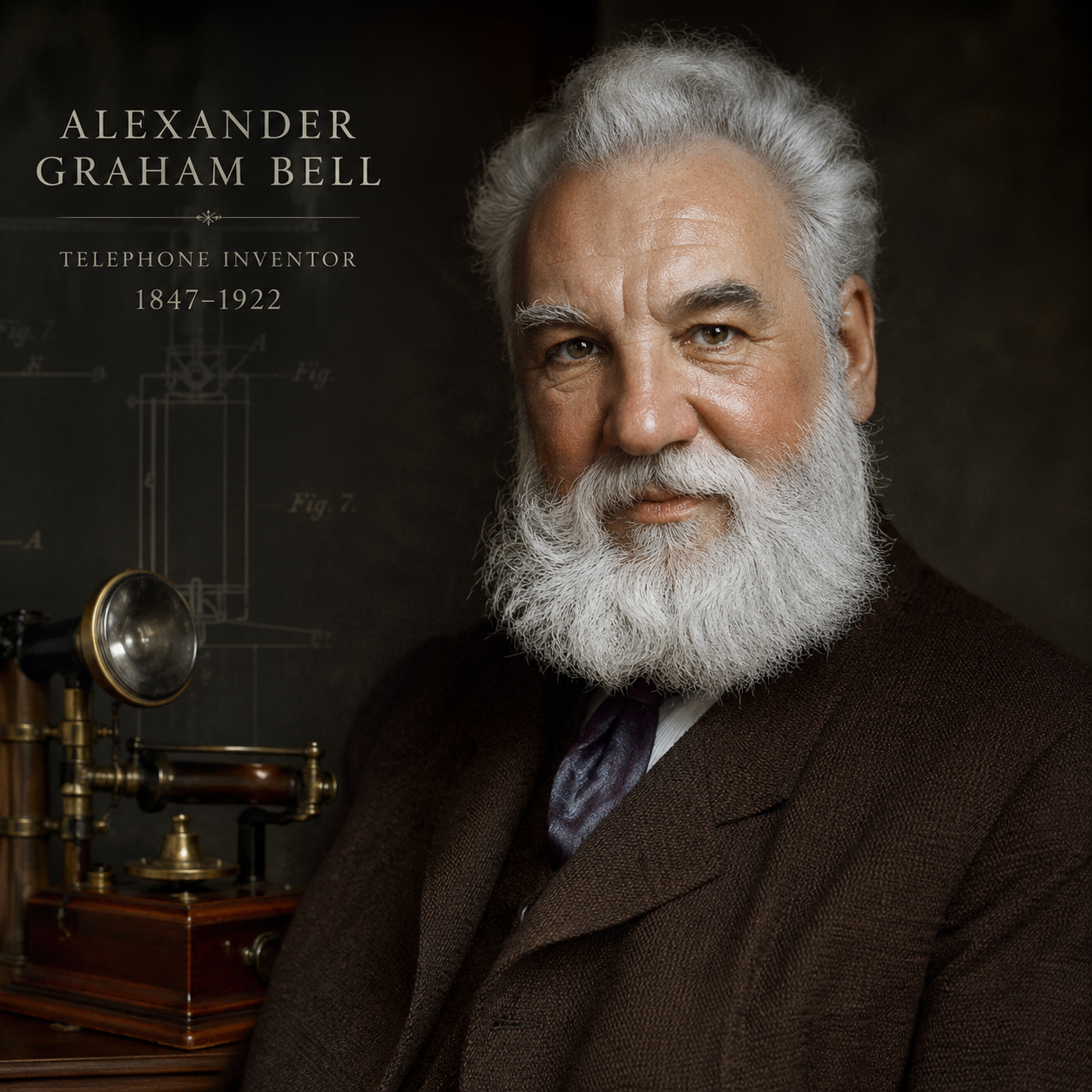
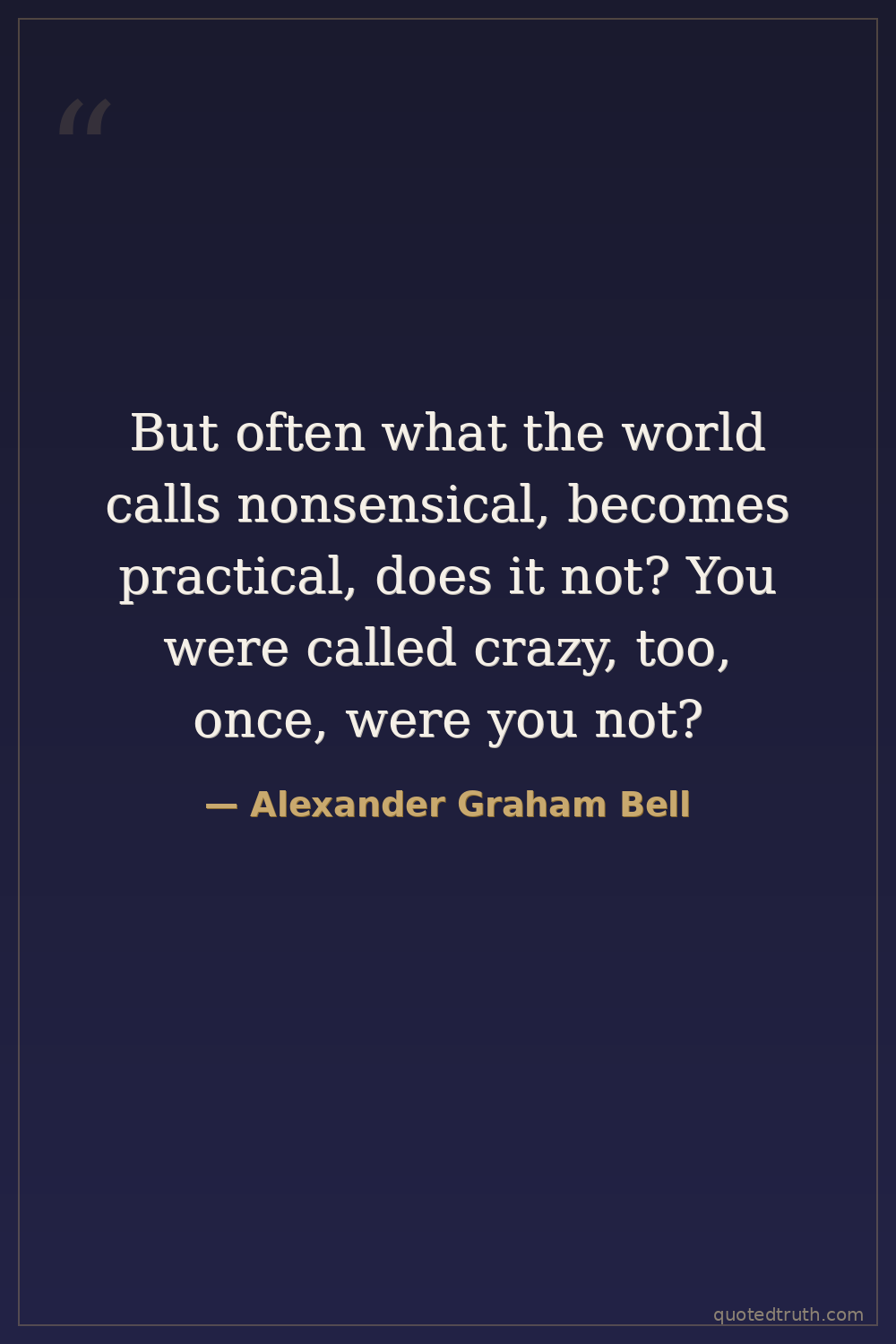
Alexander Graham Bell — "But often what the world calls nonsensical, becomes practical, does it not? You …"
But often what the world calls nonsensical, becomes practical, does it not? You were called crazy, too, once, were you not?
But often what the world calls nonsensical, becomes practical, does it not? You were called crazy, too, once, were you not?
Click any product to generate a realistic preview. Up to 3 at a time.
* Initial load can take up to 90 seconds — revising the preview in another color is nearly instant.
"I have always considered myself as an Agnostic..."
"What this power is I cannot say; all I know is that it exists and it becomes available only when a man is in that state of mind in which he knows exactly what he wants and is fully determined not to g…"
"America is a country of inventors, and the greatest of inventors are the newspaper men."
"There are no secrets to success. It is the result of preparation, hard work, and learning from failure."
"The telephone will revolutionize communication."
From an interview in 'How They Succeeded' by Orison Swett Marden, a dialogue with the interviewer.
Date: 1901
PhilosophicalFound in 1 providers: gemini
1 source checked
Ideas the world mocks as absurd have a recurring habit of becoming the foundation of everyday life. The quote flips the script on ridicule — history repeatedly vindicates the 'crazy' thinker. More pointedly, the second line turns it personal: the doubter was once doubted too. Dismissing bold ideas marks not wisdom but a conveniently short memory about one's own unconventional past.
Bell's telephone was dismissed by Western Union as a mere 'toy' with no commercial future before it rewired civilization. He also pursued the photophone — transmitting speech on a beam of light — widely mocked as fantasy, yet it prefigured fiber optics by a century. Bell navigated brutal patent battles and public skepticism throughout his career, making this defense of 'nonsensical' ideas deeply personal.
The late 19th century was a crucible of contested invention — Bell, Edison, Tesla, and Marconi all faced widespread derision before succeeding. The industrial revolution had empowered a merchant class that routinely dismissed visionary ideas as frivolous. Patent offices were battlegrounds and newspapers mocked new technologies. Yet within decades, 'impossible' inventions like electric light, radio, and telephony had rewired civilization, vindicating every inventor who refused to let ridicule be the verdict.
AI-generated insights based on extensive research and information for context. Factual errors? Email [email protected].
Your cart is empty