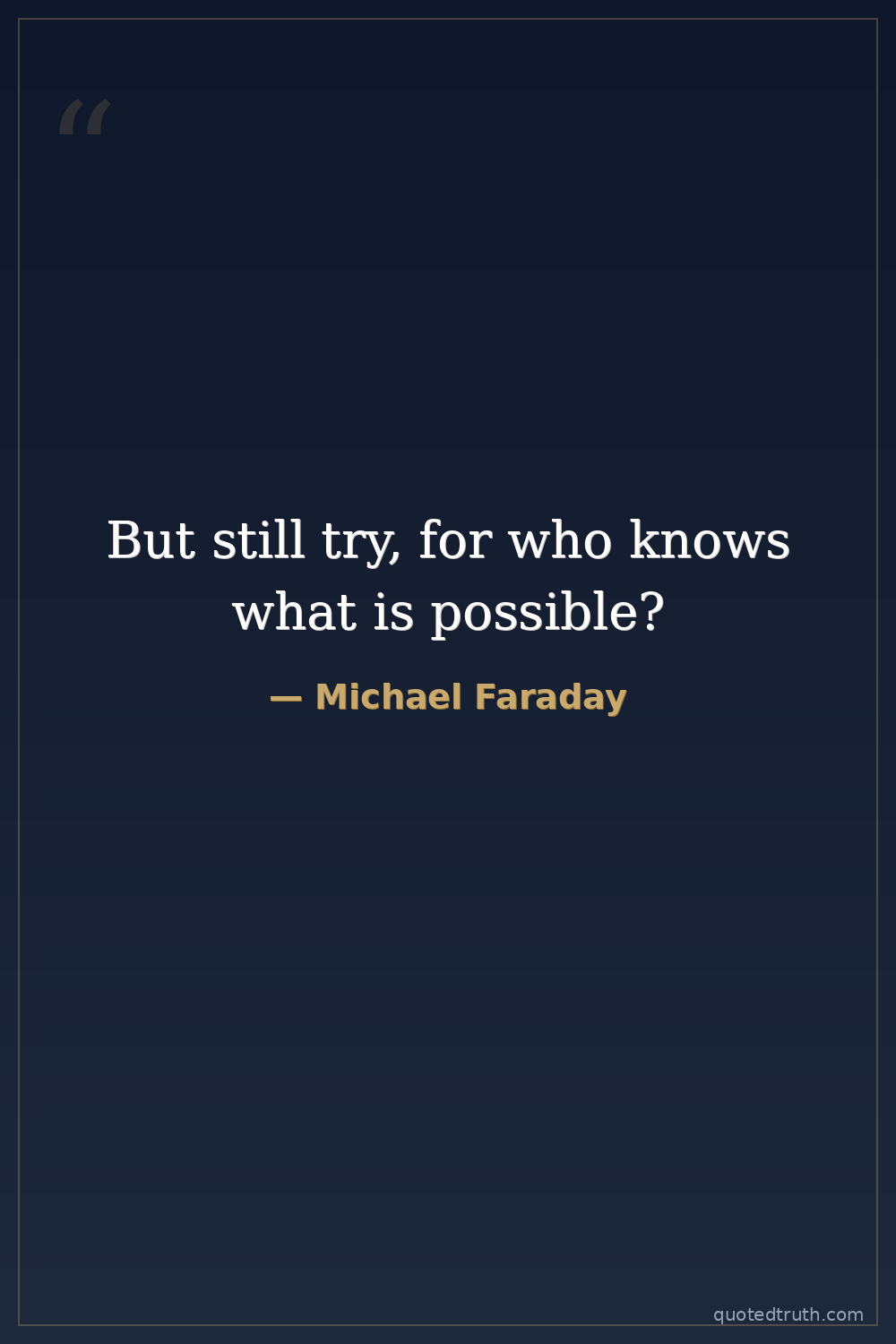
Michael Faraday — "But still try, for who knows what is possible?"
But still try, for who knows what is possible?
But still try, for who knows what is possible?
Click any product to generate a realistic preview. Up to 3 at a time.
* Initial load can take up to 90 seconds — revising the preview in another color is nearly instant.
"There's nothing quite as frightening as someone who knows they are right."
"The world is full of things that are wonderful, but we only see them when we are looking for them."
"The book of nature is written in the language of mathematics."
"The greatest enemy of knowledge is not ignorance, it is the illusion of knowledge."
"I have far more confidence in the one man who works mentally and bodily at a matter than in the six who merely talk about it."
Found in 2 providers: deepseek,gemini
2 sources checked
Keep attempting things even when the outcome is uncertain, because you cannot know what can be achieved unless you actually try. The quote pushes back against giving up before starting. It treats effort itself as the gateway to discovery, arguing that the boundaries of what is achievable are never fixed in advance and only reveal themselves to people willing to test them through action.
Faraday embodied this ethos. Born poor, largely self-educated, and working as a bookbinder's apprentice, he had every reason to think science was closed to him. He persisted, becoming Humphry Davy's assistant and eventually discovering electromagnetic induction, the laws of electrolysis, and the Faraday effect. He ran experiment after experiment without knowing which would yield results, trusting that patient trying would eventually unlock nature's hidden mechanisms.
Faraday worked in early-to-mid 1800s Britain, when electricity was a curiosity with no practical use and class barriers kept working-class men out of science. The Royal Institution and Royal Society were gentlemen's clubs. Simultaneously, the Industrial Revolution was proving that tinkering and experimentation could reshape society. Faraday's persistence-driven discoveries laid groundwork for generators, motors, and the entire electrical age that followed.
AI-generated insights based on extensive research and information for context. Factual errors? Email [email protected].
Your cart is empty