Erwin Schrodinger — "But the truth is that we are not living in a world of objects, but in a world of…"
But the truth is that we are not living in a world of objects, but in a world of events.
But the truth is that we are not living in a world of objects, but in a world of events.
Click any product to generate a realistic preview. Up to 3 at a time.
* Initial load can take up to 90 seconds — revising the preview in another color is nearly instant.
"The number of children born from educated parents is much too small."
"The human mind is not capable of grasping the universe. We are like a little child entering a huge library. The walls are covered to the ceilings with books in many different tongues. The child knows …"
"The world is not a static place, but is constantly changing and evolving."
"We do not belong to this material world that science constructs for us. We are not in it; we are outside. We are only spectators. The reason why we believe that we are in it, that we belong to the pic…"
"I am a physicist, not a philosopher. But I cannot help but think about these things."
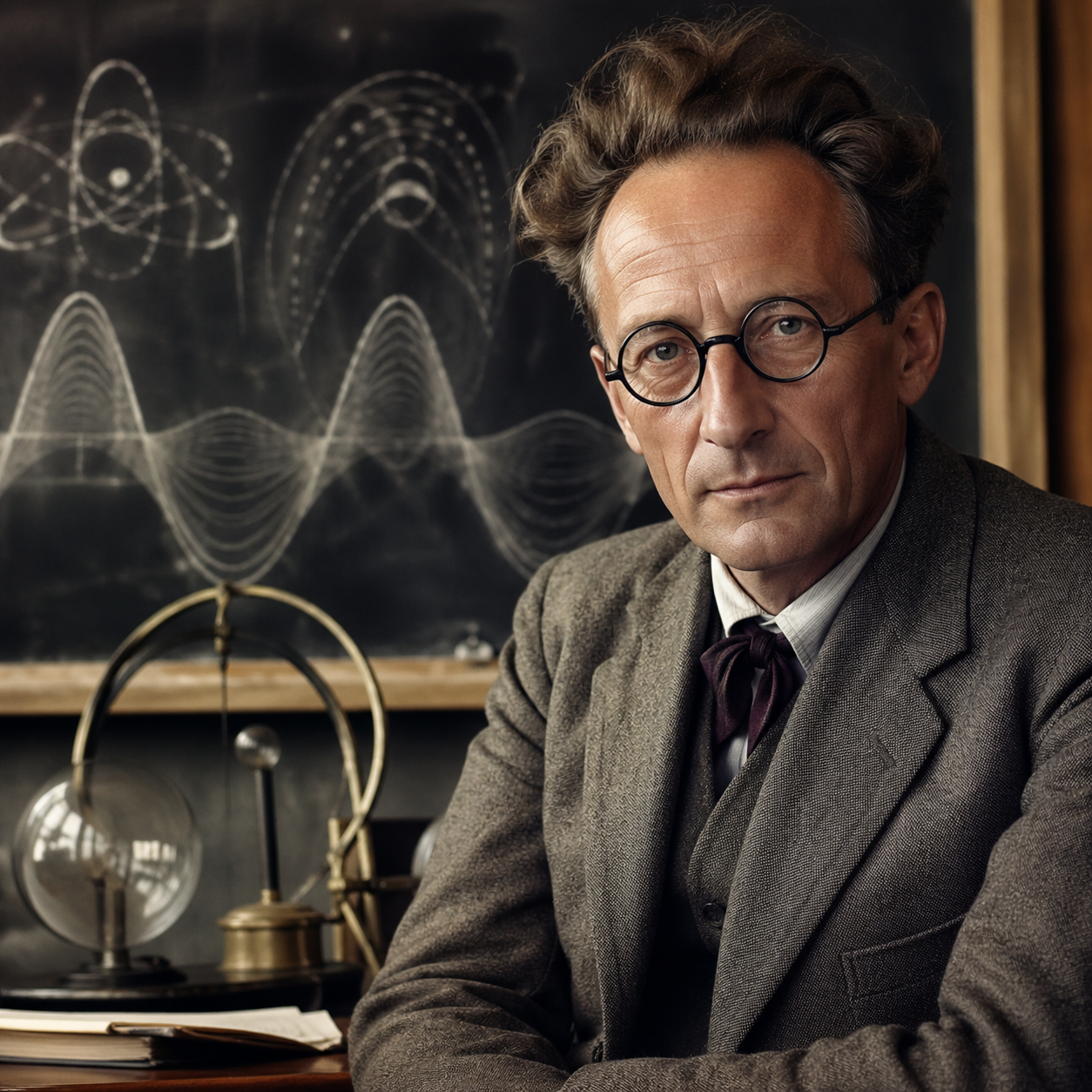
Austrian physicist who shared the 1933 Nobel for the wave equation that bears his name and the famous cat thought-experiment. Closely associated with Werner Heisenberg (matrix-mechanics rival who reached the same physics by different math) and Albert Einstein (his pen-pal on quantum interpretation). For an intellectual contrast, see Niels Bohr, Danish physicist and architect of the Copenhagen interpretation — Schrödinger's cat thought-experiment was specifically designed to ridicule Bohr's 'observer-dependent reality' reading of quantum mechanics — Schrödinger thought the Copenhagen interpretation was absurd; the cat was meant as reductio ad absurdum.
Found in 1 providers: grok
1 source checked
Reality is not made of static, fixed things sitting in space. Instead, existence is a continuous flow of happenings, interactions, and processes. What we call 'objects' are actually patterns of ongoing events — stable-seeming configurations within a dynamic universe. Nothing is truly frozen or permanent; everything is relational, contextual, and unfolding in time.
Schrödinger, who formulated the wave equation describing quantum particles as probability waves rather than definite objects, lived this insight professionally. His famous cat paradox demonstrated that quantum systems exist in superposed states until observed — events, not things. His later work in 'What Is Life?' extended this process-thinking to biology, showing his worldview consistently favored dynamic processes over static matter.
Mid-20th century physics had shattered the classical Newtonian picture of solid, billiard-ball objects obeying deterministic laws. Quantum mechanics, relativity, and field theory all converged on a universe of fields, probabilities, and interactions. Philosophers like Whitehead were simultaneously developing 'process philosophy.' Schrödinger wrote amid this intellectual revolution, when science was fundamentally reconceiving nature from substance to event.
AI-generated insights based on extensive research and information for context. Factual errors? Email [email protected].
Your cart is empty