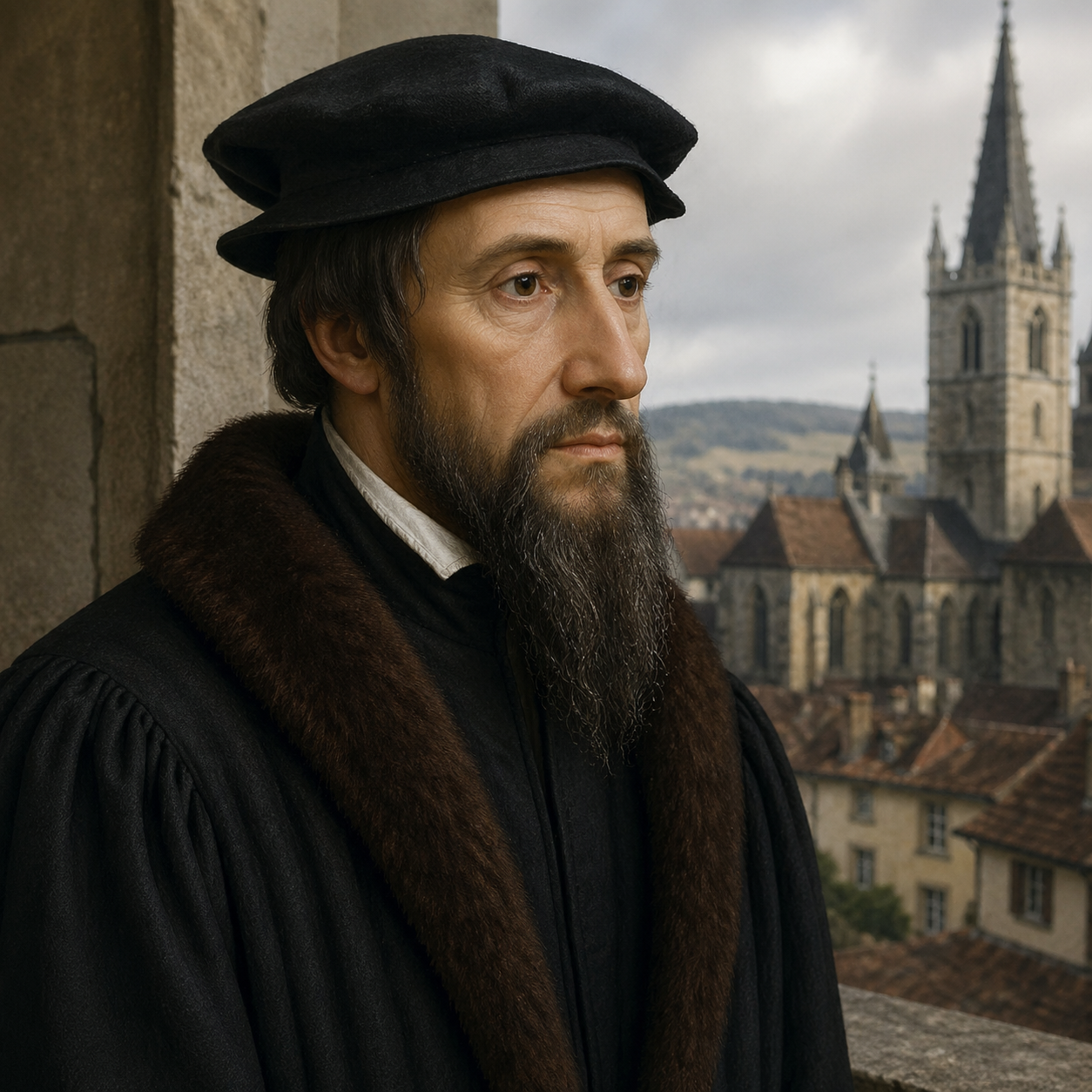
John Calvin — "By predestination we mean the eternal decree of God, by which he has determined …"
By predestination we mean the eternal decree of God, by which he has determined with himself whatever he wills to happen with regard to every man.
By predestination we mean the eternal decree of God, by which he has determined with himself whatever he wills to happen with regard to every man.
Click any product to generate a realistic preview. Up to 3 at a time.
* Initial load can take up to 90 seconds — revising the preview in another color is nearly instant.
"The fear of the Lord is the beginning of wisdom."
"It is not in our power to believe or not to believe."
"The wicked are a kind of chaff, that the wind driveth away."
"Servetus suffered the penalty due his heresies, but was it by my will. Certainly his arrogance destroyed him not less than his impiety."
"The human mind is, so to speak, a perpetual forge of idols."
French theologian whose Institutes of the Christian Religion (1536) systematized Protestant Reformed doctrine, including predestination. Closely associated with Martin Luther (Reformation founder, Calvin's predecessor). For an intellectual contrast, see Jacobus Arminius, Dutch Reformed theologian (1560-1609) — Arminius's rejection of strict double-predestination founded Arminianism — the theological tradition modern Methodism, most evangelicalism, and Pentecostalism descend from. The Calvinist-Arminian debate has divided Protestantism for 400 years.
Found in 1 providers: grok
1 source checked
God decided, before creation, exactly what would happen to every person — who would be saved and who would not. This isn't fate in a random sense but the active, deliberate will of an all-knowing God. Human choice doesn't alter the outcome. Every event in a person's life unfolds according to this prior divine decision. The decree is eternal, meaning it existed before time itself began.
Calvin built predestination into the foundation of Reformed theology through his masterwork, the Institutes of the Christian Religion. As Geneva's de facto religious governor, he structured civil and church life around God's absolute sovereignty. Believing grace alone saves — never human merit — he rejected any role for free will in salvation. His relentless writing, French exile, and harsh enforcement of doctrine in Geneva all expressed his unshakeable conviction that God's will is irresistible and sovereign over all things.
The 16th-century Reformation shattered the Catholic Church's monopoly on salvation, which depended on sacraments, indulgences, and priestly mediation. Calvin's predestination doctrine struck at a defining question: who controls eternal destiny? Against Rome's teaching that humans cooperate with grace, Calvin insisted God acts alone. Religious wars across Europe made the mechanism of salvation a political flashpoint. The Council of Trent (1545–1563) directly condemned Protestant predestination, cementing Calvin's doctrine as a central fault line of the era.
AI-generated insights based on extensive research and information for context. Factual errors? Email [email protected].
Your cart is empty