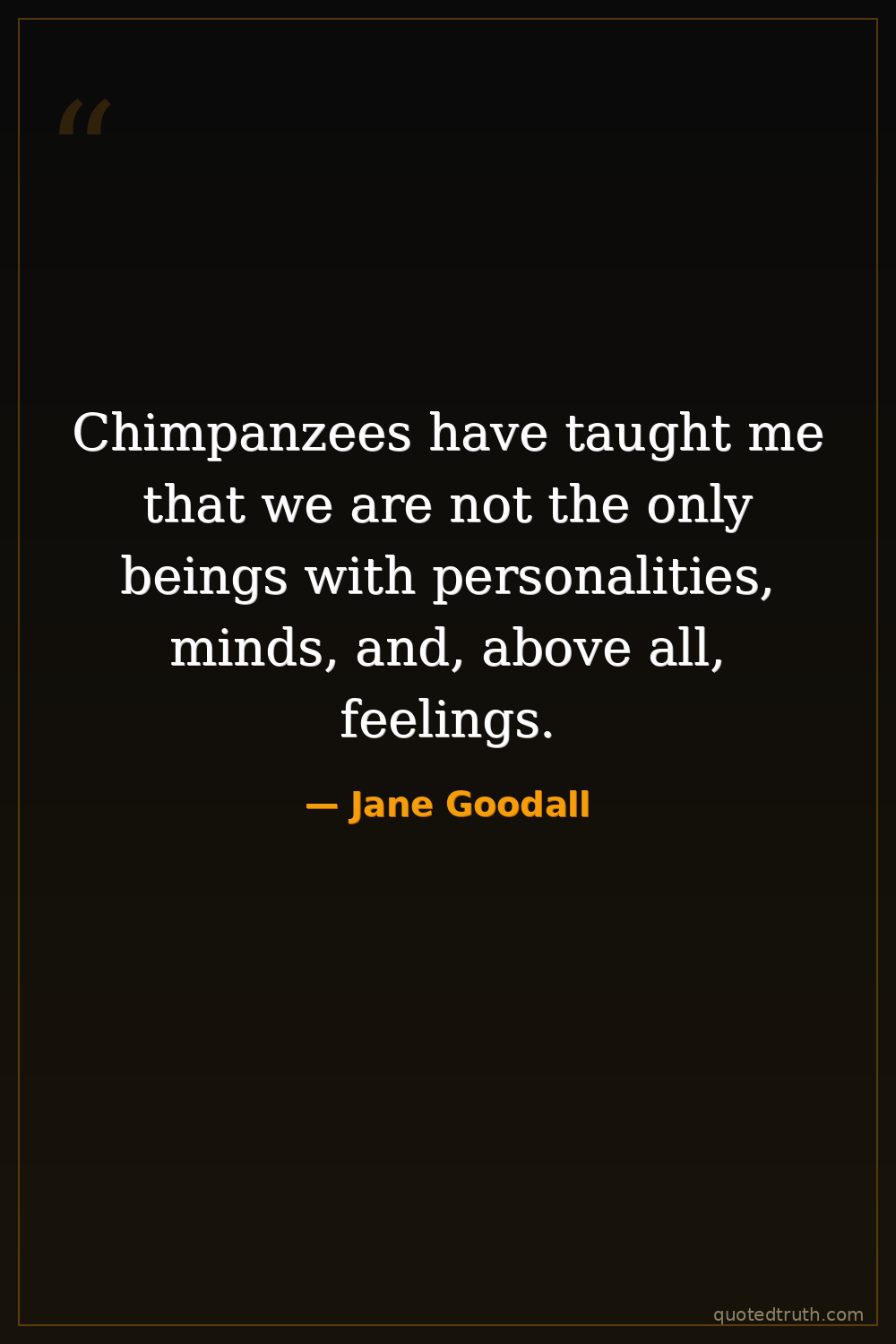
Jane Goodall — "Chimpanzees have taught me that we are not the only beings with personalities, m…"
Chimpanzees have taught me that we are not the only beings with personalities, minds, and, above all, feelings.
Chimpanzees have taught me that we are not the only beings with personalities, minds, and, above all, feelings.
Click any product to generate a realistic preview. Up to 3 at a time.
* Initial load can take up to 90 seconds — revising the preview in another color is nearly instant.
"I have always felt a deep connection to the natural world, even as a child."
"We have a responsibility to care for our planet and every creature on it."
"We have to remember that we are just one species among many, and we need to act accordingly."
"We have to be the change we want to see in the world, and that starts with each of us."
"I'm often asked if I'm an optimist or a pessimist. I say I'm a 'possibilist.'"
British primatologist who in 1960 began the longest-running wild primate study at Gombe Stream, transforming our understanding of chimpanzees. Closely associated with Dian Fossey (mountain-gorilla researcher) and Birutė Galdikas (orangutan researcher; together with Goodall and Fossey one of Louis Leakey's 'Trimates'). For an intellectual contrast, see Walter Palmer, American dentist who killed Cecil the Lion in Zimbabwe in 2015 — Palmer represents the trophy-hunting tradition Goodall's life's work has been organized against — the colonial-era hunter-naturalist worldview that treated primates and big game as specimens or trophies, which Goodall's Roots & Shoots and Jane Goodall Institute exist specifically to displace.
Found in 1 providers: grok
1 source checked
Humans long assumed we were uniquely defined by our personalities, intelligence, and emotions. Through careful observation, we can see that other animals—especially chimpanzees—share these qualities. They grieve, form friendships, display distinct personalities, and solve problems creatively. Recognizing this forces us to reconsider our moral obligations toward animals and our place in the natural world, not above it, but as part of it.
Goodall spent decades at Gombe Stream, Tanzania, starting in 1960, documenting individual chimpanzees she named—David Greybeard, Flo, Frodo—rather than numbering them. She observed tool use, mourning rituals, warfare, and mother-child bonds. Her insistence on recognizing chimpanzees as individuals with feelings drew skepticism from scientific circles initially, yet her longitudinal research ultimately reshaped ethology and animal behavior science across the globe.
When Goodall began her research in the 1960s, behaviorism dominated science—animals were studied as stimulus-response mechanisms with no acknowledged inner lives. Academic consensus dismissed animal emotions as anthropomorphism. Meanwhile, habitat destruction was accelerating and the animal rights movement had barely formed. Her findings arrived alongside Rachel Carson's Silent Spring, creating a cultural moment ripe for fundamentally rethinking humanity's relationship with the natural world.
AI-generated insights based on extensive research and information for context. Factual errors? Email [email protected].
Your cart is empty