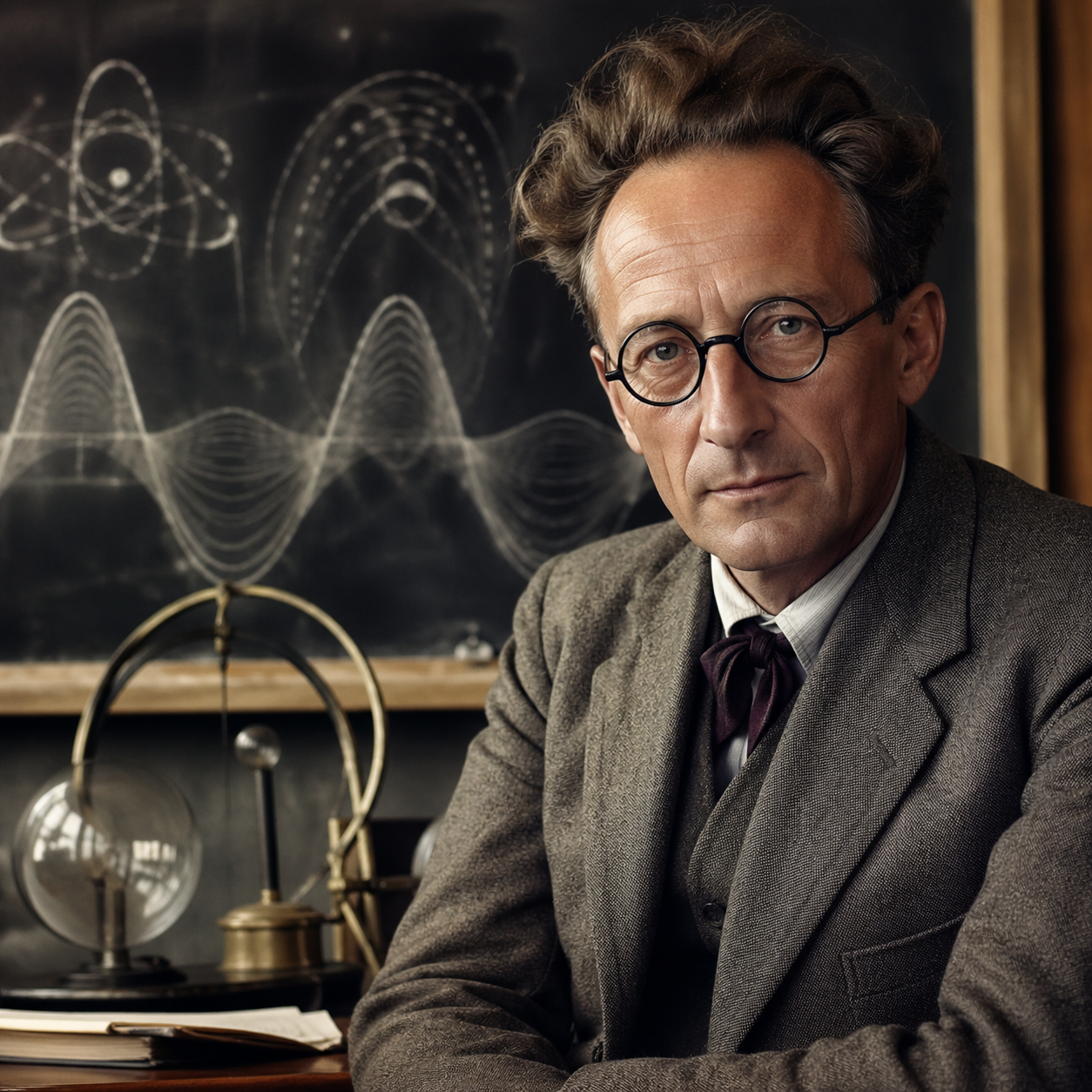
Erwin Schrodinger — "Consciousness is a singular of which the plural is unknown."
Consciousness is a singular of which the plural is unknown.
Consciousness is a singular of which the plural is unknown.
Click any product to generate a realistic preview. Up to 3 at a time.
* Initial load can take up to 90 seconds — revising the preview in another color is nearly instant.
"The number of children born to a marriage ought to be limited, and that a man who has already had some children should be sterilized."
"The world is not made of atoms, it is made of stories."
"We are all part of the same cosmic dance."
"The world is given to me only once, not one existing and one perceived. Subject and object are only one. The barrier between them cannot be said to have broken down as a result of recent experience in…"
"The world is not to be understood by reason alone. It is also to be understood by intuition and feeling."
Austrian physicist who shared the 1933 Nobel for the wave equation that bears his name and the famous cat thought-experiment. Closely associated with Werner Heisenberg (matrix-mechanics rival who reached the same physics by different math) and Albert Einstein (his pen-pal on quantum interpretation). For an intellectual contrast, see Niels Bohr, Danish physicist and architect of the Copenhagen interpretation — Schrödinger's cat thought-experiment was specifically designed to ridicule Bohr's 'observer-dependent reality' reading of quantum mechanics — Schrödinger thought the Copenhagen interpretation was absurd; the cat was meant as reductio ad absurdum.
Found in 1 providers: grok
1 source checked
There is only one consciousness, not many separate ones. What we experience as individual minds are not truly distinct entities but facets of a single unified awareness. The sense of being a separate self is an illusion — consciousness itself cannot be counted or divided into discrete units the way physical objects can. Plurality belongs to matter; consciousness stands apart, irreducibly one.
Schrödinger spent his later career bridging physics and philosophy, particularly in 'What is Life?' and 'Mind and Matter.' Having formulated wave mechanics — where a particle exists in superposition until observed — he was obsessed with the role of the observer. This quote reflects his deep engagement with Vedanta philosophy, which similarly holds that individual consciousness is an illusion masking one universal Atman.
Mid-20th century quantum mechanics shattered classical assumptions about objective reality, forcing physicists to confront the observer's role in measurement. Simultaneously, neuroscience was in its infancy and could not explain subjective experience. Schrödinger wrote this amid postwar intellectual upheaval, when Western scientists were increasingly turning to Eastern philosophy to fill gaps that materialist science left gaping.
AI-generated insights based on extensive research and information for context. Factual errors? Email [email protected].
Your cart is empty